
First Attempt Ended in Liquid Hydrogen Leak (Image Credits: Cdn.mos.cms.futurecdn.net)
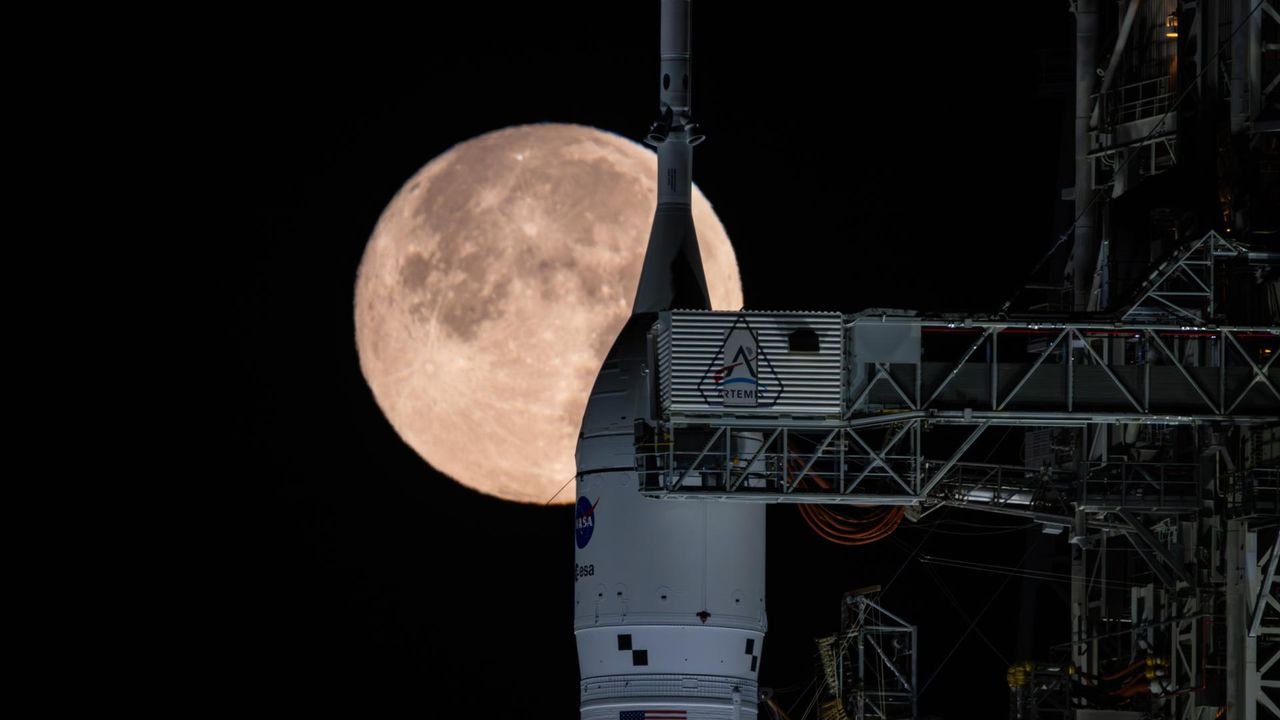
Kennedy Space Center, Florida – NASA launch teams initiated a 50-hour countdown on Tuesday for the second wet dress rehearsal of the Artemis II Space Launch System rocket, scheduled to culminate in full fueling operations on Thursday, February 19.[1][2]
First Attempt Ended in Liquid Hydrogen Leak
Engineers encountered significant hurdles during the initial wet dress rehearsal in early February. A liquid hydrogen leak emerged at the Tail Service Mast Umbilical interface as teams transitioned from slow to fast fill rates on the core stage.[3] The issue forced pauses in tanking, and a subsequent spike in leak rates halted the terminal countdown at T-minus 5 minutes and 15 seconds.[4]
Additional complications arose from a valve on the Orion crew module’s hatch pressurization system, which required retorquing after recent replacement. Closeout operations also extended longer than anticipated, compounded by cold weather impacts on cameras and communications.[5] NASA reviewed the data thoroughly to pinpoint these anomalies.
Engineers Implement Targeted Repairs
Following the setbacks, teams replaced seals in the propellant fill interfaces and conducted a partial fueling confidence test on February 12. That effort revealed materially lower leak rates compared to the first rehearsal, validating the fixes.[3]
A filter in the ground support equipment, suspected of restricting liquid hydrogen flow, was swapped out over the weekend, and lines were reconnected. These steps restored proper environmental conditions ahead of the full test.[2] Charlie Blackwell-Thompson, NASA’s Artemis launch director, emphasized the remaining objectives: “We wanted to get inside of terminal count, hold for up to three minutes with cryo prop systems launch-ready, demonstrate a recycle, handoff to the automated launch sequencer, and cutoff.”[3]
Countdown Milestones for the Feb. 19 Test
The rehearsal simulates launch day from call-to-stations through propellant loading, crew closeouts, and scrub procedures. Although the four astronauts – Commander Reid Wiseman, Pilot Victor Glover, Mission Specialist Christina Koch, and Mission Specialist Jeremy Hansen – will not participate, a closeout crew will demonstrate hatch closures on Orion and the launch abort system.[1][5]
Key phases include powering up Orion and the core stage, charging flight batteries, inerting the vehicle cavity with gaseous nitrogen, and activating the ground launch sequencer. Built-in holds allow for timing precision: 2 hours 45 minutes at L-12 hours 35 minutes, and 30 minutes at L-40 minutes.[1]
- L-49 hours: Launch team arrives, countdown clock starts.
- L-10 hours 50 minutes: Go/no-go for tanking; core stage and ICPS chilldown begins.
- L-4 hours 30 minutes: Simulated crew module hatch closure.
- T-10 minutes: Terminal count via automated sequencer.
- T-1 minute 30 seconds: Three-minute hold to verify systems.
- T-33 seconds: Recycle demonstration to new T-0.
Operations target a simulated liftoff at 8:30 p.m. EST, with draining afterward. NASA provides 24/7 live streams of the pad and tanking.[1]
Artemis II: A Crewed Return to Deep Space
This mission marks humanity’s first crewed flight beyond low Earth orbit since Apollo 17. The SLS Block 1 will propel Orion on a 10-day free-return trajectory around the Moon, testing systems, life support, and deep-space health effects on the crew.[5]
Payloads include CubeSats for radiation and space weather studies, plus optical communications demos. Reentry will use a skip technique at 25,000 mph, splashing down off San Diego.[5]
Toward a March Launch Window
A leak-free rehearsal clears the path for post-test servicing, like flight termination system checks on the boosters. Managers eye March 6 as the earliest liftoff, within windows on March 6-9 and 11, or April backups.[2][5]
NASA Administrator Jared Isaacman stressed caution: “There is still a great deal of work ahead… We will not launch unless we are ready and the safety of our astronauts will remain the highest priority.”[3]
Key Takeaways
- Second wet dress rehearsal addresses hydrogen leaks via new seals and filters.
- Simulated countdown tests full fueling, holds, and scrubs for March readiness.
- Artemis II crew will orbit the Moon, validating systems for future landings.
Success on February 19 positions Artemis II for its historic lunar flyby, reigniting NASA’s Moon ambitions. What are your thoughts on the mission’s progress? Share in the comments.