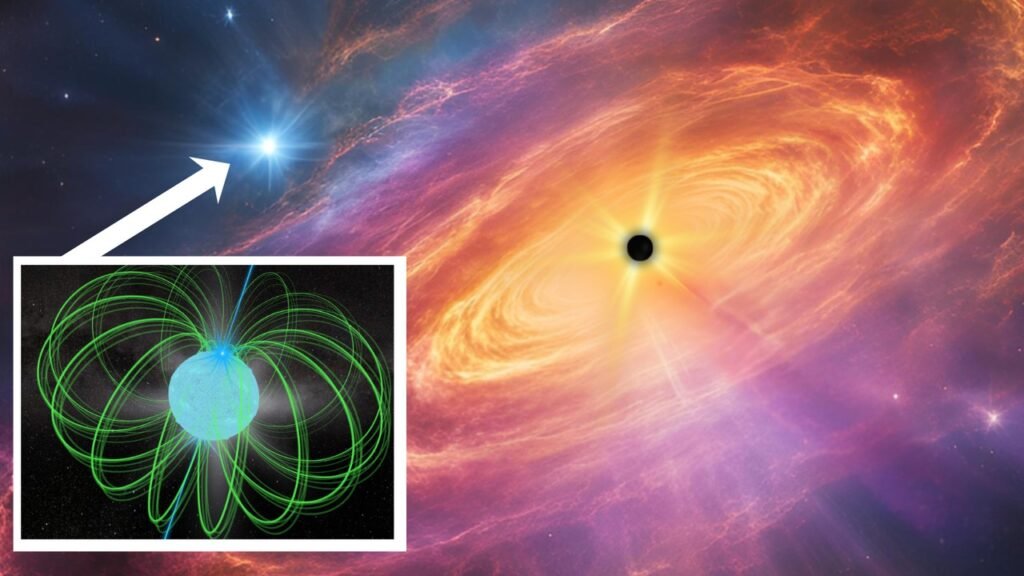

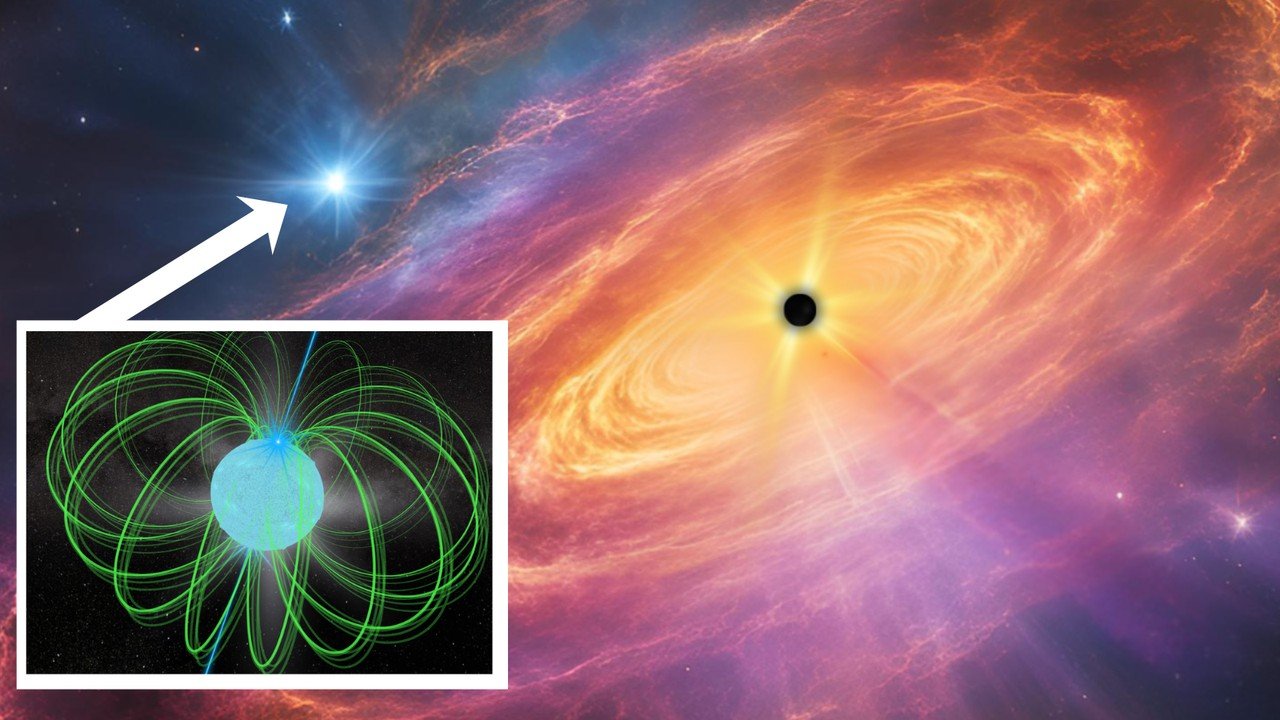
A Breakthrough Signal Emerges (Image Credits: Cdn.mos.cms.futurecdn.net)
Deep within the turbulent core of the Milky Way, researchers have detected a tantalizing signal that could reveal one of the galaxy’s best-kept secrets.
A Breakthrough Signal Emerges
Scientists scanning the galactic center identified a promising candidate for a millisecond pulsar spinning every 8.19 milliseconds.[1][2] This ultra-fast rotation marks it as one of the quickest known, if confirmed. The discovery arose from the Breakthrough Listen Galactic Center Survey, which deployed the National Science Foundation’s Green Bank Telescope for over 20 hours of observations.[3]
The candidate, dubbed BLPSR, appeared near Sagittarius A*, the supermassive black hole with a mass four million times that of the Sun. Lead author Karen I. Perez, a recent Columbia University PhD graduate now at the Green Bank Observatory, highlighted the potential in the study published in The Astrophysical Journal.[1] Follow-up observations continue to verify the signal amid the region’s intense radio interference.
Understanding Pulsars and Neutron Stars
Pulsars represent the remnants of massive stars that exploded in supernovae, collapsing into dense neutron stars roughly the size of a city but with the Sun’s mass.[4] Their powerful magnetic fields and rapid spins generate beams of radio waves that sweep across space like cosmic lighthouses. Millisecond pulsars, spun up by accreting material from companion stars, offer exceptional timing stability.
BLPSR’s 8.19-millisecond period places it among these elite fast rotators. Such objects serve as precise clocks, detecting minute changes in their pulses caused by gravitational influences.[2] Columbia research scientist Slavko Bogdanov explained that external forces warp these steady arrivals, providing measurable data on spacetime distortions.
Navigating the Galactic Center’s Chaos
The Milky Way’s core poses formidable detection challenges due to thick clouds of gas and dust that scatter radio signals.[3] Astronomers expected hundreds of pulsars in this dense stellar nursery, yet prior surveys found few. The Breakthrough Listen effort achieved unprecedented sensitivity, detecting roughly 10 percent of expected millisecond pulsars and half of slower ones – yet only this single candidate surfaced.
This scarcity puzzled researchers, suggesting either fewer neutron stars than predicted or observational limits. The survey’s high-resolution data across wide bandwidths pierced some interference, isolating BLPSR’s periodic signal.[4]
Probing Einstein’s General Relativity
A confirmed pulsar so close to Sagittarius A* would enable groundbreaking tests of general relativity. Pulse delays from the black hole’s gravity could map spacetime warping with precision unattainable elsewhere.[1] Bogdanov noted that deflections and time lags near massive objects align with Einstein’s predictions, offering a natural laboratory for extreme physics.
- Pulsars act as stable timers to quantify gravitational redshift.
- They reveal orbital dynamics around the black hole.
- Multiple pulsars could detect subtle gravitational waves.
- Insights into neutron star populations refine galaxy evolution models.
- Confirmation challenges assumptions about the core’s stellar density.
Key Takeaways
- BLPSR spins every 8.19 milliseconds near Sagittarius A*, pending confirmation.
- Breakthrough Listen’s survey used the Green Bank Telescope for deep probing.
- Potential to test general relativity via pulse anomalies from black hole gravity.
Perez expressed optimism: “We’re looking forward to what follow-up observations might reveal about this pulsar candidate. If confirmed, it could help us better understand both our own Galaxy, and General Relativity as a whole.”[2] This discovery underscores the galactic center’s role as a frontier for astrophysics. As data releases invite global analysis, the pulsar hunt intensifies – what secrets will the Milky Way’s heart yield next? Share your thoughts in the comments.