

An Unforeseen Stellar Phenomenon (Image Credits: Upload.wikimedia.org)
Astronomers recently captured a vivid image of an unexpected shock wave surrounding a white dwarf star located 730 light-years from Earth in the constellation Auriga.
An Unforeseen Stellar Phenomenon
Researchers using advanced telescopes stumbled upon a structure that defies conventional explanations. The dead star, known as RXJ0528+2838, appeared to generate a bow shock – a glowing arc formed when stellar material collides with interstellar gas. This feature, imaged in striking red, green, and blue hues, emerged during observations that sought to study the star’s faint emissions.
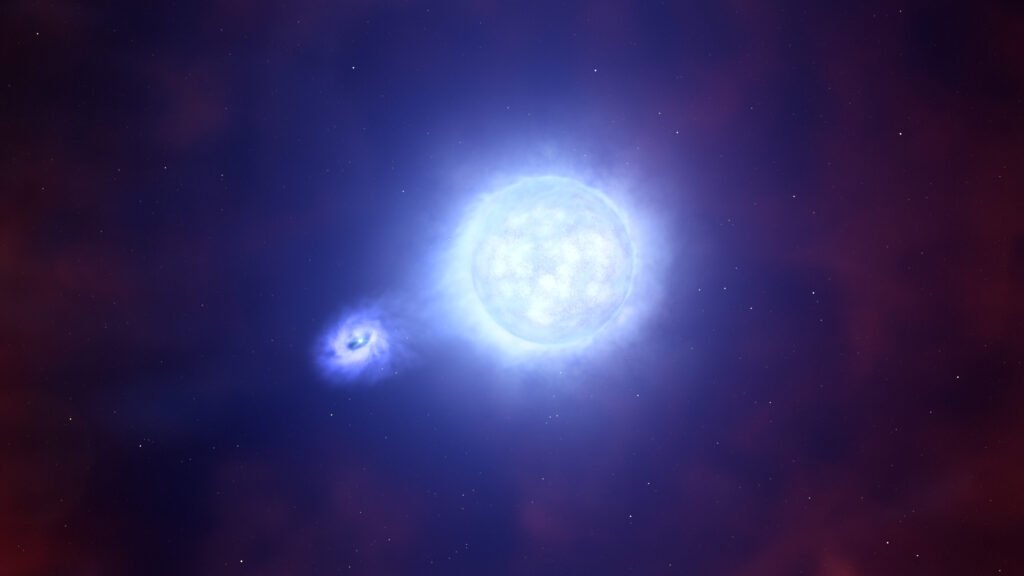
The discovery caught the team off guard. White dwarfs, the remnants of sun-like stars after they exhaust their fuel, typically lack the energy to produce such dynamic interactions. Yet this compact object, roughly the size of Earth but with the mass of the sun, showed clear evidence of a persistent shock wave. The structure spans several light-years and glows faintly, hinting at ongoing processes that astronomers had not anticipated.
Advanced Tools Reveal Hidden Details
The European Southern Observatory’s Very Large Telescope in Chile played a pivotal role in unveiling this anomaly. Equipped with specialized instruments, the telescope filtered light to highlight the shock wave’s composition. Observations spanned multiple wavelengths, allowing scientists to map the interaction between the white dwarf’s outflow and the surrounding medium.
This white dwarf moves through space at a speed that should create a bow shock, but models predicted it would be too faint or absent altogether. The clarity of the image surprised the observers, providing a rare glimpse into the life of a stellar corpse. The data confirmed the shock wave’s stability, persisting despite the star’s inactive state. Such precision in imaging has opened doors to reevaluate similar objects across the sky.
The Puzzle of the Shock Wave’s Origin
Experts grapple with how this small, cooled star could sustain such a feature. Standard theories suggest bow shocks form around more massive or active stars, like red giants shedding outer layers. For RXJ0528+2838, no obvious source of material explains the collision needed to form the wave.
One possibility involves undetected companions, such as a hidden planet or another star, feeding the white dwarf subtle streams of gas. Alternatively, the shock might stem from ancient ejections reignited by the star’s motion. The research team, co-led by scientists from Durham University and international collaborators, emphasized the novelty of the find. “We found something never seen before and entirely unexpected,” one researcher noted in a statement from the observatory.
Broadening Our View of Stellar Remnants
This observation prompts a rethink of how white dwarfs influence their cosmic neighborhoods. Past studies focused on their gravitational effects, but this case highlights potential for energetic outflows even in dormancy. The international effort involved physicists from 12 institutions across seven countries, underscoring the global push to decode stellar evolution.
Future surveys may scan for similar structures around other white dwarfs, potentially revealing a hidden population of active remnants. Enhanced models could incorporate these findings to predict interstellar interactions more accurately. The discovery adds a layer of complexity to our understanding of the universe’s quiet corners, where even dead stars hold surprises.
Key Takeaways
- The shock wave around RXJ0528+2838 marks the first observed bow shock from a white dwarf, challenging existing models.
- Imaged by ESO’s Very Large Telescope, the structure glows in multiple colors, spanning light-years in size.
- This finding suggests white dwarfs may interact more dynamically with space than previously thought, urging new research.
As astronomers continue to probe the mysteries of RXJ0528+2838, this enigmatic shock wave reminds us that the cosmos still conceals fundamental secrets. What implications might this have for our models of stellar death? Share your thoughts in the comments below.