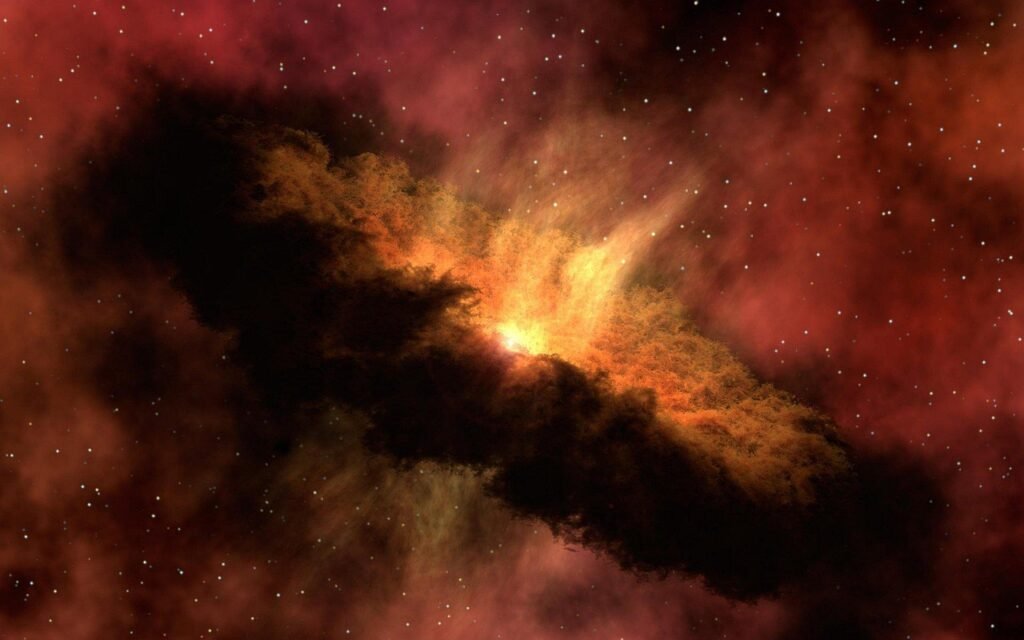

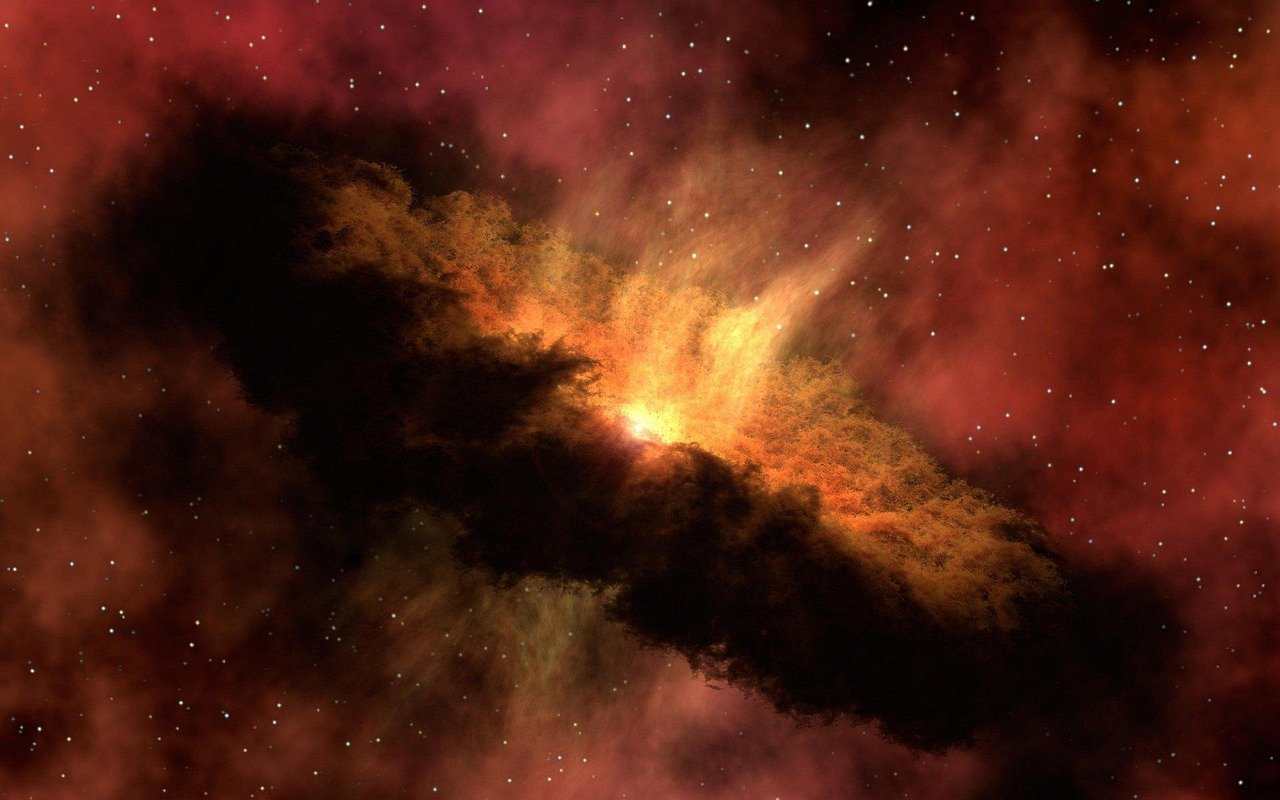
A Red Supergiant’s Fiery Display (Image Credits: Pixabay)
High in the winter sky, Betelgeuse gleams as Orion’s fiery red shoulder, a cosmic beacon that has long intrigued astronomers with its variability and looming fate.[1]
A Red Supergiant’s Fiery Display
Astronomers identified Betelgeuse as the closest red supergiant to Earth, residing about 650 light-years away in the constellation Orion. This variable star, known for its muted orange-red hue, ranks as the 10th-brightest in the night sky and holds the seventh spot for observers in much of the Northern Hemisphere. Its position at right ascension 05h 55m 10.3053s and declination +07° 24′ 25.4″ makes it a staple for stargazers during winter evenings.[1]
Recent observations revealed a companion star, dubbed Betelbuddy, confirmed through studies in 2024 and 2025. This smaller star, roughly the size of the sun, orbits nearby and may influence Betelgeuse’s behavior. Ground-based telescopes and space observatories captured images showing the pair, with Betelbuddy appearing as a blue point beside the giant’s orange glow.[1][2]
The Mystery of the Great Dimming
Betelgeuse captured global attention in late 2019 and early 2020 during its Great Dimming, when it faded dramatically from view. Scientists later determined that a massive surface mass ejection – 400 billion times larger than a typical solar event – ejected hot gas that cooled into a dust cloud, temporarily obscuring the star’s light. NASA’s Hubble Space Telescope and other instruments provided crucial data to confirm this mechanism.[1]
Since then, the star has shown cycles of brightening and dimming, though none matched the 2019 event’s scale. The companion star’s gravitational pull could stir surrounding gas, contributing to these fluctuations. Observations continue, with Hubble detecting a “wake” from Betelbuddy in early 2026, as the companion currently hides behind Betelgeuse from Earth’s perspective.[1][3]
Charting the Path to Explosion
Betelgeuse hurtles toward a Type II supernova once its core exhausts nuclear fuel, particularly after about 1,000 years of carbon burning. A June 2023 research paper analyzed its evolutionary stage and posited that the star entered late-stage carbon burning, suggesting a timeline of “tens of years” before detonation. The authors concluded: “We conclude that Betelgeuse is … a good candidate for the next galactic supernova.”[1]
However, experts caution against precise predictions. Surface conditions remain stable even in advanced phases, leaving room for explosion tomorrow, in decades, or even centuries. Historical records of Milky Way supernovae are sparse, underscoring the event’s rarity in human lifetimes.[1]
Spectacle Without the Danger
When Betelgeuse erupts, it could rival a full moon’s brilliance, potentially visible during daylight across much of the world. Northern Hemisphere viewers might spot it rising near sunset in January or dominating winter nights; Southern observers could catch it best in December-January evenings.
- Northern mid-latitudes: Prominent in winter evenings, dawn in summer.
- Southern Hemisphere: Peaks during summer evenings.
- Global impact: Safe at 650 light-years, far beyond any harmful distance.
Earth faces no threat, as the distance exceeds four times the radius where radiation could pose risks. Post-explosion, astronomers anticipate studying the remnant, while casual observers will mourn the loss of Orion’s signature red star.[1]
Recent companion discoveries refine models but confirm no imminent blast on human timescales. As telescopes like Hubble and Gemini track the system – planning more views when Betelbuddy reemerges in 2027 – Betelgeuse remains a symbol of stellar evolution’s grandeur.[4]
Key Takeaways
- Betelgeuse’s dimmings stem from dust clouds and companion interactions, not pre-explosion signs.
- A 2023 study flags it as a prime supernova candidate, yet timing stays uncertain.
- The blast promises a dazzling, harmless sky show visible worldwide.
Betelgeuse teaches patience in cosmic timescales; its supernova will mark a generational event worth watching for. What are your thoughts on witnessing this stellar finale? Share in the comments.