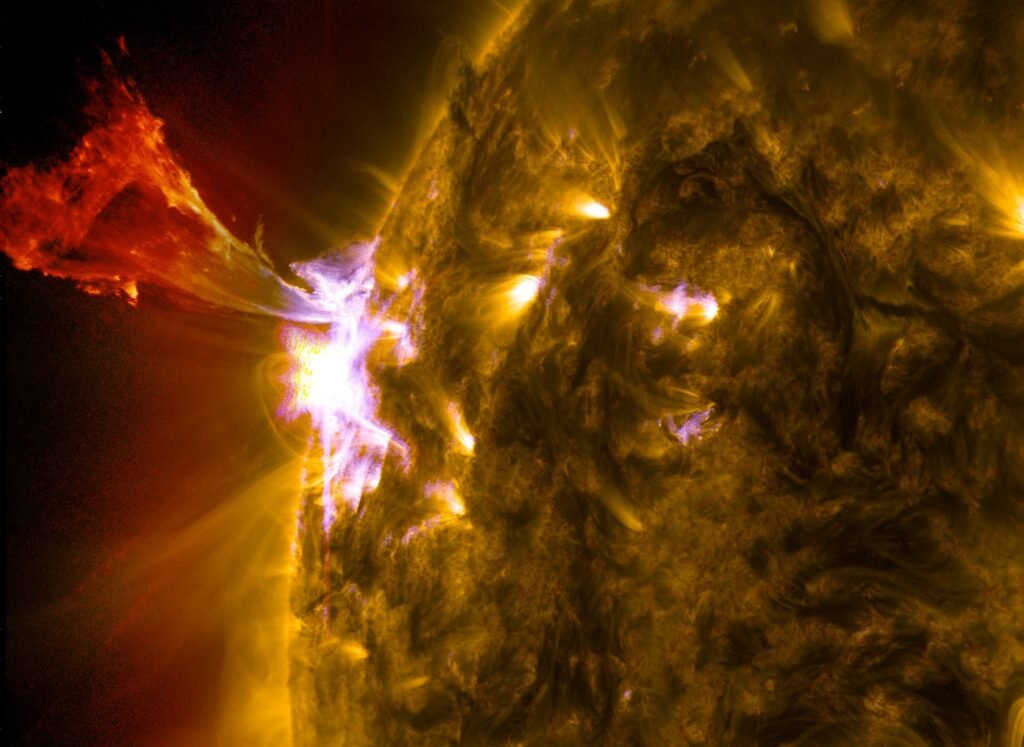


Recent Flare Activity Signals Heightened Solar Dynamics (Image Credits: Upload.wikimedia.org)
On January 12, 2026, the Sun unleashed a moderate flare from its edge, intensifying an already turbulent period of space weather that has captivated skywatchers worldwide.
Recent Flare Activity Signals Heightened Solar Dynamics
Solar activity reached moderate levels as a notable flare emerged near the Sun’s western limb late on January 11. This event, classified in the M-range, highlighted the ongoing volatility in the solar atmosphere. Observers noted the flare’s peak around 23:04 UTC, with X-ray emissions that suggested even greater intensity due to its position beyond direct view. Such limb flares often escape full measurement but still contribute to broader space weather patterns.
The flare accompanied a series of smaller eruptions, including one from the southeast limb that produced visible plasma streams. These incidents stemmed from active regions on the Sun’s surface, where magnetic fields twisted and released energy. Fast-moving solar wind streams exacerbated the situation, pushing charged particles toward Earth at elevated speeds. Geomagnetic conditions remained active as a result, with indices reflecting the influence of prior coronal mass ejections.
Geomagnetic Storms Stir Global Aurora Spectacles
Lingering effects from a coronal mass ejection that departed the Sun on January 8 arrived at Earth, sparking G1 to G2 level geomagnetic storms through January 10 and 11. These storms, driven by fast solar wind and CME plasma, disturbed the planet’s magnetic field and triggered widespread auroral displays. High-latitude regions from Canada to Scandinavia reported vivid lights dancing across the night sky, drawing crowds outdoors despite the winter chill.
The storms also raised concerns for satellite operations and high-frequency radio communications, though disruptions stayed minor. Power grids in vulnerable areas monitored for induced currents, but no major outages occurred. This episode followed earlier watches issued for the first days of January, underscoring the unpredictable nature of solar influences on our technology-dependent world.
Sunspots and Magnetic Fields Fuel the Fire
At the heart of this activity lay sunspot region 4336, a quiet yet potent feature harboring a delta-class magnetic configuration. Such fields store immense energy, capable of unleashing powerful X-class flares, though this region has so far produced only milder outbursts. Hydrogen-alpha imagery captured intricate details of prominences and filaments near the limb, revealing the Sun’s complex plasma dynamics.
Forecasts from agencies like NOAA indicated continued moderate solar activity into mid-January, with potential for more flares from emerging active regions. The solar cycle, now in its declining phase after peaking in late 2024, still delivered surprises through these magnetic interactions. Researchers emphasized the importance of monitoring, as even moderate events could cascade into significant space weather.
Implications for Space Weather Monitoring
Events like this limb flare remind scientists of the Sun’s role in shaping near-Earth environment. Instruments aboard satellites such as GOES provided real-time data on X-ray fluxes and radio emissions, aiding predictions. The 10.7 cm radio flux measured around 111 solar flux units, indicating a sun moderately active compared to recent spotless periods.
Ultralow frequency waves and particle fluxes also spiked, contributing to the thermosphere’s warming. This expansion can increase drag on low-Earth orbit satellites, a factor space agencies track closely. Overall, the combination of flares and storms highlighted the need for robust forecasting to safeguard assets in space.
Key Takeaways
- A moderate M3.3-level flare peaked from the Sun’s east limb on January 11, likely stronger than observed.
- G1-G2 geomagnetic storms lit up auroras through January 11, with fast solar wind sustaining activity.
- Sunspot 4336’s delta magnetic field poses risks for future intense flares.
As solar activity ebbs and flows through 2026, these events serve as a stark reminder of our planet’s vulnerability to cosmic forces – yet they also offer breathtaking natural displays. What auroral sights have you witnessed lately? Share your experiences in the comments.