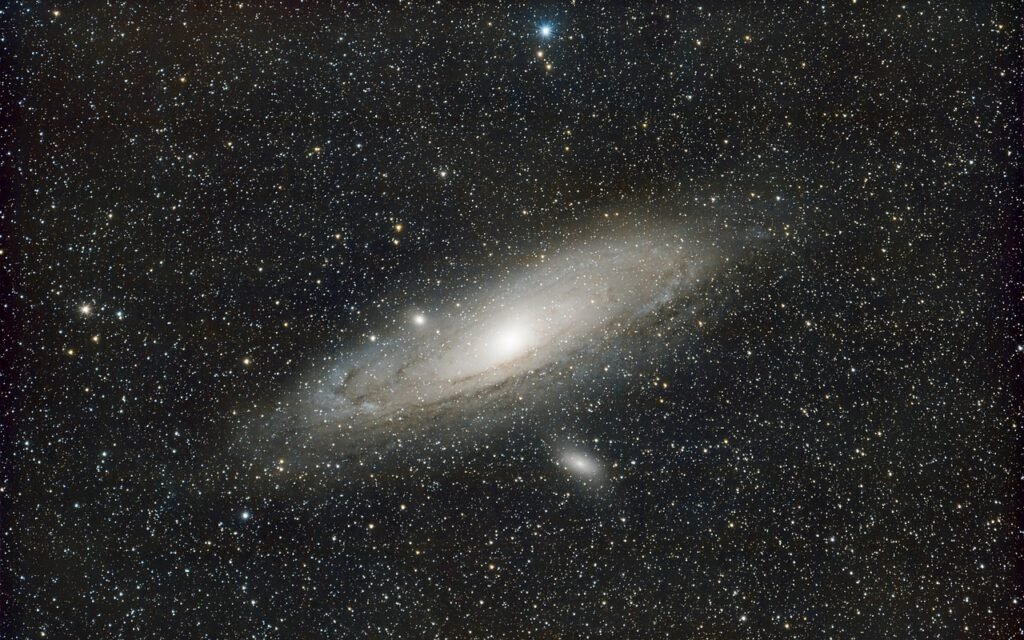

A Flattened Cosmic Prison Emerges (Image Credits: Pixabay)
A groundbreaking computer simulation has revealed that the Milky Way and Andromeda galaxies reside within a flattened sheet of dark matter, positioned between two expansive voids in space.[1][2]
A Flattened Cosmic Prison Emerges
Researchers identified a structure spanning 32 million light-years that encases the Local Group of galaxies. This dark matter sheet lies along the Supergalactic Plane and confines the Milky Way and its neighbor Andromeda on a path toward collision. Unlike expectations in an expanding universe, most nearby large galaxies move away from the Milky Way. The discovery resolves a long-standing puzzle about these peculiar motions.[1]
Dark matter, which constitutes about 85 percent of the universe’s mass, exerts gravitational influence without emitting light. The sheet’s concentration keeps internal galaxies stable amid cosmic expansion. Voids on either side – underdense regions – permit distant galaxies to recede rapidly. This configuration matches observations of galaxy velocities relative to the Hubble flow.[1]
Simulations Replicate the Universe’s infancy
A team from the University of Groningen launched simulations from tiny density fluctuations in the Cosmic Microwave Background, the universe’s oldest observable light. These models evolved gravitational conditions from the Big Bang to today. Hundreds of scenarios matched the Local Group’s dynamics. Lead author Ewoud Wempe noted, “We are exploring all possible local configurations of the early universe that ultimately could lead to the Local Group.”[1]
The simulations predicted a flattened dark matter distribution without prior assumptions. They incorporated 31 nearby galaxies and revealed velocities through arrow-like representations in visualizations. Co-author Amina Helmi expressed excitement: “I am excited to see that, based purely on the motions of galaxies, we can determine a mass distribution that corresponds to the positions of galaxies within and just outside the Local Group.”[1]
Published in Nature Astronomy on January 27, 2026, the study titled “The mass distribution in and around the Local Group” provides the first such detailed local model consistent with broader cosmology.[1]
Unraveling Galaxy Flight Patterns
Most galaxies beyond the immediate Local Group exhibit outward motion exceeding the standard Hubble expansion rate. The dark matter sheet shields the Milky Way and Andromeda from this pull. Other nearby giants, however, drift away due to the flanking voids. This explains Andromeda’s unique approach at high speed.[1]
Key features of the structure include:
- A thickness far less than its 10-megaparsec width, forming a thin plane.
- Underdense voids above and below, accelerating external galaxy recession.
- Stable internal Hubble flow, quieter than surrounding regions.
- Prediction of distant galaxy flattening in the Local Supercluster.
Traditional spherical halo models failed to account for these observations. The sheet model aligns halo masses for the Milky Way and Andromeda with measured values.[1]
Implications for Local Cosmology
This finding challenges assumptions of uniform dark matter halos around galaxy groups. It suggests large-scale structures influence local dynamics more profoundly than previously thought. Future observations could test the sheet’s extent and void properties. The model supports the standard cosmological framework while refining our home region’s picture.[3][4]
Key Takeaways:
- The Local Group sits in a 32-million-light-year dark matter sheet.
- Voids enable neighboring galaxies to flee the Milky Way.
- Simulations from Big Bang match current observations precisely.
Astronomers now possess a virtual twin of our cosmic vicinity, paving the way for deeper insights into dark matter’s role. What does this structure mean for the inevitable Milky Way-Andromeda merger? Share your thoughts in the comments.