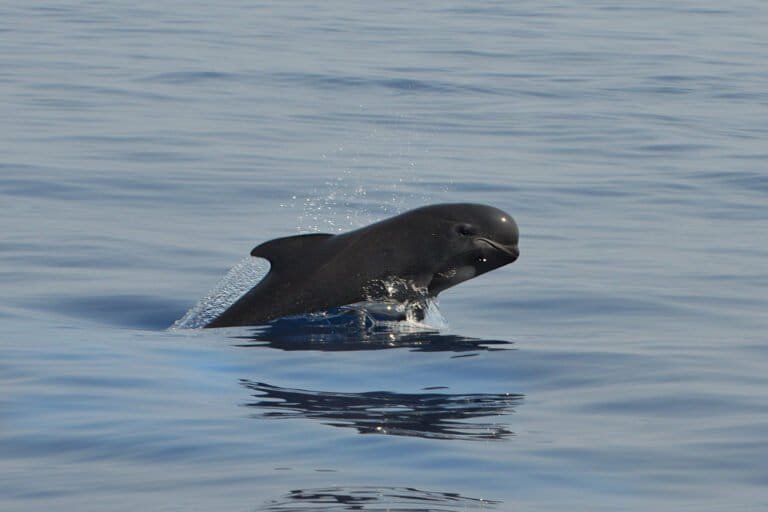
Shocking Afternoon Discovery Ignites Alarm (Image Credits: Imgs.mongabay.com)
East Nusa Tenggara, Indonesia – A pod of 55 short-finned pilot whales beached themselves in shallow waters off Mbadokai Beach in Rote Ndao regency on March 9, igniting a desperate community-led effort to return them to the sea.[1][2]
Shocking Afternoon Discovery Ignites Alarm
Residents of nearby Deranitan village first spotted the distressed whales around 3:30 p.m. local time. The animals struggled in the shallow coastal waters, a narrow bay known for its steep gradients and tricky topography.[1]
Word spread quickly through the community. Local police mobilized immediately, coordinating with naval personnel and representatives from Indonesia’s fisheries ministry. By evening, teams converged on the site, facing a race against the tide as the whales risked exhaustion and injury.[3]
Heroic Overnight Battle to Refloat the Pod
Rescue operations stretched through the night into March 10. Volunteers, officials, and security forces deployed boats to nudge the massive mammals toward deeper waters. The whales’ hefty size – adults reaching up to 5.1 meters – complicated the task, as repeated attempts saw some animals turn back toward shore.[2]
Imam Fauzi, head of the marine conservation agency in Kupang, led the coordinated response. His team, alongside residents, managed to guide 34 whales to safety. The 21 that perished underwent immediate necropsies; among them, eight males and 13 females, including four calves as small as 2.4 meters. Carcasses received proper burial by evening, using an excavator to avoid contamination.[2]
- Discovery: 3:30 p.m., March 9, shallow waters near Mbadokai Beach.
- Total stranded: 55 short-finned pilot whales (Globicephala macrorhynchus).
- Rescued: 34 returned to open sea.
- Fatalities: 21, necropsied and buried.
- Key responders: Locals, police, navy, BK-KSDA Kupang.
Decoding the Causes Behind the Tragedy
Investigators from the fisheries ministry pored over necropsy results to pinpoint why the pod veered into peril. Pilot whales exhibit strong social bonds, often following a lead individual into danger if it becomes disoriented.[1] Christofel Oktavianus Nobel Pale, head of aquatic resources management at Nusa Nipa University, explained: “Pilot whales have high social cohesion; when one individual, perhaps sick or disoriented, enters shallow water, the rest follow even into danger.”
The area’s bathymetry – shallow flats dropping sharply – likely confused their echolocation. Strong currents emerged as another suspect. Past strandings in Indonesia have involved hunger, lung issues, and navigation failures, underscoring recurring vulnerabilities in these migratory routes.[4]
Warning Signals for Marine Ecosystems
Environmental advocates viewed the event as a red flag. Yuvensius Stefanus Nonga, executive director of Walhi NTT, called it a “signal that must not be ignored,” potentially tied to climate-driven prey shifts or human-generated ocean noise. Indonesia’s waters host dozens of cetacean species, yet its Ocean Health Index scores just 65 out of 100.[1]
Authorities stressed the whales’ protected status and warned against handling remains. Such incidents highlight the need for bolstered monitoring and training, as Indonesia builds capacity for strandings along its vast coastline.[3]
Key Takeaways
- Community vigilance saved over half the pod, showcasing effective local response.
- Necropsies offer clues, but broader factors like climate and noise pollution loom large.
- Strandings urge policy upgrades for cetacean protection in vital migratory zones.
This stranding serves as a stark reminder of fragile ocean balances, where human and natural pressures intersect. Enhanced research could prevent future losses and safeguard these deep-diving social marvels. What do you think about these recurring marine alerts? Tell us in the comments.