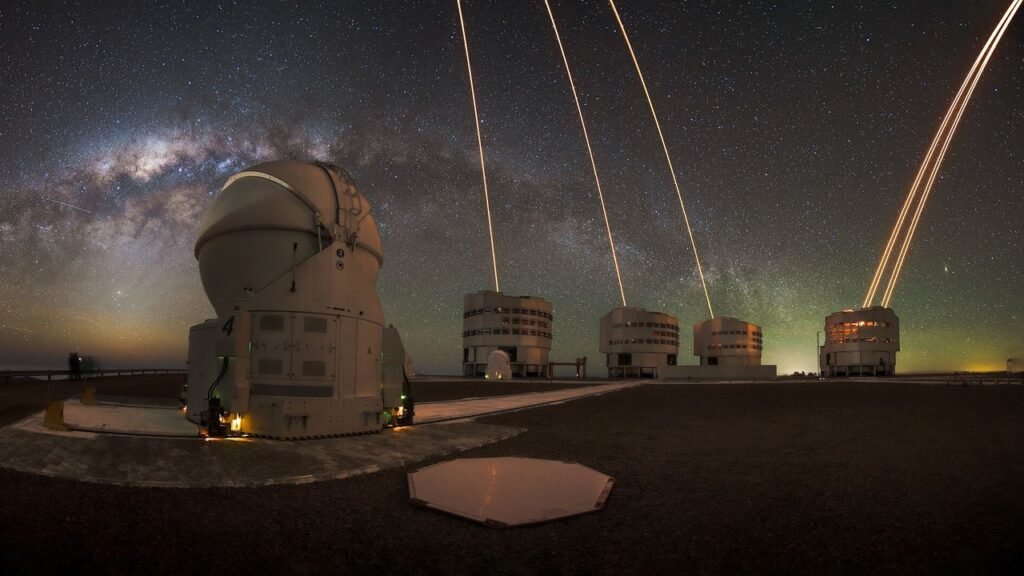

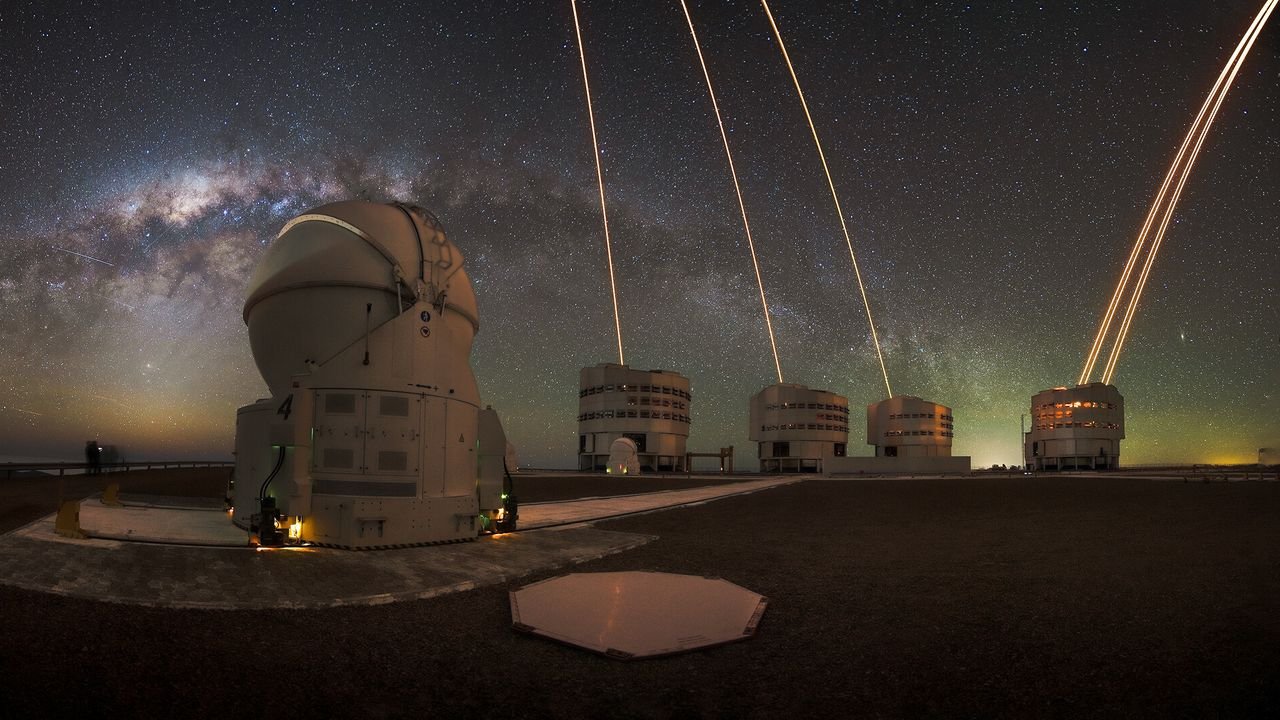
Laser Beams Defy the Atmosphere (Image Credits: Cdn.mos.cms.futurecdn.net)
Chile – Powerful lasers pierced the pristine night sky above the Paranal Observatory, creating artificial stars that guide astronomers toward sharper views of the cosmos.
Laser Beams Defy the Atmosphere
High-powered lasers shot from the Very Large Telescope created pinpoint beacons roughly 90 kilometers above Earth’s surface. These man-made stars emerged from sodium atoms excited by the beams in the upper atmosphere. Astronomers relied on them during observations at the European Southern Observatory’s flagship facility.[1][2]
The technique addressed a key challenge in ground-based astronomy. Earth’s atmosphere distorts incoming starlight, blurring images much like heat haze warps a distant view. Without correction, even the largest telescopes struggled with fine details.
Unlocking Adaptive Optics
Adaptive optics systems transformed this limitation into an advantage. The artificial stars served as reference points for measuring atmospheric turbulence in real time. Deformable mirrors within the telescopes then adjusted thousands of times per second to counteract the distortions.
Unit Telescope 4 at Paranal employed four such laser beams simultaneously. This setup allowed for wider sky coverage compared to natural guide stars. Observers gained crystal-clear images of distant galaxies, exoplanets, and black holes.
- Excites sodium layer to form bright spots mimicking real stars.
- Enables wavefront sensing for precise corrections.
- Expands observable sky regions beyond bright natural stars.
- Boosts resolution rivaling space telescopes.
- Supports interferometry for ultra-fine measurements.
Paranal’s Prime Position
Nestled in Chile’s Atacama Desert, Paranal offered ideal conditions for such innovations. The site’s high altitude and arid climate minimized water vapor interference. Clear skies prevailed over 300 nights per year, maximizing observation time.
The Very Large Telescope array consisted of four 8.2-meter mirrors that operated independently or combined for heightened power. Recent upgrades enhanced the laser systems, coinciding with groundbreaking discoveries. ESO scientists pushed boundaries in studying the universe’s earliest epochs.
This remote outpost drew global talent. Teams from Europe, South America, and beyond collaborated under the southern sky’s splendor.
A Snapshot of Cosmic Wonder
Chilean astrophotographer Alexis Trigo captured the lasers in action against the Milky Way’s glow. His image highlighted the blend of cutting-edge technology and natural beauty. Space.com selected it as the photo of the day for February 17, 2026.[3]
ESO featured similar vistas in its Picture of the Week series earlier that month. The shots underscored Paranal’s role in advancing astronomy.[4]
Key Takeaways
- Laser guide stars revolutionized ground-based imaging by compensating for atmospheric blur.
- Paranal Observatory remains a cornerstone of ESO’s efforts to decode the universe.
- Such technologies pave the way for future giants like the Extremely Large Telescope.
These artificial stars not only sharpened our cosmic gaze but also symbolized human ingenuity piercing the veil of night. As observatories evolve, they promise revelations from the universe’s depths. What celestial secrets will the next laser beam uncover? Share your thoughts in the comments.