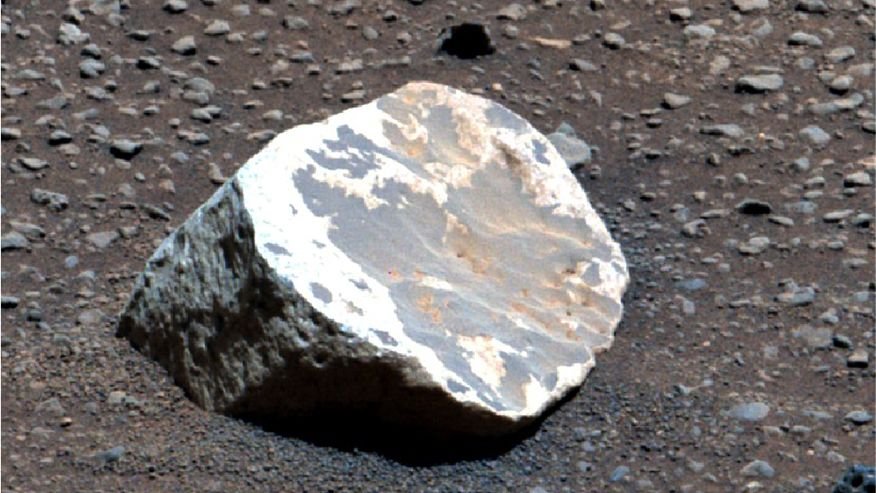
Thousands of Anomalous Rocks Litter the Crater Floor (Image Credits: Cdn.mos.cms.futurecdn.net)
Mars’ Jezero Crater – Fragments of pale, aluminum-rich clay scattered across the rover’s path have provided compelling evidence of prolonged heavy rains billions of years ago.[1][2]
Thousands of Anomalous Rocks Litter the Crater Floor
Researchers spotted several thousand light-toned “float rocks” during Perseverance’s traverse since its landing in February 2021. These pebbles to boulders stood out sharply against the rusty terrain, prompting detailed analysis with onboard instruments.[1]
The SuperCam and Mastcam-Z tools revealed spectral signatures of kaolinite, a clay mineral rare without extensive water interaction. Unlike typical Martian rocks coated in iron oxide, these specimens showed bleaching with high aluminum and titanium but depleted iron and magnesium.[2] This discovery challenged existing models of the planet’s arid history.
Leaching Process Mirrors Earth’s Rainforests
Kaolinite forms when rainwater slowly dissolves other minerals from parent rocks over thousands to millions of years. On Earth, such clays thrive in humid tropical zones like rainforests, where annual precipitation exceeds 1,000 millimeters.[3]
Purdue University scientists compared the Martian samples to paleosols from Southern California and ancient deposits in South Africa. The chemical profiles matched low-temperature surface leaching by rain, not hot hydrothermal activity underground. Briony Horgan, a Perseverance team member, noted, “You need so much water that we think these could be evidence of an ancient warmer and wetter climate where there was rain falling for millions of years.”[1]
- Aluminum oxide content: 30-45%
- Distinct spectral signature confirming kaolinite
- Bleached appearance from iron removal
- Depleted magnesium and iron levels
- Comparable to non-hydrothermal Earth kaolins
Mystery Surrounds the Rocks’ Journey to Jezero
Jezero Crater, once home to a lake twice Lake Tahoe’s size, holds no nearby major kaolinite outcrops. Satellite data shows larger deposits elsewhere on Mars, but these fragments puzzle scientists with their distribution.[1]
Possible explanations include transport by the ancient river that built the crater’s delta or ejection from an impact event. Adrian Broz, lead author of the study, remarked, “So when you see kaolinite on a place like Mars, where it’s barren, cold and with certainly no liquid water at the surface, it tells us that there was once a lot more water than there is today.”[2] Further rover exploration aims to trace their source.
Implications for Mars’ Habitability
These rocks record one of the wettest chapters in Mars’ past, suggesting a full hydrological cycle with evaporation, clouds, and persistent downpours. Such conditions fostered chemical reactions potentially supportive of microbial life.[3]
The findings, detailed in Communications Earth & Environment, bolster arguments for sample return missions to analyze these time capsules in Earth labs. Broz emphasized, “All life uses water. So when we think about the possibility of these rocks on Mars representing a rainfall-driven environment, that is a really incredible, habitable place where life could have thrived if it were ever on Mars.”[1]
Key Takeaways
- Mars hosted tropical-like rains for millions of years, forming kaolinite through prolonged leaching.
- Float rocks in Jezero Crater offer ground-truth for orbital kaolinite detections.
- Source remains elusive, spurring plans for deeper crater rim investigations.
These bleached survivors transform our view of the Red Planet from eternal desert to fleeting oasis. What secrets might future missions unlock from Mars’ watery youth? Tell us in the comments.