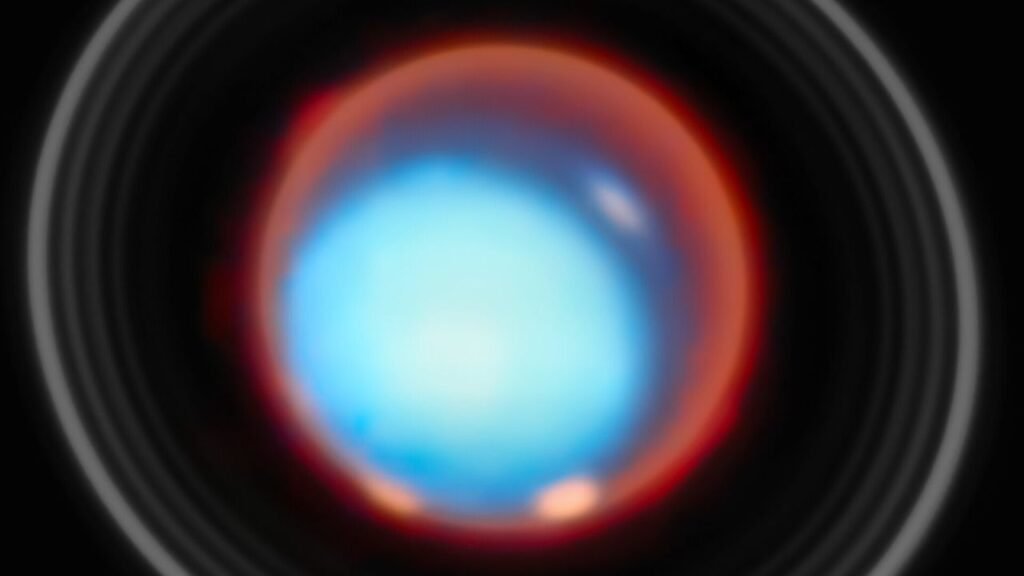

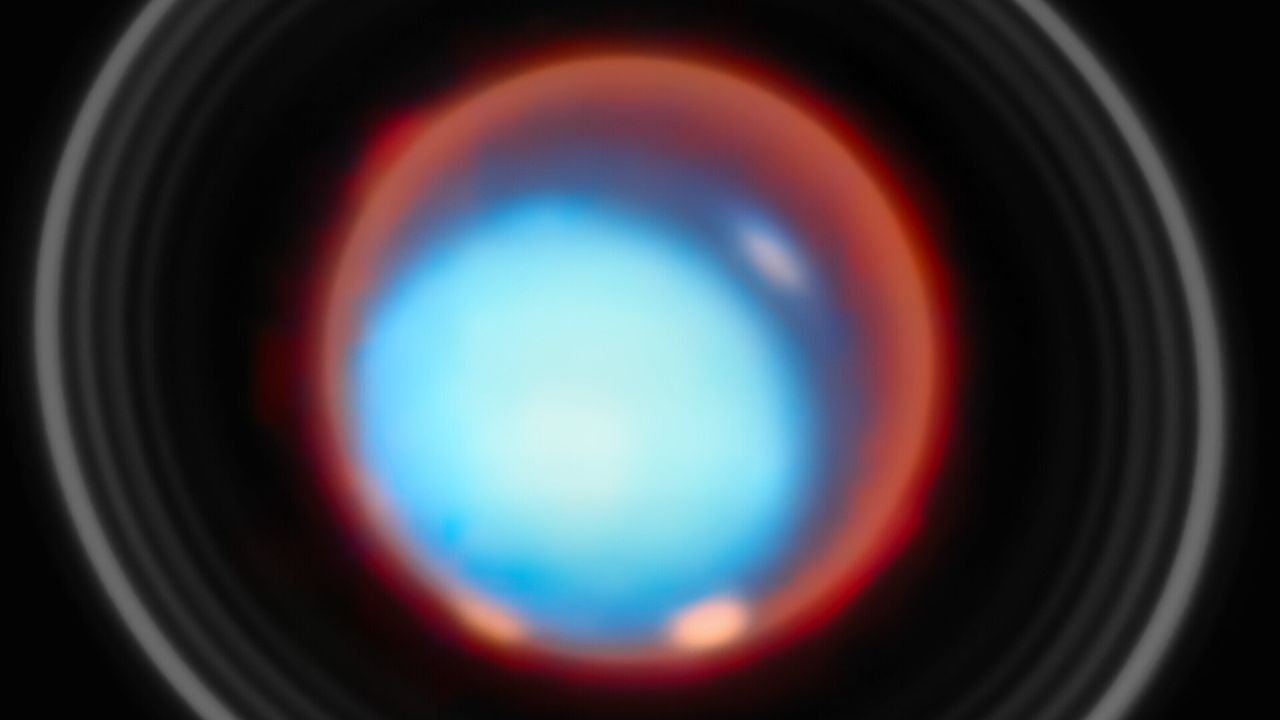
Breakthrough Observations from Orbit (Image Credits: Cdn.mos.cms.futurecdn.net)
Astronomers captured the first three-dimensional view of Uranus’s upper atmosphere, highlighting glowing auroras shaped by the planet’s peculiar magnetic field.[1]
Breakthrough Observations from Orbit
Researchers utilized the James Webb Space Telescope’s Near-Infrared Spectrograph instrument to observe Uranus for nearly a full rotation over 15 hours on January 19, 2025. The data revealed faint emissions from molecules like H2 and H3+ high above the cloud tops. This marked the first detailed mapping of the ionosphere, extending up to 5,000 kilometers into the atmosphere. Temperatures peaked between 3,000 and 4,000 kilometers altitude, while ion densities reached their maximum around 1,000 kilometers. Longitudinal variations emerged clearly, tied directly to the planet’s magnetic geometry.[1]
Paola Tiranti, a PhD student at Northumbria University who led the study, described the achievement. “This is the first time we’ve been able to see Uranus’s upper atmosphere in three dimensions,” she stated. “With Webb’s sensitivity, we can trace how energy moves upward through the planet’s atmosphere and even see the influence of its lopsided magnetic field.” The observations came from JWST General Observer program 5073, with Henrik Melin as principal investigator.[2]
Uranus’s Tilted Magnetic Field in Focus
Uranus possesses one of the solar system’s most unusual magnetospheres, tilted at nearly 60 degrees and offset from its rotation axis. This configuration causes auroras to sweep across the planet’s surface in unpredictable patterns. Webb’s images detected two bright auroral bands near the magnetic poles. A notable dark zone appeared between these bands, characterized by low emission and ion density. Scientists linked this feature to transitions in magnetic field lines, similar to darkened regions observed on Jupiter.[1]
Tiranti emphasized the magnetosphere’s oddity. “Uranus’s magnetosphere is one of the strangest in the Solar System,” she noted. “It’s tilted and offset from the planet’s rotation axis, which means its auroras sweep across the surface in complex ways.” These insights clarified how charged particles interact with the ionosphere, sculpting atmospheric structures.
Signs of Long-Term Atmospheric Cooling
The new data confirmed a decades-long cooling trend in Uranus’s upper atmosphere, which began in the early 1990s. Researchers measured an average temperature of 426 kelvins, roughly 150 degrees Celsius, cooler than prior ground-based or Voyager 2 readings. Ion densities varied significantly across the disk, with peaks aligned to auroral regions. The vertical profiles showed distinct layers where energy deposition occurred. This cooling persists despite solar influences, raising questions about internal heat sources.[1]
Earlier JWST observations from January 2023 had already hinted at frigid conditions, recording a median of 415 kelvins – the lowest ever. The latest mapping built on that foundation, providing spatial and vertical context. Such trends offer clues to the planet’s thermal evolution.
Key Features Discovered
The study illuminated several atmospheric highlights:
- Two prominent auroral bands near magnetic poles, glowing from ionized particles.
- A central dark zone with depleted ions, driven by magnetic field geometry.
- Temperature peaks at mid-altitudes, averaging cooler than expected.
- Longitudinal shifts in density, mirroring magnetosphere twists.
- Ongoing cooling, extending three decades of observations.
These elements combined into the first comprehensive 3D portrait, produced as a timelapse showing Uranus’s rotation and atmospheric dynamics.[1]
Pathways to Understanding Distant Worlds
The findings extend beyond Uranus, aiding models of ice giant exoplanets. Tiranti highlighted the broader value: “By revealing Uranus’s vertical structure in such detail, Webb is helping us understand the energy balance of the ice giants. This is a crucial step towards characterising giant planets beyond our Solar System.” Researchers anticipate further JWST observations to refine these profiles. The work appeared in Geophysical Research Letters.[2]
Key Takeaways
- First 3D ionosphere map charts auroras and energy flow.
- Tilted magnetic field dictates complex auroral patterns.
- Atmosphere cools steadily, averaging 426 K.
Webb’s gaze on Uranus not only thrilled scientists but also opened doors to planetary enigmas. What secrets might future observations uncover? Share your thoughts in the comments.