
A Dying Star’s Explosive Outbursts (Image Credits: Cdn.mos.cms.futurecdn.net)
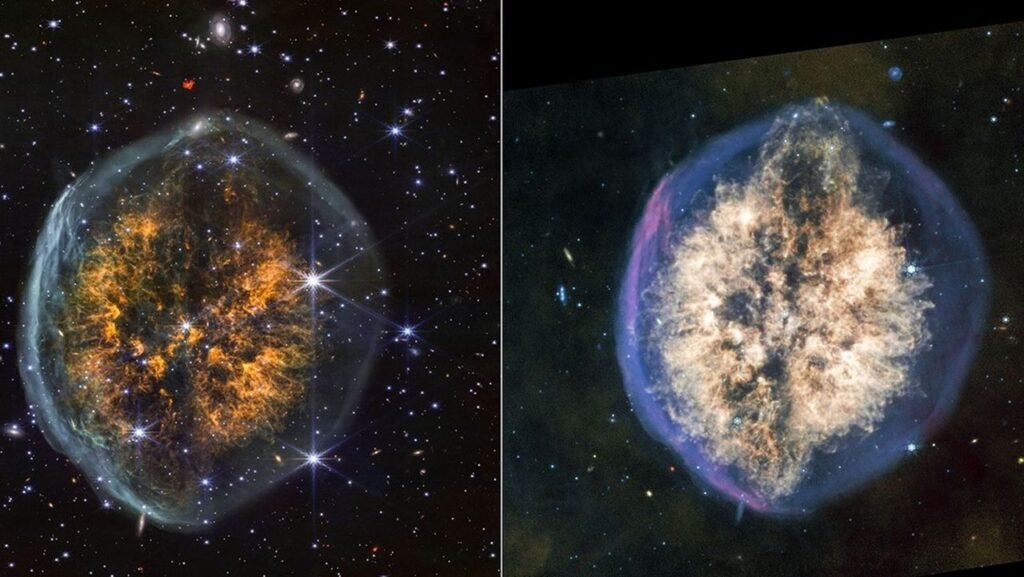
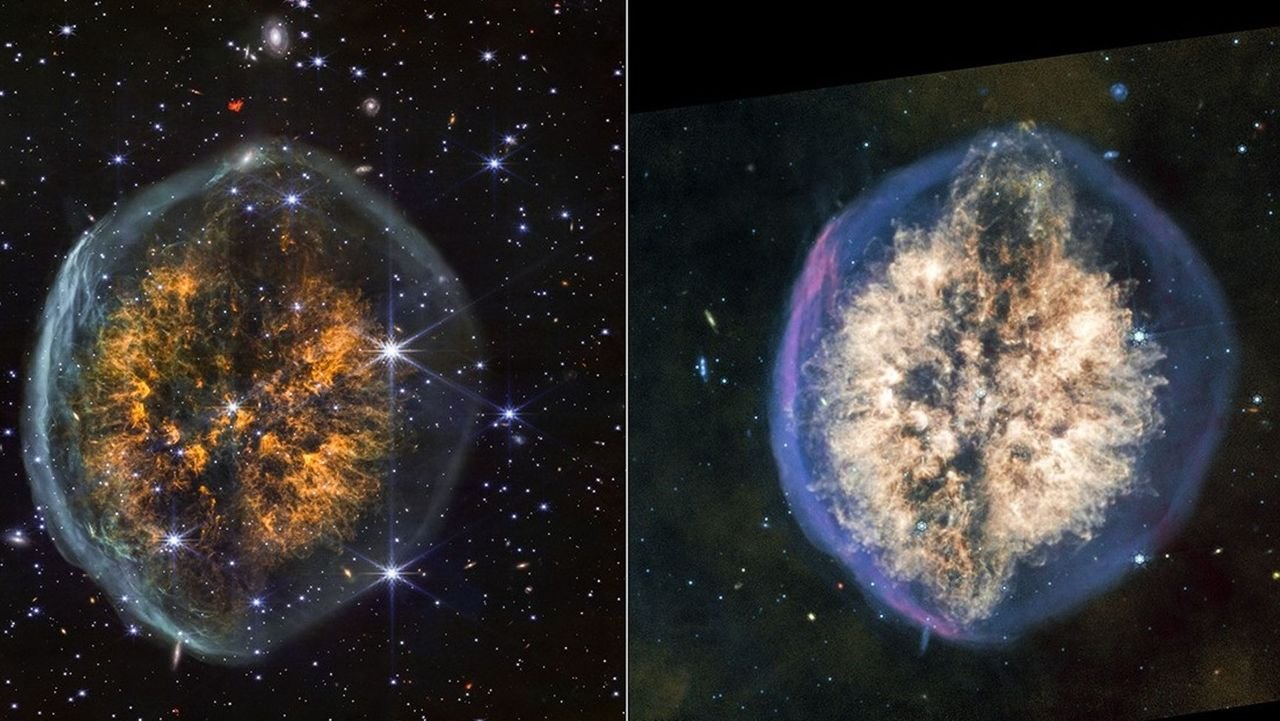
The James Webb Space Telescope recently unveiled intricate infrared views of PMR 1, a planetary nebula in the Vela constellation that strikingly evokes a brain encased in a translucent skull.[1][2]
A Dying Star’s Explosive Outbursts
Astronomers first spotted the nebula more than a decade ago through NASA’s Spitzer Space Telescope, but Webb’s advanced instruments delivered far sharper details.[1] The structure reveals multiple phases of material ejection from its central star, which has reached the turbulent end of its life cycle.
The outer shell consists primarily of hydrogen shed in an initial outburst, forming a bubble-like enclosure. Inside lies a more complex mix of heavier elements, sculpted by subsequent ejections. A prominent dark lane bisects the interior, dividing it into two hemispheres and enhancing the nebula’s eerie resemblance to neural tissue.[2][3]
NIRCam and MIRI: Complementary Cosmic Probes
Webb employed its Near-Infrared Camera (NIRCam) and Mid-Infrared Instrument (MIRI) to capture the nebula from complementary perspectives. NIRCam pierced through the gas to reveal background stars and distant galaxies, while highlighting the whitish hydrogen envelope and inner orange-hued material.[1]
MIRI, in contrast, emphasized glowing cosmic dust and fewer distant objects. It prominently displayed material ejections at the nebula’s top, disrupting the oval shape, along with a subtler counterpart at the bottom – suggesting a bipolar outflow driven by the central star.[3] These observations, taken about 5,000 light-years from Earth, help quantify the star’s shedding rate and current evolutionary phase.[4]
| Instrument | Key Revelations | Strengths |
|---|---|---|
| NIRCam (Near-IR) | Stars, galaxies, hydrogen shell, dark lane | Penetrates gas layers |
| MIRI (Mid-IR) | Dust glow, bipolar ejections | Highlights dusty material |
Mysteries of a Potential Wolf-Rayet Star
The nebula’s progenitor appears to exhibit traits of a Wolf-Rayet star, an unstable type known for ferocious stellar winds that strip away outer layers, exposing a hot helium-burning core.[4] Such stars, often classified as WC or WO subtypes, display strong emission lines from carbon or oxygen.
Yet uncertainties persist. Researchers debate whether this star possesses sufficient mass for a supernova explosion or if it will fade into a white dwarf after exhausting its envelope. Further analysis of the outflows and composition promises insights into these dynamics.[2]
Insights into Planetary Nebulae
Planetary nebulae like PMR 1 represent brief, vivid interludes in stellar evolution, lasting roughly 10,000 to 20,000 years. They disperse enriched elements into the interstellar medium, fostering future star and planet formation.[4]
- Webb’s resolution exposes ejection sequences invisible to prior telescopes.
- Bipolar outflows hint at hidden companions or magnetic influences.
- Dust and gas mapping refines models of late-stage mass loss.
- Comparative studies with Spitzer underscore technological leaps.
- These events elevate galactic metallicity, aiding complex chemistry.
Key Takeaways
- PMR 1 showcases a star’s layered demise through hydrogen shell and inner complexity.
- Infrared duality reveals dust, outflows, and obscured backgrounds.
- Unresolved fate: supernova or white dwarf?
Webb’s gaze into the Exposed Cranium Nebula illuminates the raw mechanics of stellar death, reminding us that even in demise, stars sculpt cosmic wonders. What secrets might future observations unlock? Share your thoughts in the comments.