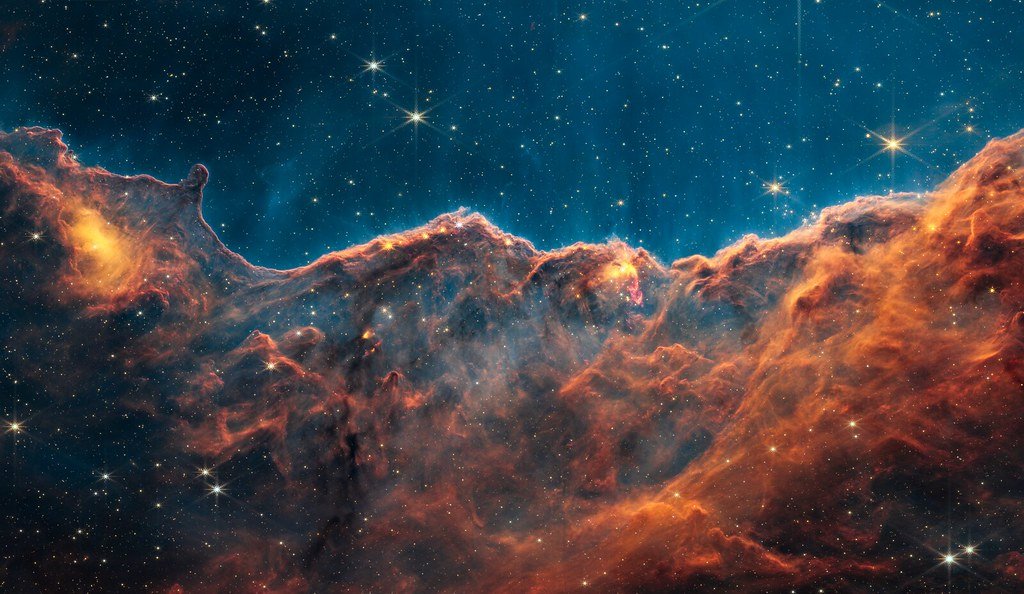
A Crystal-Clear View of Cosmic Construction (Image Credits: Flickr)
In the Taurus star-forming region, some 525 light-years from Earth, a young protostar named IRAS 04302+2247 harbors a protoplanetary disk teeming with the raw materials of future worlds. The James Webb Space Telescope recently captured the sharpest images yet of this edge-on disk, offering astronomers unprecedented insights into how tiny dust grains coalesce into massive planets. These observations pierce through the obscuring veil of gas and dust, revealing dynamic processes that shape planetary systems across the galaxy.
A Crystal-Clear View of Cosmic Construction
Astronomers have long puzzled over the swift transformation of microscopic dust into thousand-mile-wide planets, a process that unfolds in mere millions of years. JWST delivered the clearest glimpse to date with its infrared eyes trained on IRAS 04302+2247’s disk, which spans about 40 billion miles – over five times Neptune’s orbital diameter. The disk appears as a dark vertical band slicing through glowing reflection nebulae, its width holding steady across multiple wavelengths.
This stability suggests a uniform distribution of intermediate-sized dust grains, roughly 10 microns across, far larger than the sub-micron particles that initially populate such disks. Earlier telescopes struggled with the dust and gas that block visible light, but JWST’s sensitivity changes that equation entirely.
Tracing the Growth of Building Blocks
Dust grains in protoplanetary disks represent the starting point for planet formation, aggregating amid swirling gas around newborn stars. Around IRAS 04302+2247, a Class I protostar weighing 1.6 times our Sun’s mass, these grains have already reached sizes that hint at ongoing clumping. The disk’s structure, embedded in the L1536 dark cloud, showcases how material concentrates and moves outward from the central star.
Reflection nebulae flanking the disk scatter light from the hidden protostar, with the eastern side shining brighter at shorter infrared wavelengths and the western dominating at 21 microns. This wavelength-dependent glow points to subtle variations in dust properties or disk orientation, fueling aggregation into larger bodies.
JWST’s Infrared Arsenal in Action
The Near-InfraRed Camera (NIRCam) and Mid-InfraRed Instrument (MIRI) combined forces to image the disk at five wavelengths from 2.0 to 21 microns. These observations not only map the disk’s extent but also compare directly with Hubble Space Telescope data from 25 years prior. A prominent dust knot shifted roughly 16 astronomical units in that time, racing away at about 6,700 miles per hour.
Such motion underscores the disk’s dynamism, where features evolve rapidly and challenge static models of growth. By resolving fine details invisible to previous instruments, JWST bridges gaps in our understanding of how dust scales up efficiently.
| Wavelength (microns) | Key Observation |
|---|---|
| 2.0 – shorter IR | Eastern nebula brighter |
| 21 | Western nebula dominates |
| All observed | Consistent disk width |
Unraveling the Speed of Planet Birth
Planet formation demands extraordinary efficiency, as disks around most young stars dissipate within a few million years. Yet the leap from micron-scale dust to planetesimals remains a theoretical hurdle, with sticking mechanisms and turbulence playing key roles. IRAS 04302+2247’s disk provides a textbook example, its edge-on perspective ideal for gauging thickness and density.
Face-on disks reveal rings and gaps from emerging planets, but edge-on views like this one excel at exposing vertical structure and grain evolution. The dust knot’s trek suggests outward flows that concentrate material, potentially seeding pebble-sized aggregates and beyond. These findings echo remnants in our own solar system, like the Kuiper Belt.
- Dust grains grow from microns to 10-micron intermediates rapidly.
- Disk spans 40 billion miles with stable width across wavelengths.
- Dust knot moved 16 AU in 25 years at high speed.
- Reflection nebulae vary by wavelength, hinting at tilt or composition.
- Edge-on view measures density crucial for growth models.
Key Takeaways
- JWST’s infrared resolution reveals dust dynamics invisible before.
- Protoplanetary disks like IRAS 04302+2247’s operate efficiently galaxy-wide.
- Movements and structures challenge and refine formation theories.
These JWST images not only illuminate one disk’s story but also refine models for countless planetary nurseries. As observations accumulate, the galaxy’s planet-building blueprint sharpens, reminding us that worlds emerge from humble dust amid cosmic churn. What surprises might the next disk reveal? Share your thoughts in the comments.