High-Velocity Winds Captured in Neon Glow (Image Credits: Flickr)
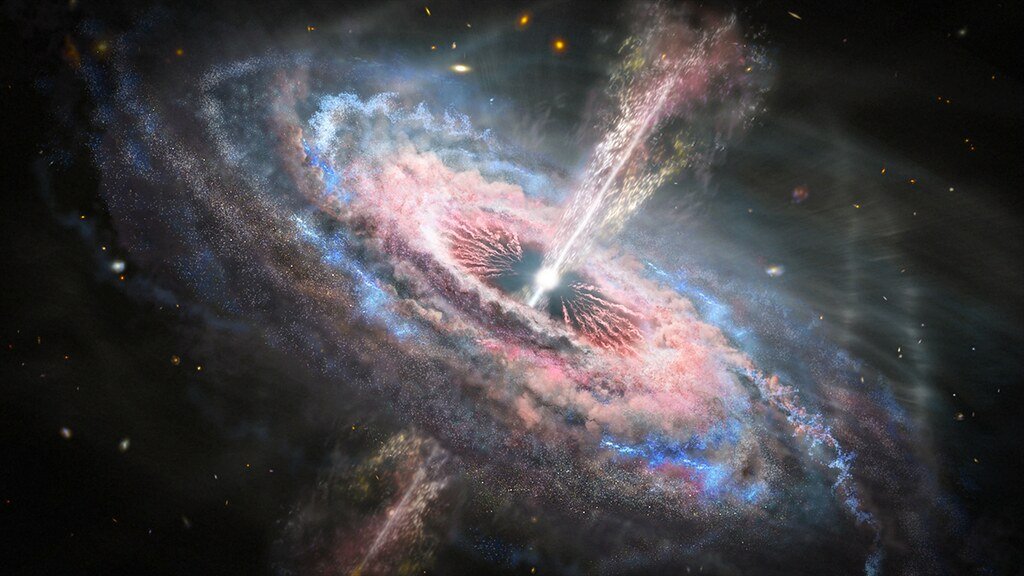
Astronomers using the James Webb Space Telescope detected powerful outflows of highly ionized neon gas reaching speeds of nearly 4000 kilometers per second in two ultraluminous infrared galaxies, revealing how active galactic nuclei launch winds that suppress star formation and curb black hole growth.[1][2]
High-Velocity Winds Captured in Neon Glow
Researchers identified outflows with a velocity at the 90th percentile, v90, around 4000 km/s, traced by emission lines from highly ionized neon such as [Ne VI]. These blueshifted features appeared in nuclear spectra from both galaxies, with velocities increasing alongside ionization potential.
The James Webb Space Telescope’s Mid-Infrared Instrument Medium-Resolution Spectrometer provided the data, covering wavelengths from 4.9 to 27.9 microns across short, medium, and long gratings. Spectral resolution reached 30 to 85 km/s, allowing precise kinematic measurements after pipeline processing with version 1.15.1.[1]
In one galaxy, F05189-2524, a biconical outflow extended outward up to about 2 kiloparsecs, showing median velocities around 1000 km/s in neon lines from [Ne III] to [Ne VI]. Flux-weighted means ranged from 500 to 810 km/s, with extent decreasing for higher ionization.
Spotlight on Ultraluminous Infrared Powerhouses
The study targeted F11119+3257 at redshift 0.19 and F05189-2524 at redshift 0.043, both classified as ultraluminous infrared galaxies with bolometric luminosities exceeding 1012 solar luminosities. Each hosted nuclear X-ray ultra-fast outflows and kiloparsec-scale molecular outflows detected previously.
F11119+3257 powered 71 percent of its output from its active galactic nucleus, with a bolometric luminosity near 1046.3 erg/s. Its counterpart, F05189-2524, drew 69 percent AGN contribution at about 1045.8 erg/s. Star formation rates measured 6 plus or minus 2 solar masses per year in the first and 4 plus or minus 2 in the second, derived from 11.3-micron PAH emission.[1]
| Galaxy | Redshift | Lbol (erg/s) | AGN Fraction | SFR (M⊙/yr) |
|---|---|---|---|---|
| F11119+3257 | 0.19 | ∼1046.3 | 71% | 6 ± 2 |
| F05189-2524 | 0.043 | ∼1045.8 | 69% | 4 ± 2 |
Unraveling AGN-Driven Feedback
Both galaxies displayed a deficit of rotational molecular hydrogen lines within 1 kiloparsec of their central quasars, up to 100 times weaker than ionized lines. This pointed to radiative feedback from the active galactic nuclei heating the gas and inhibiting molecular formation essential for stars.
No evidence emerged of molecular gas entrainment in the quasar-driven outflows. Energetic calculations showed warm ionized gas supplied just 0.1 to 5 percent of the total momentum outflow rate, leaving prior assessments intact.[2]
- [Ne II] at 12.81 μm: Lower ionization, broader distribution.
- [Ne III] at 15.56 μm: Mid-level ionization, outflow signatures.
- [Ne V] at 14.32 μm: Higher ionization, blueshifted peaks.
- [Ne VI] at 7.65 μm: Highest ionization, v90 ∼4000 km/s.
Momentum rates aligned with conservation models, where UFO momentum near 6 Lbol/c in F11119+3257 and 3 Lbol/c in F05189-2524 extended to kiloparsec scales.
Shaping Galaxies Through Powerful Expulsions
These observations confirmed active galactic nuclei generate momentum-driven winds that quench star formation by clearing nuclear gas reservoirs. Escape velocities of 330 to 390 km/s meant roughly 90 percent of outflow mass likely fled the galaxies.
The findings reinforced connections between nuclear ultra-fast outflows and large-scale winds, with warm phases carrying minimal energetics but tracing high-velocity components. Stratified outflows showed higher speeds and ionization along the axis.[3]
Key Takeaways
- 4000 km/s outflows in neon lines demonstrate AGN wind power.
- Molecular hydrogen deficit signals radiative quenching of star formation.
- Momentum-conserving model holds, with warm gas minor contributor.
Supermassive black holes thus actively regulate their host galaxies’ evolution, balancing growth through feedback that prevents excessive star birth. What role do you see these winds playing in the universe’s grand structure? Share your thoughts in the comments.