
PhD-Led Observations Capture Historic Data (Image Credits: Unsplash)
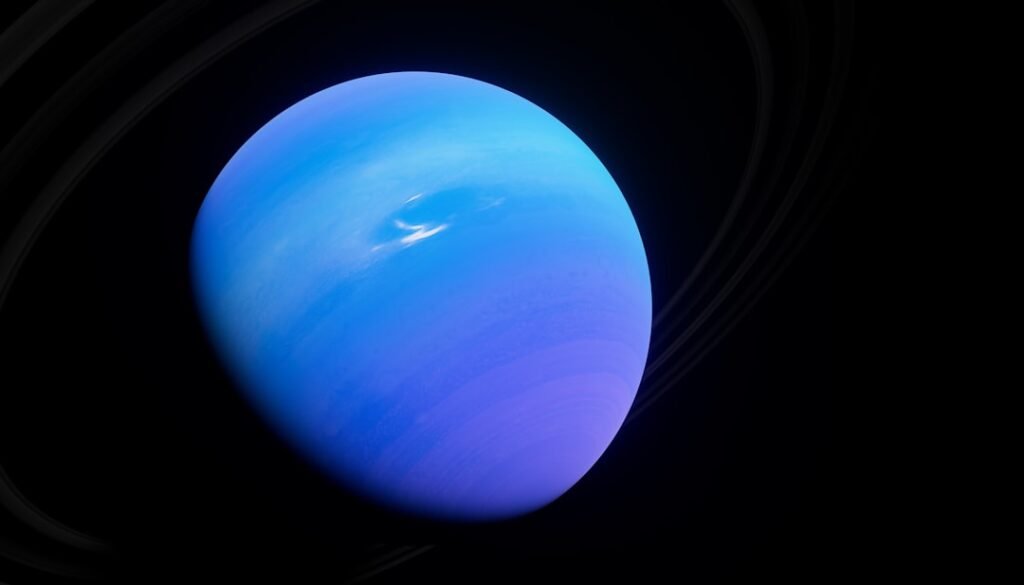
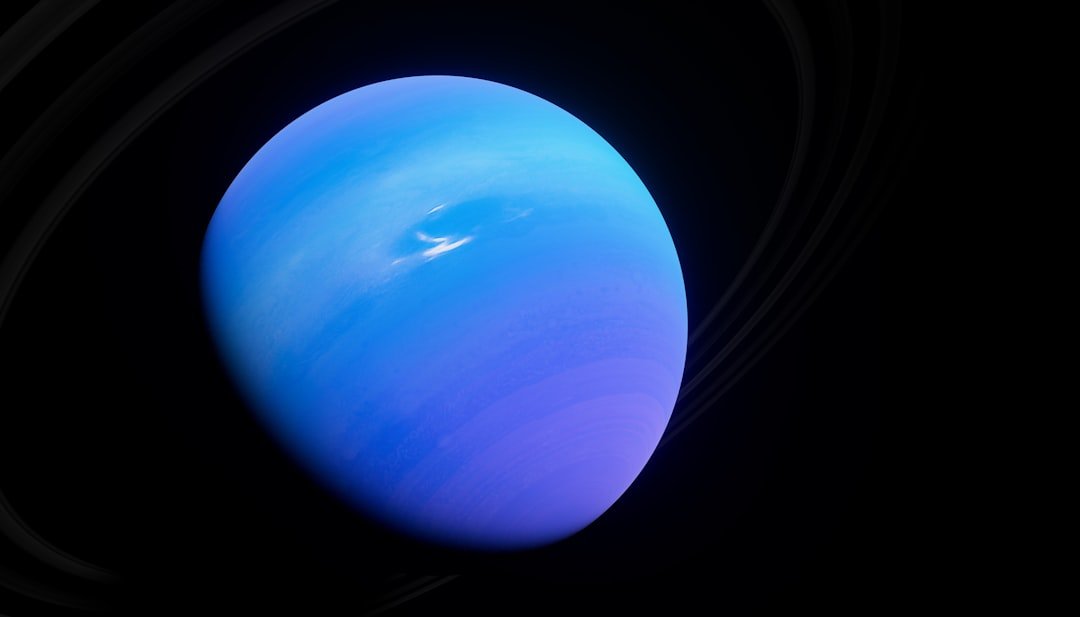
Astronomers produced the first three-dimensional map of Uranus’s upper atmosphere with the James Webb Space Telescope, exposing the profound influence of the planet’s skewed magnetic field on its vivid auroras.[1][2]
PhD-Led Observations Capture Historic Data
Paola Tiranti, a PhD student at Northumbria University in the United Kingdom, spearheaded an international team that targeted Uranus on January 19, 2025. The group utilized the James Webb Space Telescope’s Near-Infrared Spectrograph with its Integral Field Unit for 15 hours, capturing nearly a full rotation of the distant ice giant. This effort yielded faint emissions from molecules as high as 5,000 kilometers above the cloud tops.[1]
The data formed the basis of a study published February 19, 2026, in Geophysical Research Letters. Researchers mapped the ionosphere, where solar radiation ionizes gases and magnetic interactions intensify. Tiranti noted, “This is the first time we’ve been able to see Uranus’s upper atmosphere in three dimensions.” Such precision marked a leap beyond prior ground-based or Voyager-era glimpses.[3]
Uranus’s Peculiar Magnetic Field Takes Center Stage
Uranus possesses one of the Solar System’s most bizarre magnetospheres, tilted nearly 60 degrees from its rotation axis and offset from the planetary center. Charged particles trapped in this field collide with atmospheric gases, sparking auroras thousands of kilometers aloft. The JWST observations pinpointed two bright auroral bands hugging the magnetic poles, separated by a zone of diminished emission and ion density.[2]
This depleted region echoed features at Jupiter, where field line geometry channels particle flows. On Uranus, the lopsided configuration drove auroras to sweep unpredictably across the globe. Tiranti explained, “With Webb’s sensitivity, we can trace how energy moves upward through the planet’s atmosphere and even see the influence of its lopsided magnetic field.” The mapping revealed longitudinal variations tied directly to these magnetic intricacies.[1]
Vertical Profiles Reveal Temperature Peaks and Cooling Trend
Temperatures in the upper atmosphere crested between 3,000 and 4,000 kilometers above the clouds, while ion densities maximized near 1,000 kilometers. An average temperature of 426 kelvins – roughly 153 degrees Celsius – emerged from the analysis, cooler than earlier estimates from telescopes or spacecraft. This finding extended a puzzling cooling pattern observed since the early 1990s.[4]
Scientists puzzled over the persistent chill despite Uranus’s great distance from the Sun. The JWST results offered the sharpest vertical profiles yet, highlighting weaker-than-expected ion densities overall.
| Altitude (km above clouds) | Key Feature |
|---|---|
| ~1,000 | Peak ion density |
| 3,000–4,000 | Peak temperatures |
| Up to 5,000 | Faint molecular glow detected |
Broader Insights for Ice Giants and Exoplanets
The breakthrough illuminated energy dynamics in ice giant atmospheres, where circulation and external inputs balance heat. Northumbria’s Dr. Henrik Melin, principal investigator for the JWST program, oversaw observations that built on prior work at Jupiter, Saturn, and Neptune. Such data refined models of how these worlds retain or shed energy.[3]
Tiranti emphasized the wider reach: “By revealing Uranus’s vertical structure in such detail, Webb is helping us understand the energy balance of the ice giants. This is a crucial step towards characterising giant planets beyond our Solar System.”[2]
- First 3D ionosphere map via JWST NIRSpec.
- Confirmed auroral bands and magnetic depletions.
- Ongoing atmospheric cooling validated.
- Enhanced grasp of particle-magnetic interactions.
- Foundation for exoplanet atmosphere studies.
Key Takeaways
- Uranus’s tilted magnetic field sculpts unique auroral patterns visible up to 5,000 km high.
- Temperatures average 426 K, peaking midway in the ionosphere amid decades of cooling.
- Findings bridge Solar System ice giants to distant exoworlds.
This pioneering map not only demystifies Uranus’s elusive glow but also equips astronomers to probe similar worlds farther afield – what secrets might JWST unlock next on these frozen frontiers? Share your thoughts in the comments.