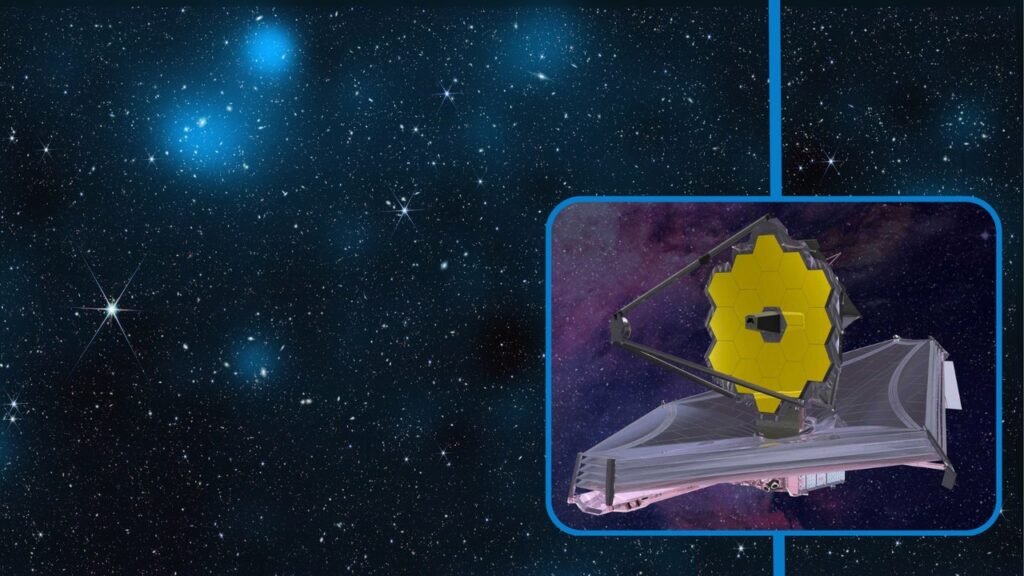

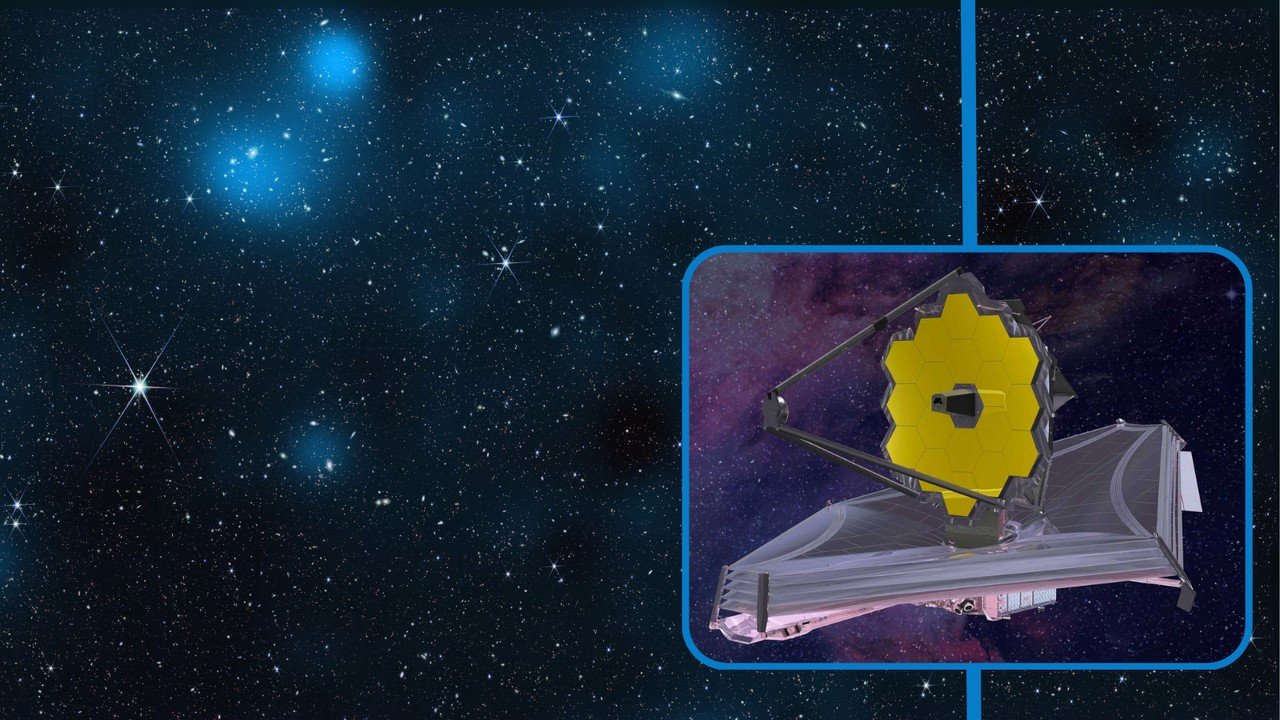
Gravitational Lensing Reveals Hidden Mass (Image Credits: Cdn.mos.cms.futurecdn.net)
NASA’s James Webb Space Telescope has delivered a groundbreaking view of the universe’s invisible scaffolding through its observations of nearly 800,000 galaxies.[1][2]
Gravitational Lensing Reveals Hidden Mass
Researchers relied on the subtle distortions caused by dark matter’s gravity to construct this intricate map. Dark matter, which neither emits nor absorbs light, exerts a powerful gravitational pull that bends spacetime itself. Light from distant galaxies passing through these warped regions undergoes weak gravitational lensing, creating faint but measurable distortions. The James Webb Space Telescope’s Near-Infrared Camera captured this 0.54-square-degree patch in the constellation Sextans over 255 hours of observation.[1]
Brighter blue regions in the resulting overlay denote higher concentrations of dark matter. This approach allowed scientists to infer the distribution of this elusive substance without direct detection. Previous efforts depended on similar techniques but lacked the telescope’s sensitivity and resolution.
Surpassing Hubble’s Legacy
The new map marked a significant leap forward from a 2007 analysis using Hubble Space Telescope data from the same sky region. Webb’s image included twice as many galaxies as Hubble’s and ten times more than those from ground-based telescopes. It uncovered previously unseen clumps of dark matter and offered sharper details overall.[1]
| Observatory | Galaxy Count | Key Advantage |
|---|---|---|
| Hubble (2007) | ~400,000 | Established baseline map |
| Webb (2026) | Nearly 800,000 | Higher resolution, new clumps |
These improvements stemmed from Webb’s advanced instruments, which pierced deeper into cosmic dust and resolved fainter objects.
Role in the COSMOS Project
The observations formed part of the Cosmic Evolution Survey, or COSMOS, a long-term effort imaged by at least 15 telescopes. This collaboration combined data to trace galaxy growth and dark matter’s influence. Webb’s Mid-Infrared Instrument refined distance measurements to thousands of galaxies, including those shrouded in dust.[1]
Only Hubble and Webb contributed dark matter maps within COSMOS so far. Ground and space telescopes provided complementary wavelengths for a fuller picture. The full COSMOS field spans 2 square degrees, roughly ten times the full moon’s size.
Probing the Universe’s Foundations
Dark matter’s gravitational effects shape galaxy formation and cluster evolution, yet its nature remains one of cosmology’s greatest puzzles. This map highlighted dense halos enveloping galaxies and clusters. Scientists anticipate it will refine models of cosmic structure formation.
Future surveys with Webb promise even broader coverage and precision. Enhanced understanding could reveal dark matter’s particle properties or alternative theories.
Key Takeaways
- Webb mapped dark matter via weak lensing from 800,000 galaxies in Sextans.
- Map shows twice the galaxies of Hubble’s, with new high-density clumps.
- Part of COSMOS survey; MIRI aided dusty galaxy distances.
This unprecedented dark matter portrait underscores Webb’s power to illuminate the cosmos’s hidden architecture. As analysis continues, it paves the way for deeper insights into the universe’s evolution. What surprises might the next cosmic map reveal? Share your thoughts in the comments.