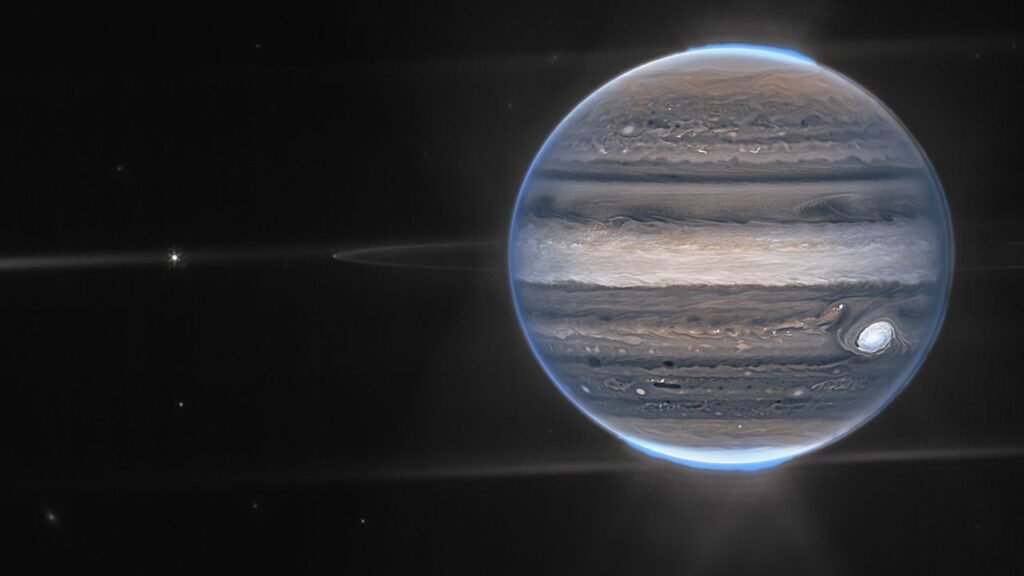


A Chilling Discovery Amid the Heat (Image Credits: Cdn.mos.cms.futurecdn.net)
Observations from the James Webb Space Telescope have exposed cold, dense imprints left by Jupiter’s moons in the planet’s intense auroral displays, revealing complexities long hidden from view.[1][2]
A Chilling Discovery Amid the Heat
Researchers captured a startling cold spot within the auroral footprint linked to Io during a series of JWST snapshots. Temperatures there plunged to 538 Kelvin, or 265 degrees Celsius, compared to the surrounding aurora’s steady 766 Kelvin, equivalent to 493 degrees Celsius.[1] This unexpected chill marked the first time scientists measured such physical properties directly in these moon-induced features.
The footprint also showed material three times denser than in Jupiter’s main aurora. Particularly notable were concentrations of the trihydrogen cation, H₃⁺, which reached levels three times higher overall and varied by up to 45 times across tiny regions.[2] These findings emerged from infrared spectral data, offering unprecedented insights into the upper atmosphere.
Moons’ Magnetic Dance with Jupiter
Jupiter’s four Galilean moons – Io, Europa, Ganymede, and Callisto – interact constantly with the planet’s powerful magnetic field. As they orbit, they disrupt surrounding plasma, accelerating charged particles along field lines into the atmosphere to produce bright auroral spots known as footprints.[1]
Io stands out due to its volcanic eruptions, which eject roughly 1,000 kilograms of material per second into space. This feeds a plasma torus that generates strong electrical currents, fueling some of the brightest auroral activity in the solar system.[1] Europa’s footprint, observed alongside Io’s, highlighted similar but distinct patterns during the 22-hour JWST session in September 2023.
Rapid Shifts Challenge Expectations
Extreme variability defined the observations. While four snapshots showed typical conditions, the fifth revealed the cold spot, with changes in temperature and density unfolding over mere minutes.[2] Lead researcher Katie Knowles of Northumbria University noted, “We found extreme variability in both temperature and density within Io’s auroral footprint that happened on the timescale of minutes. This tells us that the flow of high-energy electrons crashing into Jupiter’s atmosphere is changing incredibly rapidly.”[1]
Such dynamics contrast with Earth’s auroras, driven mainly by solar wind. Jupiter’s rotate every 10 hours, outpacing Io’s 42.5-hour orbit and creating a turbulent environment.[1]
The team detailed these results in a study published March 3, 2026, in Geophysical Research Letters.[1]
Implications for Giant Worlds
These revelations open doors to studying moon-planet interactions across the solar system. Similar footprints appear at Saturn from Enceladus, suggesting rapid atmospheric responses may be common among gas giants.[2]
Knowles emphasized the breakthrough: “For the first time, we’ve now been able to describe the physical properties of the auroral footprints – the temperature of the upper atmosphere and the ion density, which has never been reported on before.”[1] Follow-up observations with NASA’s Infrared Telescope Facility in January 2026 aim to track how these features evolve.
Key Takeaways
Jupiter’s auroras, the solar system’s most powerful, now appear even more dynamic, shaped in real time by their moons. What secrets might future telescopes uncover next? Share your thoughts in the comments.