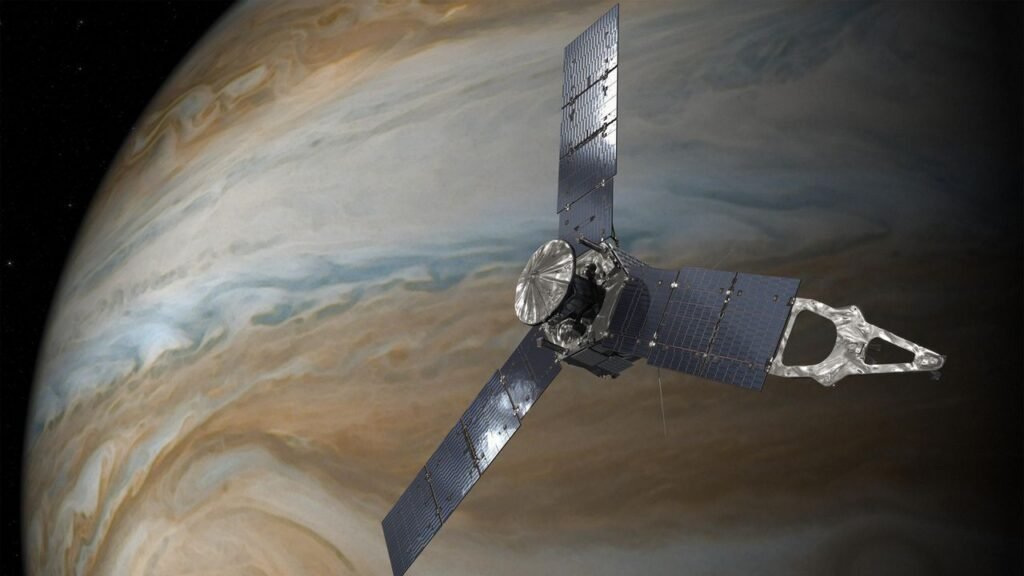

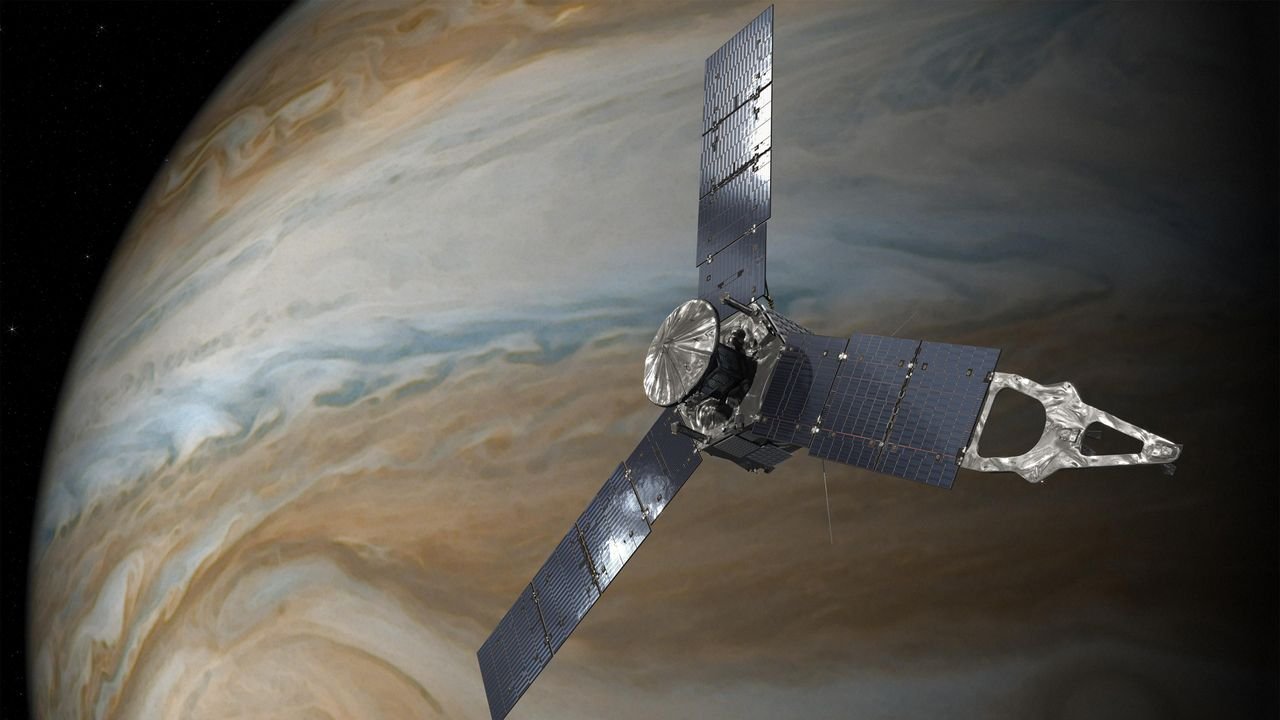
Overturning 50 Years of Data (Image Credits: Cdn.mos.cms.futurecdn.net)
Precise observations from NASA’s Juno spacecraft have revealed that Jupiter measures slightly smaller and flatter than long-accepted estimates suggested.[1][2]
Overturning 50 Years of Data
Astronomers based their understanding of Jupiter’s dimensions on just six radio measurements collected nearly five decades ago by NASA’s Pioneer 10 and 11, along with Voyager 1 and 2 spacecraft. Those flybys provided foundational data but limited precision due to their brief encounters and lack of accounting for atmospheric winds.[3] Researchers at Israel’s Weizmann Institute of Science led the charge to update this picture.
Juno, which arrived at Jupiter in 2016, gathered 26 new measurements during close passes behind the planet from Earth’s viewpoint. A 2021 mission extension shifted its orbit to enable these occultations, where radio signals bend through Jupiter’s atmosphere before vanishing.[2] This approach yielded far greater accuracy.
Tracking Signals Through the Atmosphere
The team analyzed how Juno’s radio transmissions distorted as they traversed Jupiter’s dense layers. By mapping these bends, scientists constructed detailed profiles of temperature and density down to the 1 bar pressure level, equivalent to Earth’s surface.[4]
PhD student Maria Smirnova developed techniques to process the data, revealing how zonal winds – those powerful equatorial jets – shaped prior discrepancies. Juno’s principal investigator, Scott J. Bolton, noted that these passes opened new avenues for sizing the planet precisely.[5] The results appeared in Nature Astronomy.
Key Dimensional Shifts
New figures show Jupiter’s equatorial diameter at roughly 142,976 kilometers (88,841 miles), trimming about 8 kilometers (5 miles) from earlier values. At the poles, the planet appears 24 kilometers (15 miles) flatter, enhancing its oblate spheroid profile.[1][5]
These refinements stem from correcting for atmospheric dynamics overlooked before. Here’s a breakdown of the changes:
- Equatorial radius: Reduced by approximately 4 kilometers.
- Polar radius: Flatter by 12 kilometers per pole.
- Overall oblateness: Increased, reflecting faster rotation effects.
- Measurement count: From 6 to 26 data points.
- Precision level: Down to 400 meters in each direction.
Insights into Jupiter’s Hidden Core
The updated size bolsters models of Jupiter’s interior structure. Adjusting for the new dimensions improved fits with data on density distributions, hinting at a more dilute core than once assumed.[2]
Lead researcher Yohai Kaspi emphasized that radio data pierces the clouds to expose wind depths and cyclone influences. Such details link surface storms to subsurface layers, refining theories on gas giant formation.[3] Future Juno flybys of moons will build on this foundation.
Key Takeaways:
- Juno’s 26 measurements eclipse outdated flyby data from the 1970s.
- Jupiter shrinks by 8 km equatorially and flattens by 24 km overall.
- Refinements enhance interior models and atmospheric wind analysis.
These findings underscore how ongoing missions like Juno continue to reshape our solar system knowledge, even for well-studied worlds. Textbooks may soon reflect Jupiter’s truer form. What implications do you see for other gas giants? Share your thoughts in the comments.