
A New Milestone in the Early Universe (Image Credits: Cdn.mos.cms.futurecdn.net)
NASA’s James Webb Space Telescope has pushed the boundaries of observation further than ever before by confirming a galaxy that existed mere hundreds of millions of years after the Big Bang.[1][2]
A New Milestone in the Early Universe
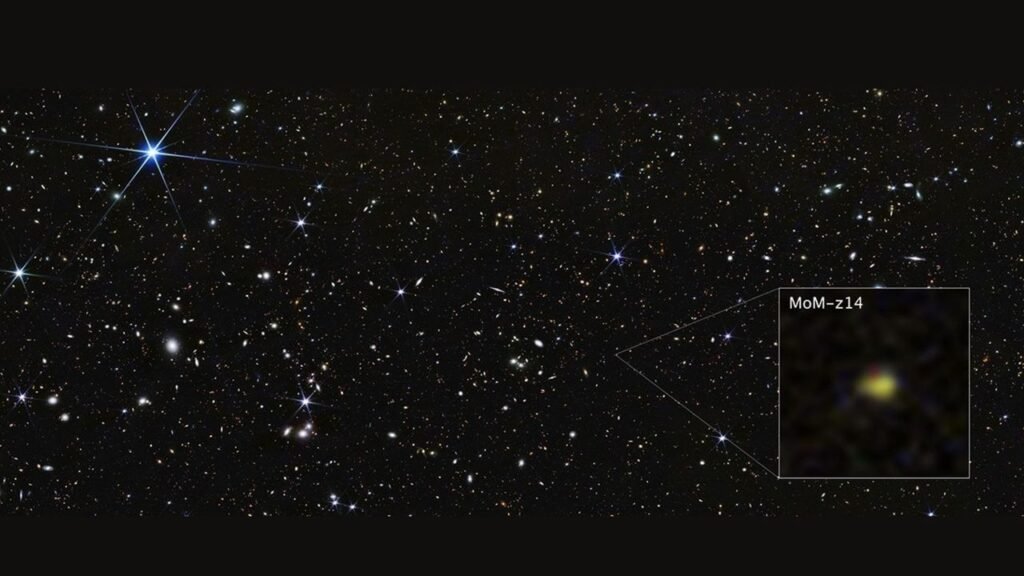
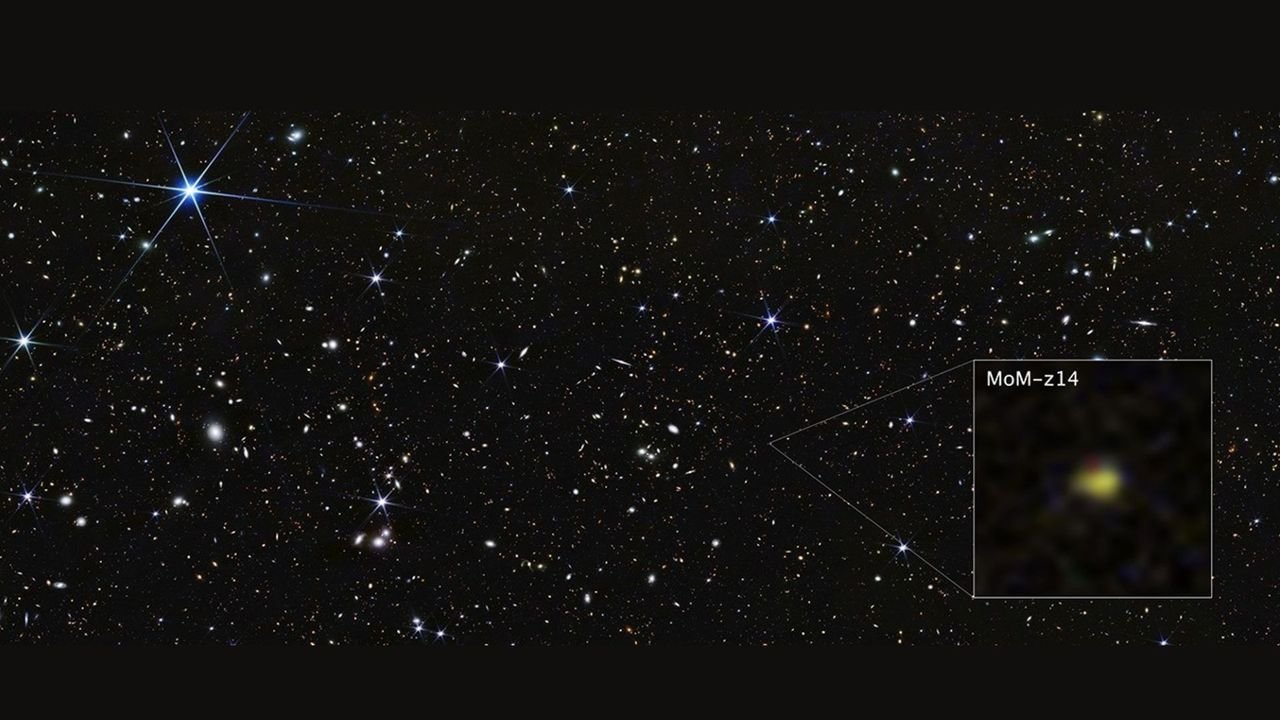
Astronomers identified the galaxy, designated MoM-z14, through detailed spectroscopic analysis that placed it at a redshift of 14.44. This measurement indicates the light from MoM-z14 traveled approximately 13.5 billion years to reach Earth, capturing the galaxy as it appeared just 280 million years after the universe’s birth.[2]
The discovery surpassed the previous record holder, JADES-GS-z14-0, which registered a redshift of 14.32. Researchers spotted MoM-z14 in existing JWST images from the COSMOS field and confirmed its extreme distance in April 2025 using the telescope’s Near-Infrared Spectrograph (NIRSpec).[1]
This finding emerged from targeted observations designed to probe cosmic dawn, the epoch when the first galaxies ignited.
Unexpected Brightness Defies Models
MoM-z14 stood out immediately due to its remarkable luminosity, shining about 100 times brighter than theoretical predictions for galaxies at such an early stage. Lead author Rohan Naidu from MIT noted, “With Webb, we are able to see farther than humans ever have before, and it looks nothing like what we predicted, which is both challenging and exciting.”[1]
The galaxy’s compactness, spanning roughly 240 light-years, further puzzled scientists. Its intense star formation suggested processes far more efficient than anticipated, hinting at the role of supermassive stars in clearing primordial hydrogen fog and aiding reionization.[2]
High nitrogen enrichment relative to carbon added to the intrigue, as this composition implied rapid chemical evolution without sufficient time for multiple stellar generations under standard models.
Key Characteristics at a Glance
- Redshift: 14.44, the highest confirmed to date.
- Age: Visible 280 million years post-Big Bang.
- Luminosity: 100 times brighter than expected for early galaxies.
- Size: Approximately 240 light-years across.
- Notable elements: Elevated nitrogen levels, signs of ionized gas emissions.
- Instruments: NIRCam for imaging, NIRSpec for spectroscopy.
These traits positioned MoM-z14 as an archetype for a growing class of luminous early galaxies that demand revisions to formation theories.[1]
Challenging Theories of Galaxy Formation
The detection highlighted a widening gap between observations and simulations. Jacob Shen, a postdoctoral researcher at MIT, observed, “There is a growing chasm between theory and observation related to the early universe.”[1]
Team members suggested that supermassive stars or other exotic mechanisms accelerated growth. Pascal Oesch from the University of Geneva, a co-principal investigator, emphasized the need for broader surveys to identify common patterns among these outliers.
Future observations with JWST and the upcoming Nancy Grace Roman Space Telescope promise to reveal more such galaxies, potentially from even earlier epochs.
Key Takeaways
- MoM-z14 redefines the observable frontier, existing closer to cosmic dawn than any prior find.
- Its brilliance and chemistry force reevaluation of early star and galaxy evolution models.
- Discoveries like this underscore JWST’s power to reshape our understanding of the universe’s infancy.
This breakthrough not only extends humanity’s gaze into the past but also invites deeper questions about the universe’s rapid maturation. What secrets will the next observation unveil? Share your thoughts in the comments.