
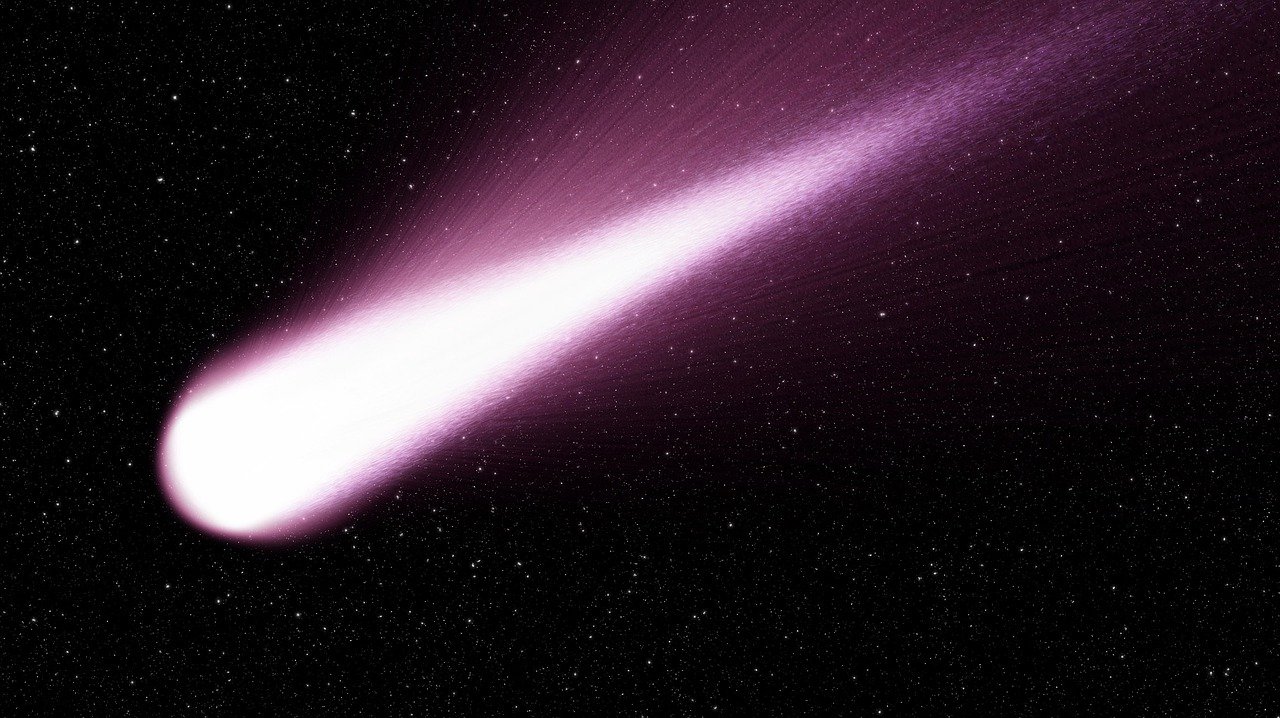
A Flurry of Activity Greets the Newcomer (Image Credits: Pixabay)
Astronomers tracked the path of 3I/ATLAS with anticipation as the rare visitor from another star system hurtled toward its solar rendezvous.[1][2]
A Flurry of Activity Greets the Newcomer
Telescopes worldwide captured the comet’s dramatic entrance into the inner solar system. Discovered on July 1, 2025, by the ATLAS survey in Chile, 3I/ATLAS quickly earned its interstellar designation as the third such object after 1I/’Oumuamua and 2I/Borisov. Its hyperbolic orbit confirmed an origin beyond our sun’s gravitational pull, with a speed of 58 kilometers per second relative to the sun.[2]
Early observations revealed a small nucleus, estimated between 0.5 and 0.7 kilometers across, surrounded by a coma of gas and dust. Activity began unusually far out, around 6.4 astronomical units from the sun, driven by sublimating ices. Ground-based and space telescopes, including Hubble and JWST, documented its evolving tail and reddish coma as it approached.[1]
Perihelion Passage Tests the Visitor’s Resilience
On October 29, 2025, 3I/ATLAS reached perihelion at 1.36 AU from the sun, accelerating to a peak speed of 68 kilometers per second. Scientists watched closely, knowing the intense heat and radiation could strip away outer layers or even disintegrate fragile comets. Yet the object held together, emerging with renewed vigor.[2]
Post-perihelion images showed a recovering tail stretching up to 100,000 kilometers, confirming structural integrity. Missions like NASA’s SPHEREx and PUNCH captured the event, noting no fragmentation. This survival provided a rare window into how interstellar bodies withstand stellar environments different from their home systems.
Post-Solar Flare-Ups Surprise Observers
Instead of fading, 3I/ATLAS brightened dramatically after its solar flyby. In December 2025, it erupted with increased gas and dust production, reaching magnitudes observable by mid-sized telescopes. NASA’s Hubble revisited it on November 30, revealing hydrogen envelopes and dynamic outbursts.[1]
Ground observations from Lowell Observatory and others documented this unexpected behavior. The flare-up hinted at fresh material exposure beneath a possibly baked outer crust, formed during its long interstellar journey or prior stellar encounters.
Chemical Clues Point to Alien Formation
Spectroscopy unlocked the comet’s most intriguing secrets: an unusually high carbon dioxide content, with a CO2/water ratio of 8, far exceeding typical solar system comets. Trace amounts of carbon monoxide, OCS, CN gas, and even atomic nickel vapor appeared in the coma.[2]
These findings suggest formation in a cold, low-metallicity protoplanetary disk beyond the CO2 frost line around another star. Depleted carbon-chain molecules further distinguished it from local comets. Key observations included:
- JWST detection of water ice grains and CO2-dominated coma in August 2025.
- Very Large Telescope identification of nickel emissions preceding cyanide.
- James Clerk Maxwell Telescope measurements of high HCN production rates.
- Hubble UV spectra showing elevated S/O ratios.
| Parameter | Value |
|---|---|
| Perihelion Distance | 1.36 AU |
| Hyperbolic Excess Speed | 58 km/s |
| Nucleus Size Estimate | 0.5-0.7 km |
| CO2/H2O Ratio | 8 |
Such data reshape models of extrasolar chemistry and volatile preservation over billions of years.
Key Takeaways
- 3I/ATLAS marks the third interstellar object, offering pristine samples from another system.
- High CO2 levels indicate formation in extreme cold, challenging comet evolution theories.
- Its survival and outbursts highlight resilience of interstellar wanderers.
As 3I/ATLAS speeds toward the outer solar system and eventual exit, it leaves astronomers with invaluable data on cosmic building blocks. This encounter underscores the solar system’s role as a natural laboratory for extraterrestrial visitors. What secrets might the next interstellar guest reveal? Share your thoughts in the comments.