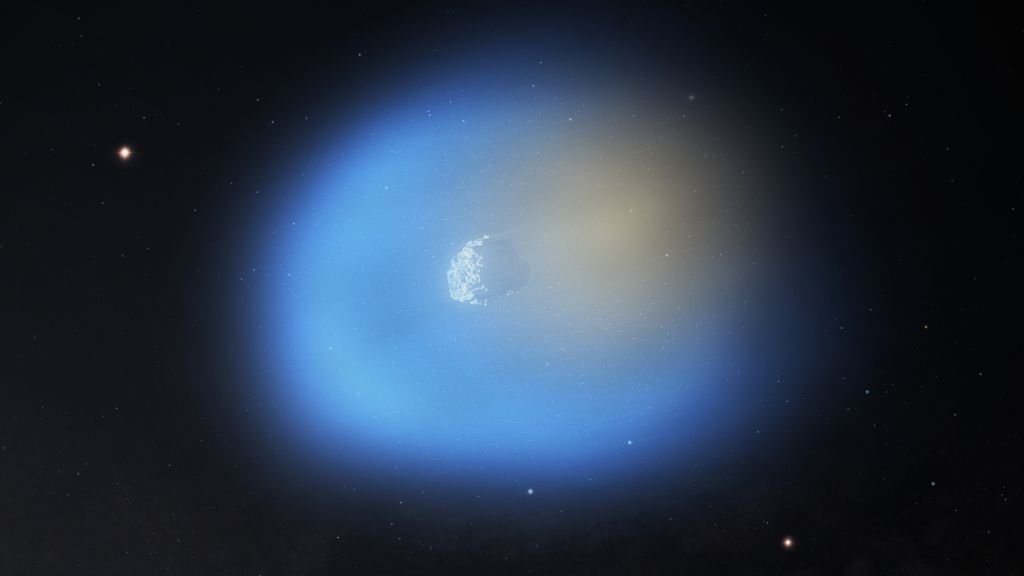
Third Visitor from Deep Space (Image Credits: Cdn.mos.cms.futurecdn.net)
Astronomers captured a chemical snapshot of the third confirmed interstellar object, 3I/ATLAS, as it hurtled through our solar system late last year.
Third Visitor from Deep Space
Only the third interstellar interloper confirmed to date, 3I/ATLAS followed in the footsteps of 1I/ʻOumuamua in 2017 and 2I/Borisov in 2019.[1][2] This rare comet traced a hyperbolic path unbound by the Sun’s gravity, approaching our star in late 2025 before speeding away at about 60 kilometers per second toward interstellar space.[3]
As sunlight warmed its icy nucleus, the object shed gas and dust, forming a bright coma that telescopes could probe for molecular clues. Earlier observations from the James Webb Space Telescope revealed a carbon dioxide-dominated atmosphere, along with traces of iron and nitrogen. These features already hinted at origins unlike those of typical solar system comets.
ALMA Peers into the Coma
Researchers turned to the Atacama Large Millimeter/submillimeter Array (ALMA) in Chile’s Atacama Desert to analyze the faint submillimeter emissions from 3I/ATLAS. Using ALMA’s Atacama Compact Array, or Morita Array, the team observed the comet on multiple dates in late 2025, just before it swung behind the Sun.[4]
The instrument detected signatures of key molecules: methanol (CH₃OH) and hydrogen cyanide (HCN). Mapping these gases across the coma allowed scientists to trace their sources – whether from the nucleus itself or from surrounding icy grains.
A Methanol Overabundance Emerges
The data stunned observers. 3I/ATLAS released methanol at ratios of about 70 to 120 times that of HCN, measured across two epochs – one of the highest enrichments ever recorded in a comet.[1] This surpassed nearly all solar system comets studied to date, exceeded only by the anomalous C/2016 R2 (Pan-STARRS).
Unlike typical comets, where HCN often dominates, methanol poured out from both the nucleus and tiny icy particles in the coma. These grains, acting like mini-comets, sublimated near the Sun, marking the first such detailed tracing in an interstellar object.[2] Professor Nathan Roth of American University, lead author of the study, remarked, “Observing 3I/ATLAS is like taking a fingerprint from another solar system. The details reveal what it’s made of, and it’s bursting with methanol in a way we just don’t usually see in comets in our own Solar System.”[4]
- Methanol-to-HCN ratio: 70–120, far above solar system norms.
- Methanol sources: Nucleus and coma ice grains.
- HCN source: Primarily the nucleus.
- Coma composition: Dominated by CO₂, with elevated iron and nitrogen.
Insights into Distant Worlds
Such extreme chemistry suggests 3I/ATLAS formed in a colder, more irradiated, or chemically distinct environment than the regions birthing our solar system’s comets. The findings, published in The Astrophysical Journal Letters, stem from observations detailed in arXiv preprint 2511.20845.
Interstellar objects like this one preserve pristine ices from their birth stars, offering direct samples of exoplanetary system building blocks. By contrasting 3I/ATLAS with local comets, scientists refine models of how volatiles mix during planet and icy body formation across the galaxy.
Key Takeaways
- 3I/ATLAS holds record-high methanol levels, challenging assumptions about comet chemistry.
- Icy grains in its coma reveal dynamic outgassing unique to interstellar visitors.
- These clues illuminate planet formation processes in other star systems.
This methanol-rich wanderer underscores the diversity of cosmic chemistry and invites further hunts for interstellar messengers. What secrets might the next one hold? Share your thoughts in the comments.