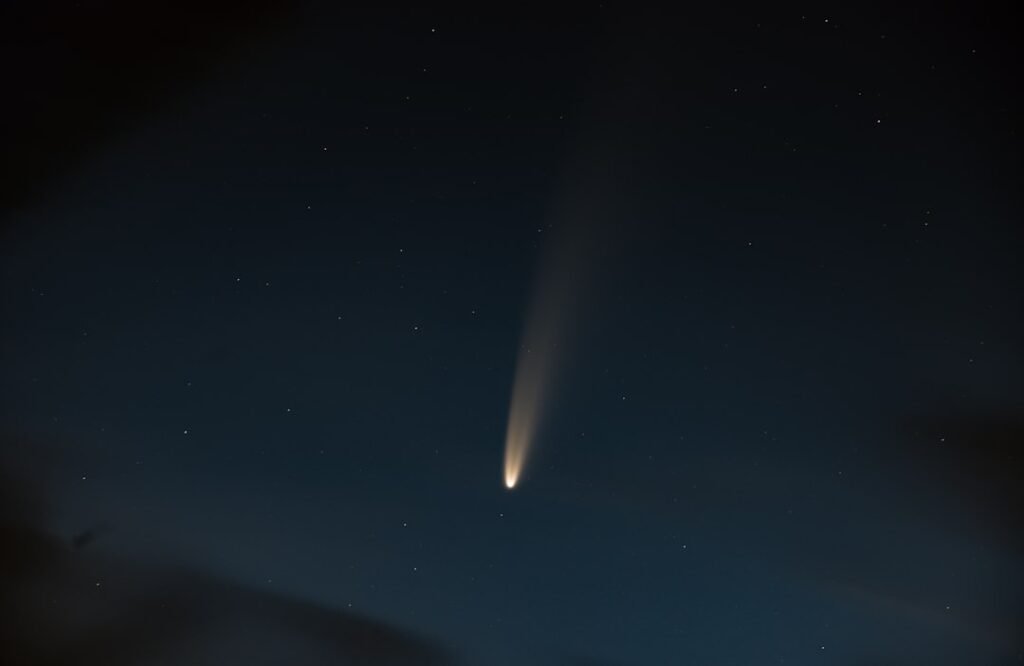

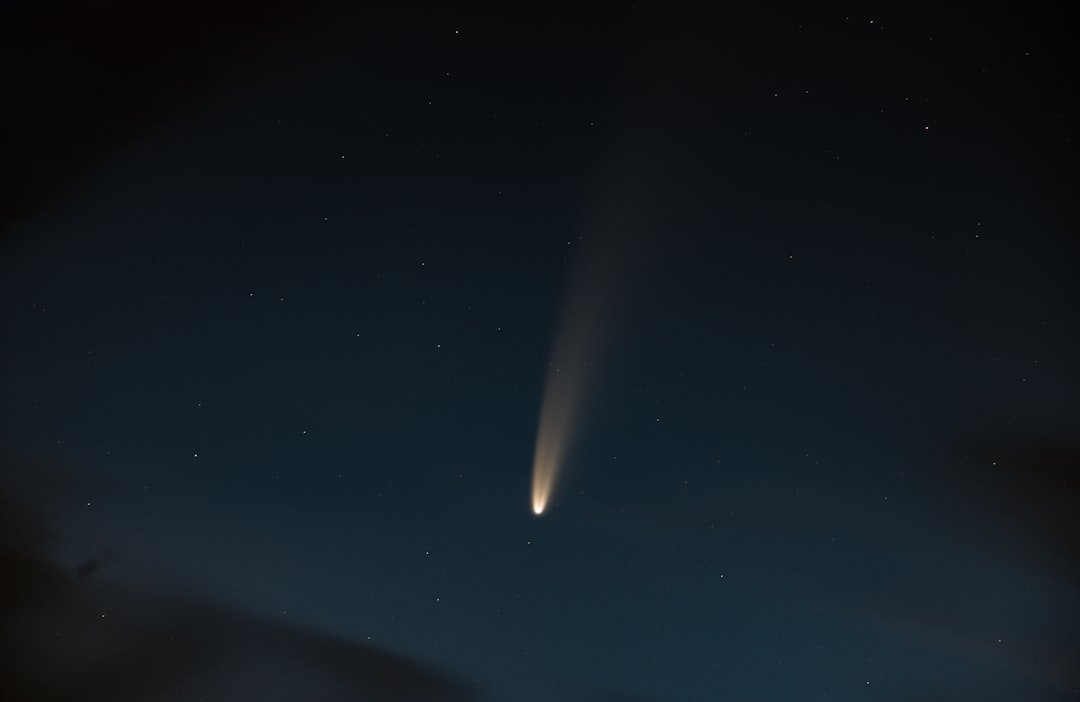
A Rapid Burst of Celestial Drama (Image Credits: Unsplash)
Late on February 9, 2026, Comet 29P/Schwassmann-Wachmann experienced a dramatic cryovolcanic outburst that boosted its brightness and transformed its appearance for skywatchers worldwide.[1]
A Rapid Burst of Celestial Drama
The comet’s magnitude surged from 13.5 to 11.5 within hours of the explosion. Observers noted a shift from a faint, diffuse patch to a compact, dense feature spanning less than 15 arcseconds. By February 13, astronomer Bob King captured it through a 15-inch telescope at magnitude 11.4, with the coma expanded to 45 arcseconds and a faint stellar pseudo-nucleus visible under high magnification.[1]
The core appeared impenetrable, surrounded by subtle jets that hinted at ongoing activity. This event follows a pattern of recent outbursts, including those in May and December 2025.[2] Such displays underscore the comet’s reputation as the solar system’s most prodigiously active cryovolcano.
Spotting the Comet in Leo
Currently positioned in southern Leo, the comet lies about 1 degree southwest of the 4.8-magnitude star 87 Leonis. It drifts slowly northwest and reaches 20 degrees altitude by 10 to 10:30 p.m. local time from mid-northern latitudes. Telescopes of 8 to 10 inches prove sufficient for most viewers, though larger apertures reveal finer details.[1]
Recent estimates place its brightness near magnitude 11.8, fading gradually as the coma expands.[3] Sky conditions and dark sites enhance the view. Star-hopping from 87 Leonis simplifies the hunt.
- Center on 87 Leonis in Leo, then move 1 degree southwest.
- Employ medium power (150x to 250x) for coma resolution.
- Use averted vision to detect the central condensation.
- Observe nightly, as morphology changes rapidly.
- Check charts from reliable sources like Sky & Telescope for precise positions.
The Mechanics of Cryovolcanic Fury
Solar heating vaporizes subsurface ices such as carbon monoxide and carbon dioxide, building pressure until the crust ruptures explosively. Material ejects at speeds up to 0.9 kilometers per second, or about 2,000 miles per hour. Unlike typical comets, 29P orbits at an average 6 astronomical units from the Sun, far from intense perihelion warmth, yet sustains dozens of outbursts annually.[1]
Minor events cause slight brightening, while major ones like this can increase luminosity by 5 magnitudes. The nearly circular 15-year orbit keeps it in a stable, temperate zone, amplifying the mystery of its perpetual volatility. Rotation every 57 days aligns with vent activity cycles: prolonged solar exposure opens fissures, which seal during frigid nights.
Expert Views on Persistent Eruptions
Dr. Richard Miles, director of the British Astronomical Association’s Asteroids and Remote Planets section, has studied these events extensively. He proposes that liquid methane, ethane, propane, and dissolved carbon dioxide form a pressurized “fizzy mix” within the nucleus. Up to half a dozen cryovolcanic vents release this brew in spectacular fashion.[1]
Miles urges continued monitoring, as follow-up outbursts often cluster after a large one. Observers have documented over a million tons of ice and dust ejected in single events, reshaping the coma into spiral or horseshoe patterns nightly.
Key Takeaways
- 29P/Schwassmann-Wachmann remains visible now in modest telescopes from Leo.
- Cryovolcanism drives its unique, frequent explosions at 6 AU.
- Expect potential additional activity soon – grab your scope while it peaks.
This latest eruption reminds astronomers of the dynamic processes shaping distant wanderers. As the comet fades, it invites reflection on the solar system’s hidden volatilities. What have you seen through your telescope lately? Share your observations in the comments.