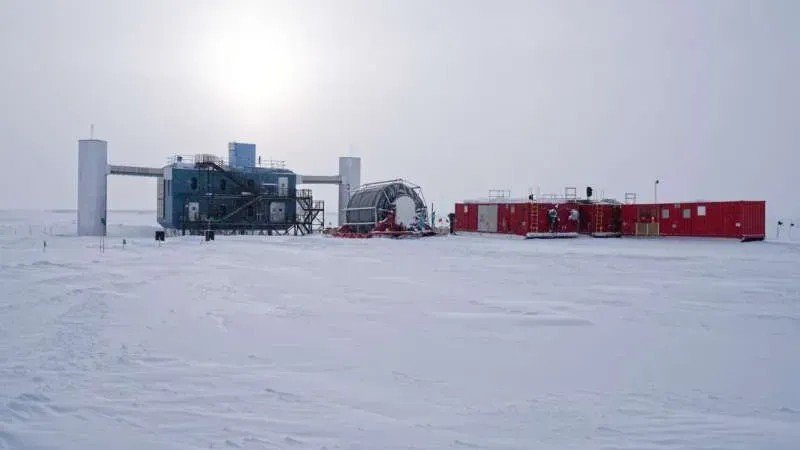

Deep beneath Antarctic ice, something extraordinary is happening. Scientists have been quietly capturing signals from the most violent events in the universe, and now they’re ready to share discoveries that could completely reshape what we thought we knew about cosmic rays and neutrinos. The IceCube Neutrino Observatory isn’t just another telescope pointing at the sky. It’s a massive detector buried under a mile of ice, designed to catch some of the most elusive particles in existence.
What makes this moment particularly exciting is the sheer volume of data researchers have accumulated. After years of patient observation, patterns are emerging that challenge conventional theories about how the universe works. The team behind IceCube has been working through countless terabytes of information, and they’re finally ready to unveil findings that could answer questions scientists have been asking for decades. Let’s dive into what makes this Antarctic research station so special and why its latest revelations matter.
The Ghost Particles That Travel Through Everything
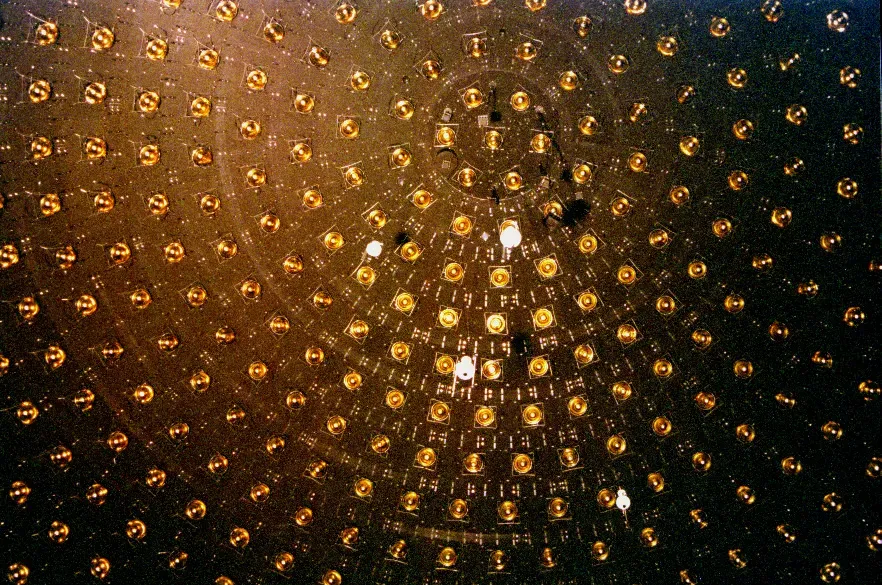
Neutrinos are genuinely bizarre. These subatomic particles pass through matter like it doesn’t exist at all. Trillions of them are streaming through your body right now as you read this, and you’ll never feel a thing. They’re born in the most extreme environments imaginable: supernova explosions, black hole jets, and the nuclear furnaces at the hearts of stars.
IceCube detects these ghost particles by watching for the faint blue flashes they create when they occasionally interact with ice molecules. It’s like trying to spot a single firefly in a stadium full of strobe lights. The detector uses more than 5,000 sensors arranged in a cubic kilometer of pristine Antarctic ice, creating the largest neutrino detector ever built. When a neutrino does interact, it produces a charged particle that moves faster than light travels through ice, creating a telltale glow called Cherenkov radiation.
Tracking Cosmic Rays Back to Their Origins
For over a century, scientists have known that Earth is constantly bombarded by cosmic rays. These high energy particles arrive from deep space, but their sources have remained frustratingly mysterious. They don’t travel in straight lines because magnetic fields throughout the galaxy bend their paths, making it nearly impossible to trace them backward to their origins.
That’s where neutrinos come in. Unlike cosmic rays, neutrinos aren’t affected by magnetic fields. They travel in perfectly straight lines from their source to Earth. IceCube’s recent observations have successfully linked specific neutrino detections to distant galaxies with active black holes at their centers. These blazars shoot jets of material across millions of light years, and now we know they’re also cosmic particle accelerators. It’s honestly mind blowing to think we can now point to a specific galaxy billions of light years away and say with confidence that’s where certain cosmic rays originated.
The Unexpected Discovery That Changed Everything
Sometimes the most important discoveries are the ones you weren’t looking for. IceCube researchers noticed something peculiar in their data. There was an excess of high energy neutrinos coming from directions that didn’t align with any known sources. These weren’t random noise or detector errors. They formed a pattern suggesting there are previously unknown objects out there pumping out neutrinos at incredible rates.
The implications are staggering. We might be detecting entirely new classes of astronomical objects, or witnessing phenomena that current theories can’t fully explain. Some scientists speculate these mystery sources could be related to dark matter interactions or exotic physics we haven’t even theorized yet. Whatever the explanation turns out to be, it’s clear the universe has been hiding secrets that IceCube is only now beginning to expose.
Peering Inside Distant Galactic Engines
Black holes at the centers of galaxies are notoriously difficult to study directly. They’re surrounded by dense clouds of gas and dust that block most light. However, neutrinos slip right through all that material without being absorbed or scattered. IceCube is essentially giving us X ray vision into the hearts of distant galaxies.
Recent observations have revealed how matter behaves in the extreme gravitational environments near supermassive black holes. The neutrinos detected by IceCube carry information about particle acceleration processes happening in regions where temperatures exceed billions of degrees and gravitational forces warp spacetime itself. This data is helping astrophysicists refine their models of how galaxies evolve and how the largest black holes influence their surroundings across cosmic time scales.
Antarctica’s Unique Advantages for Cosmic Detection
You might wonder why scientists chose one of Earth’s most inhospitable locations for this experiment. The answer is simple: Antarctic ice is incredibly pure and stable. It’s been accumulating for hundreds of thousands of years without significant contamination from dust or bubbles that would scatter light.
The sheer depth provides natural shielding from cosmic ray interference that would otherwise overwhelm the detectors. Only neutrinos can penetrate that far underground, which means the signals IceCube receives are remarkably clean. The extreme cold also helps because it reduces thermal noise in the sensitive electronics. Working in such harsh conditions presents obvious challenges, but the scientific payoff makes it absolutely worthwhile.
Expanding the Observatory’s Capabilities
IceCube isn’t resting on its accomplishments. Plans are already underway to expand the detector array significantly. The proposed IceCube Gen2 upgrade would increase the detection volume nearly tenfold, allowing researchers to catch even rarer neutrino events. This expansion will push the boundaries of what’s possible in neutrino astronomy.
New sensor technologies will also improve detection precision, helping pinpoint neutrino sources with greater accuracy. The team is developing machine learning algorithms to sift through data more efficiently, identifying subtle patterns that human analysts might miss. These upgrades represent a major investment in fundamental physics research, but they’re essential if we want to fully capitalize on IceCube’s unique position and capabilities. The next generation of discoveries is likely to be even more surprising than what we’ve seen so far.
What This Means for Future Space Science
IceCube has fundamentally changed how we observe the universe. Before neutrino astronomy, we were limited to studying the cosmos through electromagnetic radiation like visible light, radio waves, and X rays. Now we have an entirely new messenger bringing us information from the most extreme corners of existence. This opens up what scientists call multi messenger astronomy, where different types of signals are combined to create a more complete picture of cosmic events. When a supernova explodes or two black holes collide, we can now detect gravitational waves, electromagnetic radiation, and neutrinos all from the same event. It’s like going from watching a silent movie to experiencing full surround sound and 3D visuals. The discoveries announced by IceCube represent just the beginning of this new era in astronomy.
Honestly, it’s hard to overstate how exciting this moment is for physics and astronomy. IceCube has proven that we can build instruments capable of detecting the universe’s most elusive particles and extracting meaningful information from them. The findings coming out of Antarctica are reshaping textbooks and forcing scientists to reconsider assumptions that have stood for generations. We’re witnessing the birth of an entirely new way of exploring reality itself.
What strikes me most is how this research reminds us that the universe still holds profound mysteries. Despite all our technological sophistication, we’re still discovering fundamental aspects of how nature works. The neutrinos streaming through IceCube’s sensors have traveled across unimaginable distances, carrying secrets about events that occurred when the universe was vastly different than it is today. What do you think these cosmic messengers might reveal next? The possibilities seem genuinely limitless.