
A Modest Entry in Messier’s Famous List (Image Credits: Unsplash)
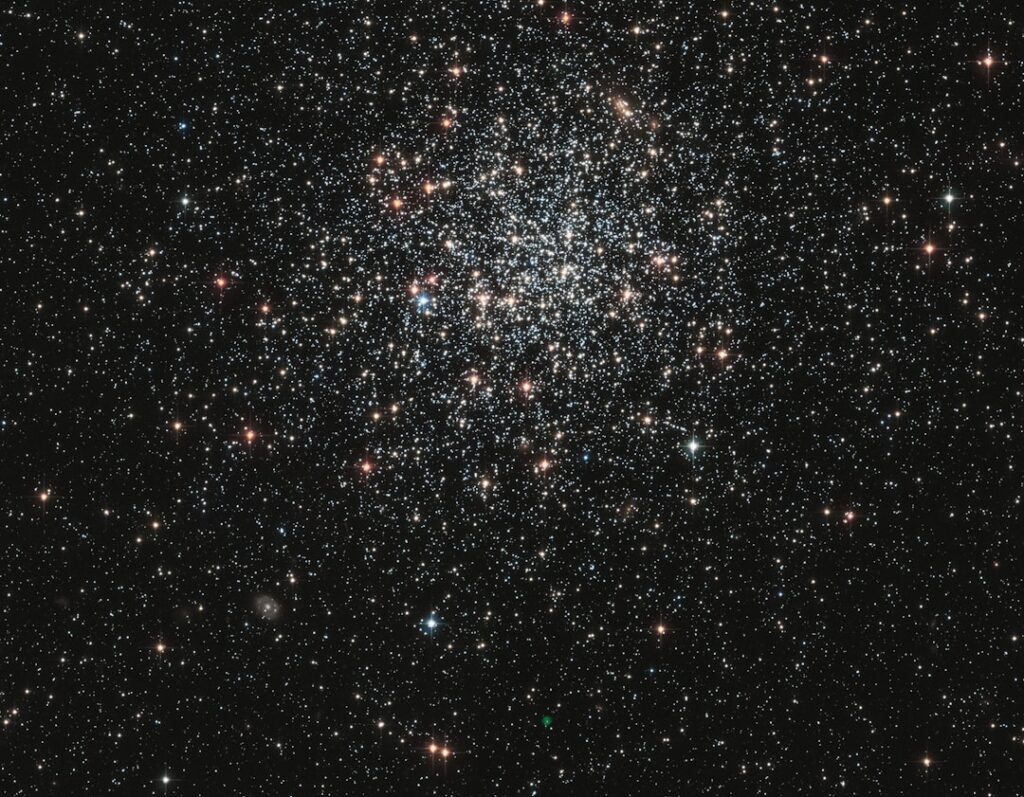
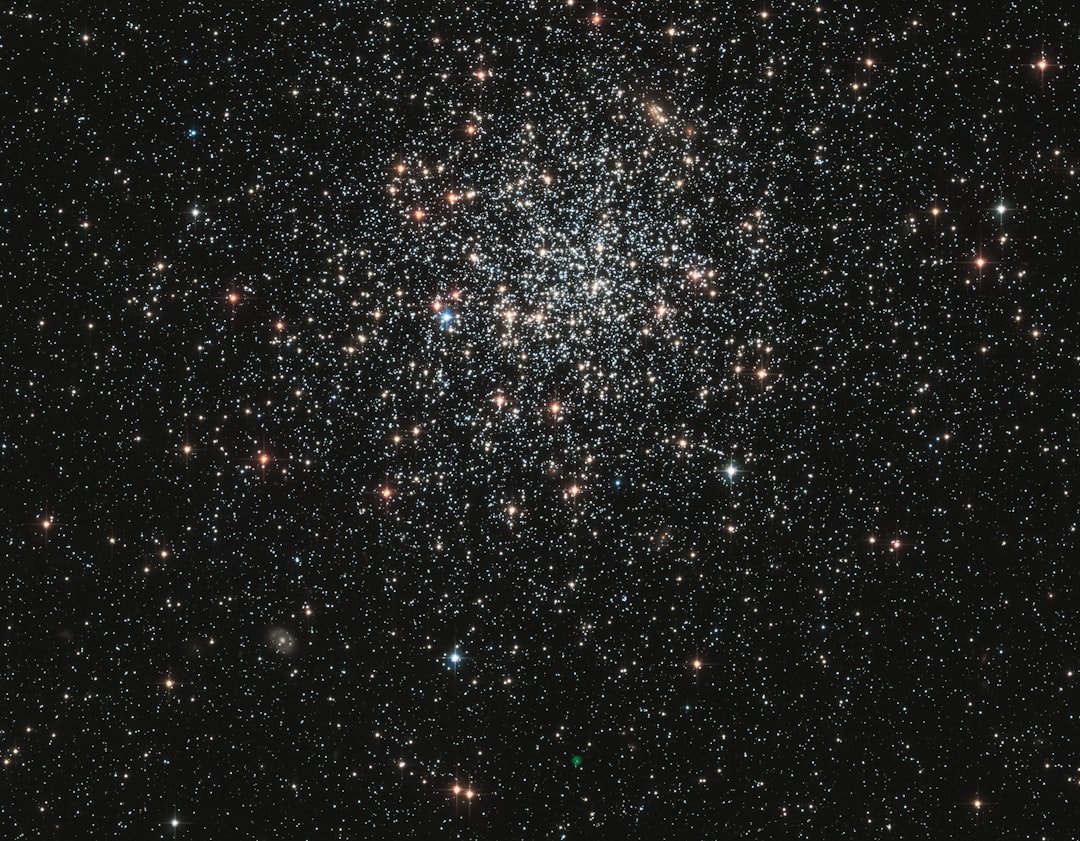
In the southwestern corner of the constellation Aquarius, globular cluster M72 emerges as a subtle beacon amid the starry expanse.[1]
A Modest Entry in Messier’s Famous List
Charles Messier cataloged M72 in the 18th century, yet it remains one of the faintest objects in his renowned compilation. At an apparent magnitude of 9.4, the cluster challenges amateur astronomers with its subdued glow. Pierre Méchain first spotted it while assisting Messier, marking it as the initial discovery in a series of five star clusters added to the list.[2]
Despite its dimness, M72 holds appeal for those equipped with larger telescopes. Observers often describe it as a hazy patch rather than a sharp pinpoint of light. This quality sets it apart from brighter Messier globulars like M13 or M22. Still, its inclusion underscores Messier’s dedication to charting deep-sky wonders.
Spanning Vast Galactic Distances
M72 resides farther from Earth than most clusters in the Messier catalog, at approximately 55,000 light-years away. This remoteness contributes to its faint appearance in earthly skies. The cluster contains around 100,000 stars packed into a spherical swarm, extending across intragalactic space.[1][3]
Measurements place it about 17 kiloparsecs from our planet and 12.9 kiloparsecs from the Milky Way’s center. With a mass equivalent to 168,000 Suns, M72 exemplifies the dense stellar environments typical of globular clusters. Its position beyond the galactic disk amplifies the journey light undertakes to reach us.[4]
Younger Than Its Peers
Estimates peg M72’s age at roughly 9.5 billion years, making it relatively youthful compared to other Milky Way globulars that often exceed 12 billion years. This discrepancy fuels speculation about its origins. Astronomers propose that the Milky Way captured M72 during an ancient close encounter with a smaller galaxy.[1]
Such events reshaped our galaxy’s structure over billions of years. Evidence for this theory lies in the cluster’s trajectory and composition. Unlike native globulars formed in the Milky Way’s early halo, M72’s path suggests an external heritage. Researchers continue to model these interactions to trace galactic evolution.
Blue Stragglers Light Up the Core
The cluster’s heart teems with blue stragglers, stars hotter and bluer than expected in a globular’s aging population. These anomalies arise from stellar mergers or mass exchanges in binary systems. Hubble observations highlight their prominence in M72’s dense central regions.[1]
Blue stragglers defy standard evolutionary paths, offering clues to dynamical processes within clusters. Their presence indicates ongoing interactions despite the cluster’s advanced age. Studies of these stars refine models of stellar collisions and rejuvenation.
| Key Characteristics | Details |
|---|---|
| Magnitude | 9.4 |
| Distance | ~55,000 light-years |
| Stars | ~100,000 |
| Age | ~9.5 billion years |
Hubble’s Advanced Observations
NASA’s Hubble Space Telescope captured M72 using ultraviolet, optical, and infrared wavelengths. This multi-spectral approach reveals details invisible to single-band imaging. The resulting data exposes the cluster’s stellar diversity and structural nuances.[1]
Earlier observations from 2012 combined with recent ones enhance our understanding. For more on the imagery, see the feature at Astronomy Magazine.
Key Takeaways
- M72 ranks among Messier’s dimmest globulars due to its great distance.
- Its youth and blue stragglers hint at a captured origin outside the Milky Way.
- Hubble’s observations across wavelengths uncover hidden stellar dynamics.
Globular cluster M72 reminds us that even faint sky objects harbor profound stories of cosmic history. As telescopes like Hubble push boundaries, such revelations deepen our grasp of the universe’s turbulent past. What draws you to deep-sky observing? Share your thoughts in the comments.