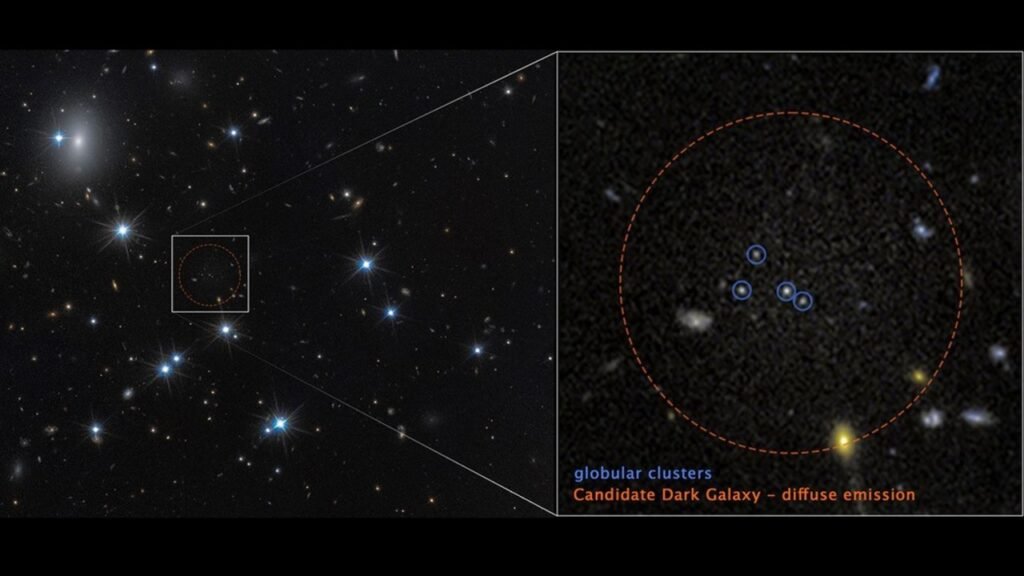

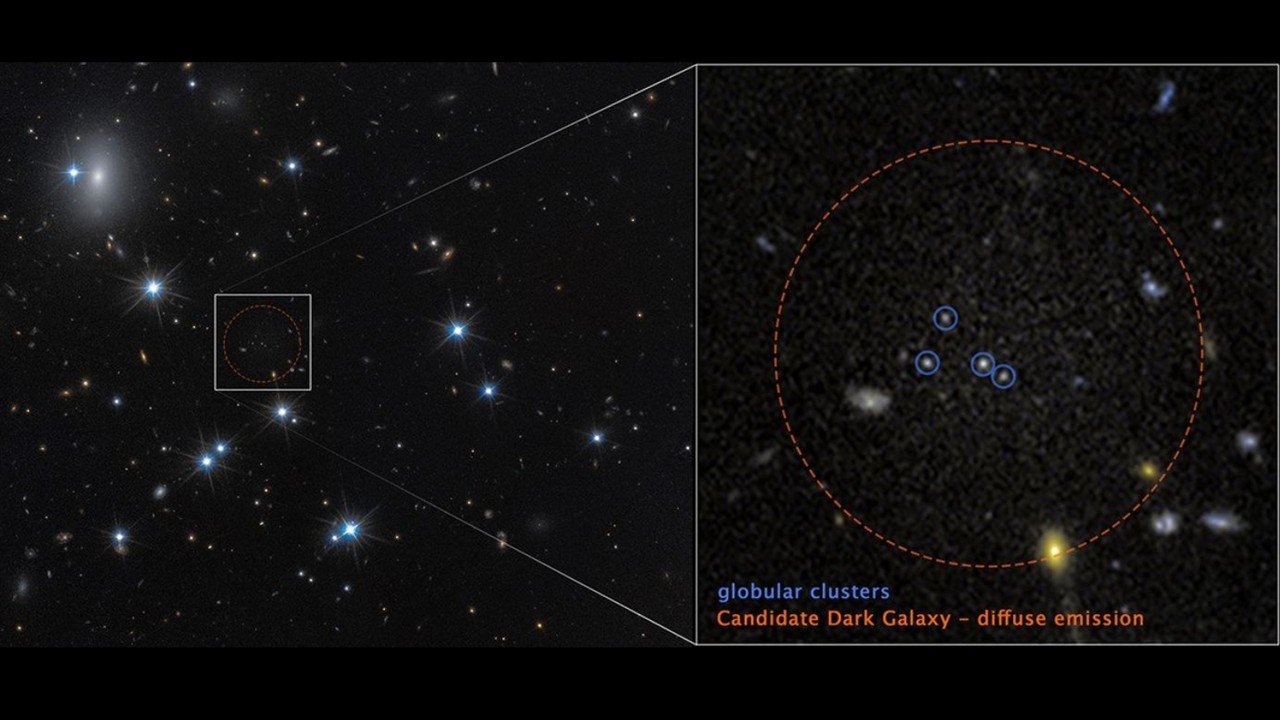
A Ghostly Presence Emerges (Image Credits: Cdn.mos.cms.futurecdn.net)
Perseus galaxy cluster astronomers recently identified a faint cosmic structure that stands out for its overwhelming dominance of invisible mass.[1][2]
A Ghostly Presence Emerges
Among the luminous giants of the universe, few objects hide as effectively as low-surface-brightness galaxies. These rare entities glow dimly, their sparse stars barely piercing the cosmic dark. Hubble’s sharp gaze pierced this veil to reveal Candidate Dark Galaxy-2, or CDG-2, lurking 300 million light-years away.[1]
The galaxy shines with the equivalent light of roughly 6 million Sun-like stars, a whisper compared to the Milky Way’s blaze. Yet its true nature lies not in visible light but in the gravitational grip that binds just four globular star clusters together. These compact stellar spheres, far fewer than the Milky Way’s 150-plus, hinted at a larger, unseen framework.[3]
Unpacking CDG-2’s Composition
Analysis showed that 99 percent of CDG-2’s total mass consists of dark matter, an invisible substance that neither emits nor absorbs light. The remaining one percent accounts for the scant visible matter, including those globular clusters that make up 16 percent of the galaxy’s luminous content. Much of its hydrogen gas, essential for star formation, likely got stripped away through gravitational tussles with neighboring galaxies in the dense Perseus cluster.[2]
Globular clusters proved resilient in this environment, their tight gravitational bonds shielding them from tidal disruption. This durability turned them into reliable beacons for astronomers hunting faint galaxies. CDG-2 represents one of the most extreme examples of dark matter dominance observed to date.[1]
The Hunt for Hidden Worlds
Astronomers led by Dayi Li of the University of Toronto employed advanced statistical methods to scan Hubble images. They sought tight groupings of globular clusters, which often trace underlying stellar populations too dim to detect directly. Hubble’s Advanced Camera for Surveys provided the high-resolution views needed to spot this quartet in the Perseus cluster.[1]
Follow-up observations bolstered the find. ESA’s Euclid space telescope confirmed a faint, diffuse glow enveloping the clusters, solidifying evidence of the galaxy itself. Ground-based data from the Subaru Telescope in Hawaii complemented these efforts. As Li noted, “This is the first galaxy detected solely through its globular cluster population.”[1]
- Hubble Space Telescope: High-resolution imaging of clusters.
- Euclid: Detection of diffuse light.
- Subaru Telescope: Supporting ground observations.
- Statistical analysis: Identified 10 confirmed low-surface-brightness galaxies and two more candidates.
Francine Marleau of the University of Innsbruck added, “The Euclid data clearly confirm the presence of the extremely faint, diffuse light of CDG-2, revealing the galaxy behind the globular clusters for the first time.”[2]
Probing Dark Matter’s Role
This discovery underscores dark matter’s pivotal role in galactic architecture. While most galaxies balance stars, gas, and dark halos, CDG-2 tips the scale dramatically toward the invisible. It offers a pristine laboratory to study how dark matter sculpts structures amid environmental pressures like those in clusters.[1]
Future surveys with telescopes like the Nancy Grace Roman Space Telescope and Vera C. Rubin Observatory promise to uncover more such phantoms. Machine learning will sift vast datasets, refining our grasp of these elusive objects. The findings appeared in The Astrophysical Journal Letters.[3]
Key Takeaways
- CDG-2 is 99% dark matter, with only four globular clusters visible.
- Located 300 million light-years away in Perseus, it evaded detection until recent multi-telescope efforts.
- Globular clusters serve as vital tracers for ultra-faint galaxies.
CDG-2 challenges astronomers to rethink faint galaxies and dark matter’s influence, potentially reshaping models of cosmic evolution. What secrets might more such discoveries unlock? Share your thoughts in the comments.