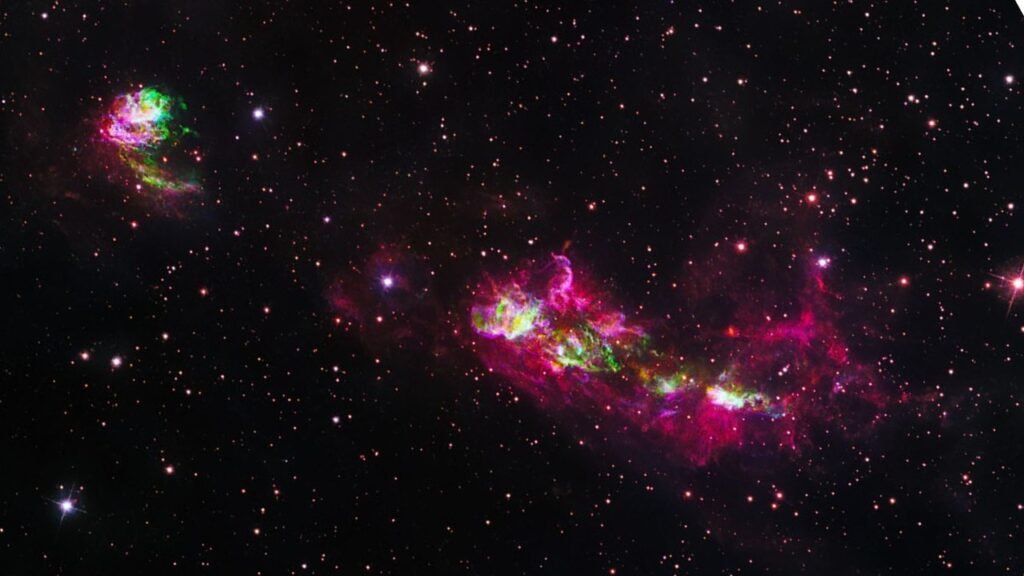

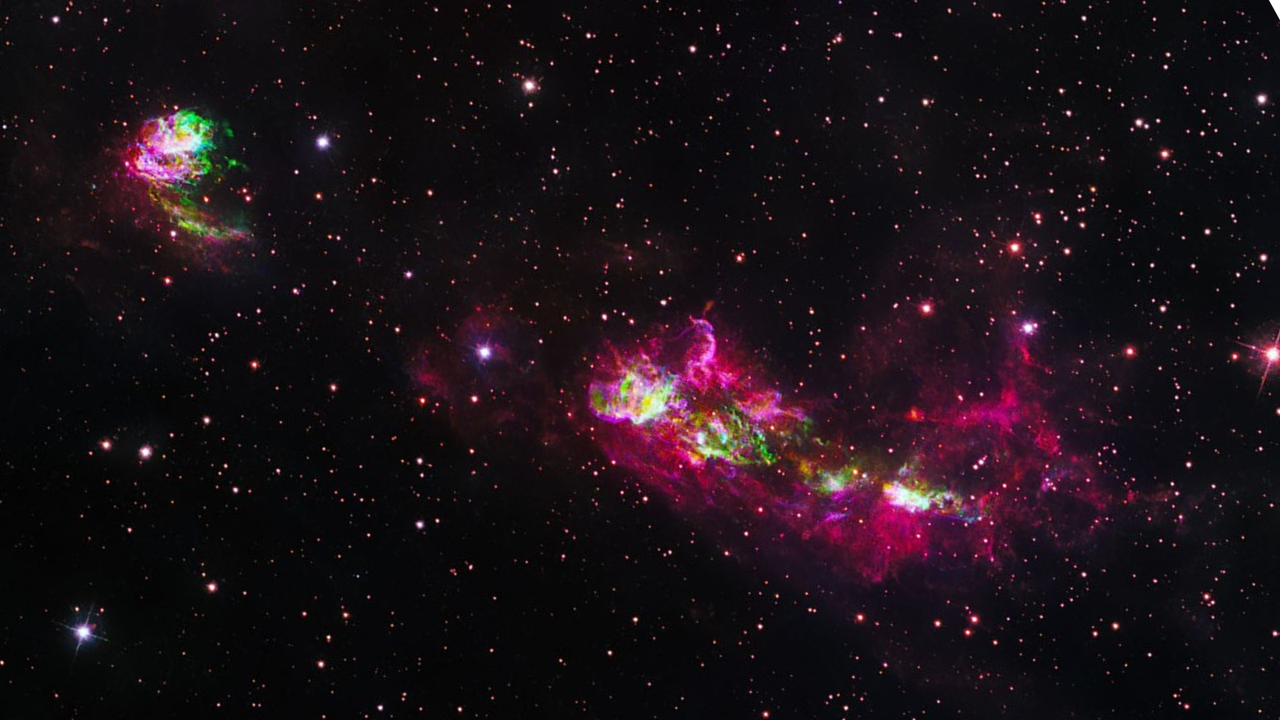
A Stellar Spectacle Unfolds (Image Credits: Cdn.mos.cms.futurecdn.net)
Astronomers have marveled at a dramatic display from a young star, where a powerful jet of superheated gas stretches an astonishing 32 light-years across space.
A Stellar Spectacle Unfolds
The Hubble Space Telescope recently captured images of what stands as the longest known outburst from a forming star, surpassing previous records in scale and intensity. This protostar, still in the early stages of its birth, ejects material at incredible speeds, carving a path through the surrounding interstellar medium. Observations show the jet originating from a massive young stellar object, with portions moving faster than 1,000 kilometers per second.
Such events highlight the violent processes that shape new stars, as gravitational forces and magnetic fields propel gas outward in focused streams. Hubble’s detailed views provide crucial data on how these outflows influence star formation in molecular clouds.
The Mechanics Behind the Jet
At the heart of this phenomenon lies a protostar drawing in vast amounts of gas and dust from its natal cloud, only to hurl some back out in bipolar jets. These ejections occur along the star’s rotational axis, driven by the interplay of accretion disks and strong magnetic fields that accelerate the material. In this case, the jet, known as part of the Herbig-Haro object HH 80/81, extends far beyond typical examples, reaching a length equivalent to over 300 trillion kilometers.
Astronomers noted that the structure includes multiple knots and shocks where the fast-moving gas collides with denser regions, creating bright emissions visible in Hubble’s infrared and optical observations. This extended reach suggests an unusually powerful engine at work, possibly fueled by the protostar’s significant mass. Further analysis from the images reveals variations in the jet’s composition, with hot ionized gas dominating the outflow.
Implications for Star Birth
Discoveries like this one deepen understanding of how protostars regulate their growth and clear surrounding material to emerge as full-fledged stars. The jets not only disperse excess angular momentum but also heat and compress nearby gas, potentially triggering the formation of additional stars in the region.
Hubble’s long-term monitoring has tracked similar outflows, but this 32-light-year span marks a milestone in observing the extremes of stellar youth. Scientists anticipate that combining these findings with data from other telescopes will refine models of early stellar evolution.
Hubble’s Enduring Legacy in Astronomy
Since its launch decades ago, the Hubble Space Telescope has delivered groundbreaking insights into cosmic nurseries, from distant galaxies to nearby star-forming zones. This latest observation underscores Hubble’s precision in resolving fine details that ground-based telescopes struggle to capture due to atmospheric interference.
The mission continues to yield surprises, even as newer observatories like the James Webb Space Telescope take the spotlight for infrared views. Yet Hubble’s ultraviolet and visible-light capabilities remain unmatched for studying dynamic events like these jets.
Researchers credit the telescope’s longevity to meticulous maintenance and upgrades over the years.
- The jet’s length exceeds previous records by a significant margin, offering a rare window into extreme stellar activity.
- Speeds in the outflow reach over 1,000 km/s, among the fastest documented for young stars.
- HH 80/81 serves as a benchmark for studying how jets interact with their environments.
- Observations highlight the role of magnetic fields in channeling the gas streams.
- Future studies may link this event to broader patterns in molecular cloud dynamics.
Key Takeaways
- This 32-light-year jet represents the longest stellar outburst ever imaged, reshaping views of protostar behavior.
- Hubble’s images reveal shocks and knots that illuminate the physics of gas ejection.
- Such phenomena play a vital role in sculpting the architecture of star-forming regions across the universe.
As Hubble peers deeper into the cosmos, events like this protostar’s fiery expulsion remind us of the universe’s raw energy and ongoing creation. What aspects of stellar birth intrigue you most? Share your thoughts in the comments below.