

Astounding Sights from a Nearby Star (Image Credits: Unsplash)
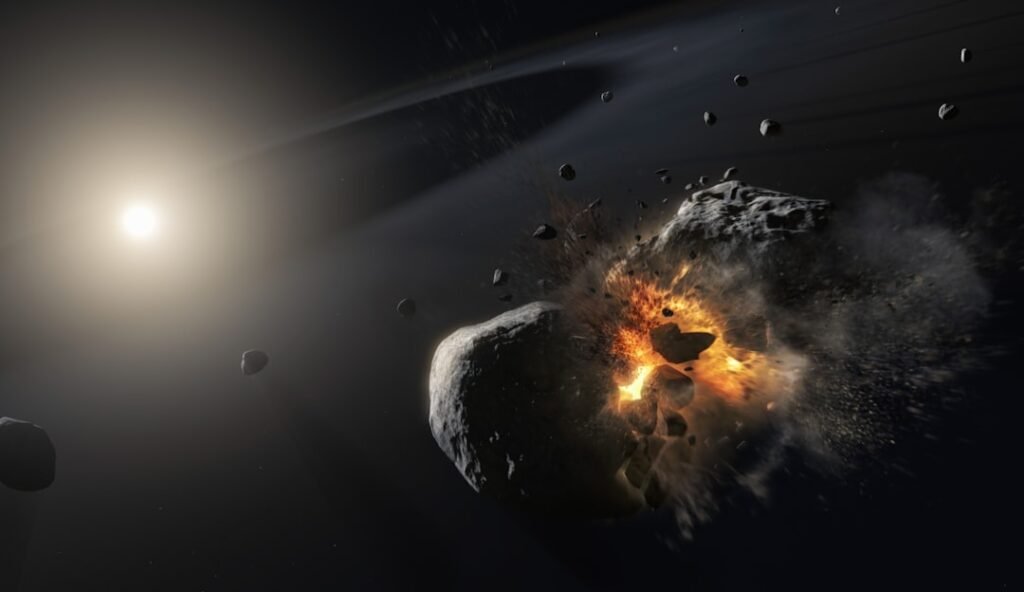
Astronomers using NASA’s Hubble Space Telescope have captured the first direct images of violent asteroid collisions unfolding in the Fomalhaut system, just 25 light-years from Earth.
Astounding Sights from a Nearby Star
Hubble’s keen eye revealed expanding clouds of dust around Fomalhaut, a brilliant star visible to the naked eye on clear nights. These clouds emerged from massive impacts between rocky bodies, marking a pivotal moment in exoplanetary studies. Scientists first noted unusual bright spots near the star in earlier observations, but recent data confirmed their origin as debris from catastrophic smash-ups.
The events echo the chaotic early phases of planetary formation, where planetesimals – building blocks of planets – frequently collided. In 2008, Hubble detected what appeared to be a planet, Fomalhaut b, orbiting the star. However, follow-up views showed it fading and expanding, leading researchers to conclude it was a transient dust cloud rather than a stable world.
Another similar feature appeared in 2023, growing over time and providing a second snapshot of this destructive process. These observations, detailed in a recent Science publication, highlight Fomalhaut’s debris disk as a dynamic laboratory for cosmic violence.
Unraveling the Mechanics of Cosmic Collisions
The collisions involve objects roughly the size of large asteroids, hurtling into each other at high speeds within the star’s debris belt. Such impacts pulverize the rocks, ejecting fine particles that scatter light and form visible clouds detectable by Hubble’s instruments. This process not only reshapes the system’s architecture but also influences how planets might eventually coalesce from the remnants.
Researchers analyzed the dust’s expansion rate, estimating the crashes occurred recently on astronomical timescales – within the past few decades or centuries. The debris disk around Fomalhaut, structured like Saturn’s rings but on a stellar scale, shows gaps and clumps that suggest ongoing interactions. These findings challenge previous models, which assumed such events were rarer in mature systems.
- Dust clouds expand at speeds indicating fresh collisions.
- Impacts involve planetesimals up to hundreds of kilometers across.
- Observations span from 2004 to 2025, capturing multiple episodes.
- The system’s youth, at about 440 million years old, amplifies activity.
- Hubble’s ultraviolet and optical data pinpoint the debris composition.
Parallels to Earth’s Ancient Past
Fomalhaut’s turmoil mirrors the solar system’s infancy, when asteroid bombardments scarred emerging planets. Earth endured a heavy influx of impacts during its first billion years, delivering water and organics while carving craters. Similarly, these Fomalhaut collisions could seed future worlds with essential materials, driving the evolution of habitable zones.
Unlike our stabilized system, Fomalhaut remains in flux, with its debris disk extending far beyond Neptune’s orbit. Astronomers note that the star’s youth contributes to this instability, as gravitational influences from unseen companions stir the pot. This glimpse offers clues about why some exoplanetary systems develop rocky planets while others favor gas giants.
Hubble’s role proves crucial, as ground-based telescopes struggle to resolve such fine details amid stellar glare. The telescope’s longevity has allowed repeated monitoring, turning sporadic detections into a coherent narrative of destruction and renewal.
Implications for Exoplanet Exploration
These observations refine theories on how debris disks evolve into planetary architectures. In Fomalhaut, the collisions suggest a high rate of planetesimal disruption, potentially explaining the scarcity of small bodies in some mature systems. Future missions, including the James Webb Space Telescope, may probe deeper into the dust’s infrared signatures for hidden planets.
Experts emphasize that such events, though brief, provide windows into otherwise invisible processes. The data from Hubble, spanning two decades, underscores the value of long-term vigilance in astronomy. As technology advances, more systems like Fomalhaut could reveal their secrets, broadening our understanding of cosmic neighborhood formation.
Key Takeaways
- Hubble’s images mark the first direct evidence of asteroid collisions beyond our solar system.
- Fomalhaut’s dust clouds, once mistaken for planets, arise from recent planetesimal impacts.
- These events illuminate the violent path to planet building, akin to our early solar history.
In peering at Fomalhaut’s clashes, Hubble reminds us that the universe’s beauty often stems from its brutality, forging worlds from wreckage. What secrets might the next collision unveil? Share your thoughts in the comments.