
Unlocking a Stellar Time Capsule (Image Credits: Telescoper.blog)
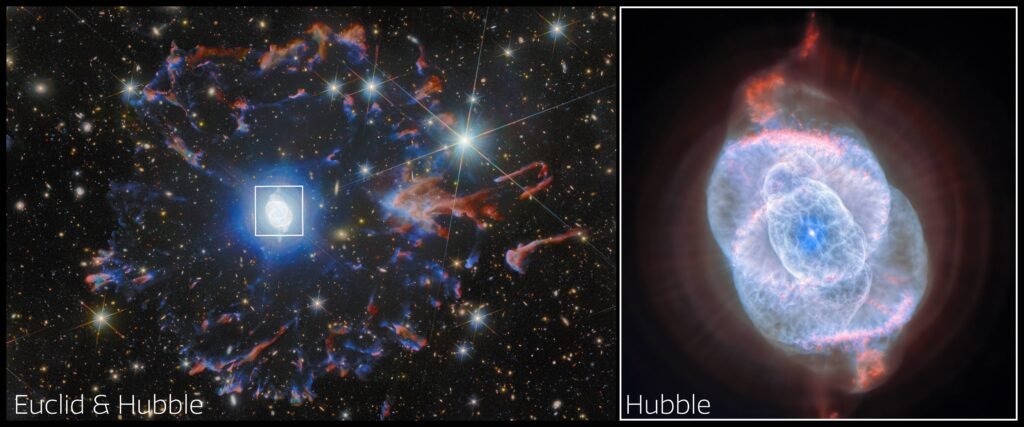
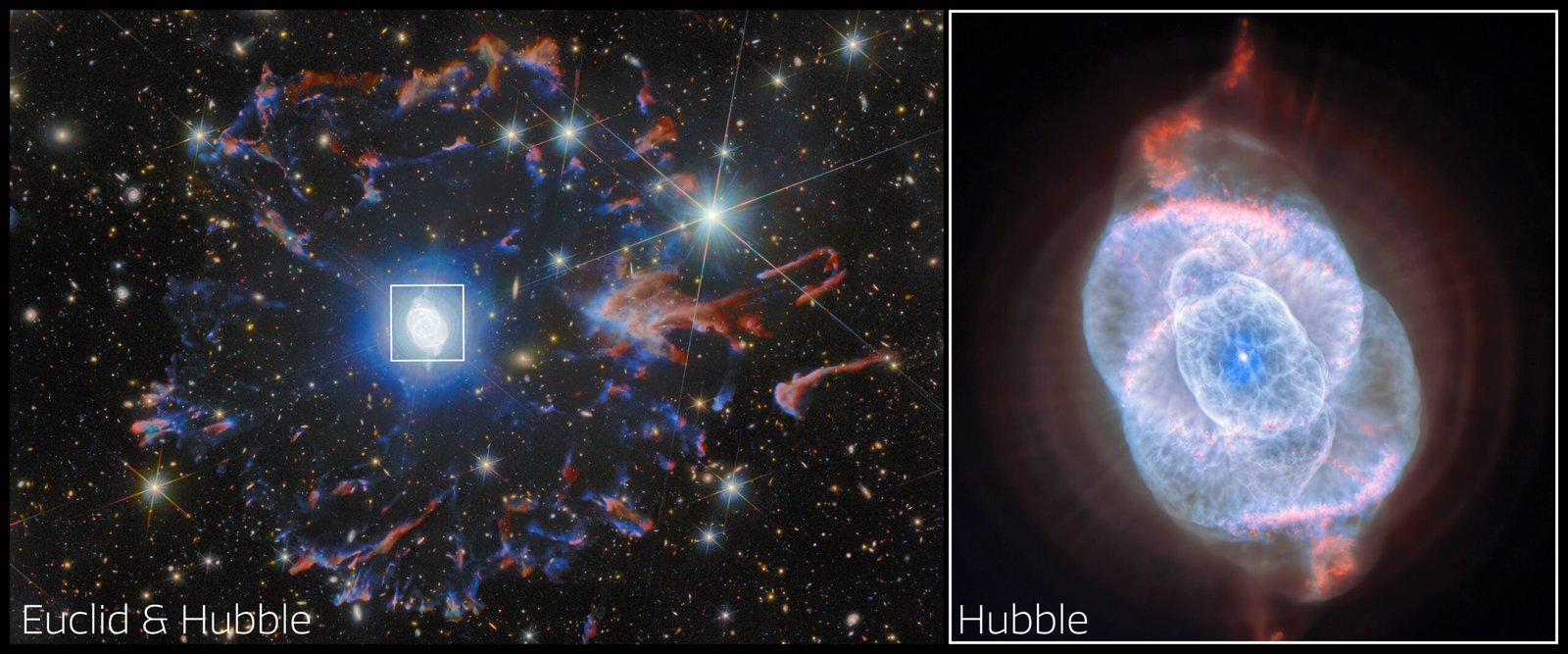
ESA’s Hubble Space Telescope and Euclid mission have merged their observations to reveal the Cat’s Eye Nebula in exquisite new clarity.
Unlocking a Stellar Time Capsule
Astronomers first confirmed the expanding nature of planetary nebulae in 1864 through the spectrum of the Cat’s Eye Nebula, NGC 6543.[1][2] This intricate structure in the constellation Draco, located about 4,300 light-years away according to ESA’s Gaia mission, serves as a visual record of a star’s final throes.[1]
Planetary nebulae form when dying stars shed outer layers of gas, creating glowing shells that expand into space. The Cat’s Eye Nebula stands out for its multilayered complexity, far beyond the simple round shapes early telescopes detected. Hubble’s earlier images from 1995 exposed hidden details, reshaping views of these cosmic phenomena.[2]
Recent data processing has now produced Hubble’s sharpest image yet of this nebula, spotlighting it as ESA’s Hubble Picture of the Month for March 2026.
Hubble Zooms into the Heart
Hubble targeted the nebula’s core using the High Resolution Channel of its Advanced Camera for Surveys. This setup excels at resolving fine details in compact regions.[2]
The resulting visible-light image unveils a tapestry of concentric shells, high-speed gas jets, and shock-sculpted knots. Previously unused observations from 2004 contributed to this view, enhanced by modern techniques. These features document episodic mass ejections from the central star, preserving its evolutionary history like a fossil.[1][2]
Such precision highlights Hubble’s enduring role in dissecting stellar remnants.
Euclid Frames the Bigger Picture
Though Euclid focuses on distant universe mapping, its deep surveys incidentally captured the Cat’s Eye Nebula. The wide-field view blends near-infrared and visible light to show arcs and filaments around the bright center.[1]
A colorful halo of gas fragments encircles this core, remnants of an earlier ejection before the main nebula formed. Distant galaxies dot the background, blending nearby drama with cosmic vastness.[2]
Euclid’s perspective complements Hubble by embedding the nebula in its stellar surroundings.
Key Structures of the Cat’s Eye
The combined images expose the nebula’s elaborate anatomy:
- Concentric gas shells from repeated outbursts.
- Jets of fast-moving material piercing the clouds.
- Dense knots formed by shock waves.
- An outer ring of early-ejected gas.
- Filaments and arcs framing the central star.
These elements illustrate violent interactions during the star’s death, offering clues to late-stage stellar evolution.[1]
Key Takeaways
- Hubble and Euclid together provide the sharpest and widest views of NGC 6543 yet.
- The nebula records a dying star’s mass-loss episodes over centuries.
- Modern surveys link local wonders to the distant universe.
These observations underscore how complementary telescope capabilities illuminate stellar finales against the universe’s grand scale. The Cat’s Eye Nebula endures as a testament to cosmic artistry. What aspect of this stellar spectacle captivates you most? Tell us in the comments.