

A Historic Burst in the Night Sky (Image Credits: Unsplash)
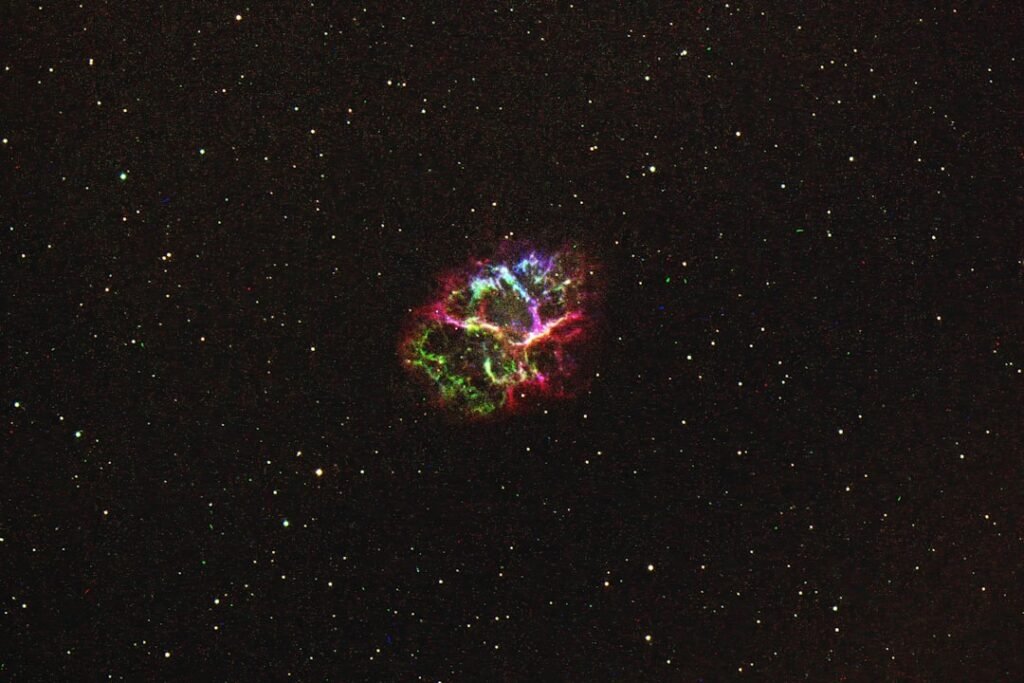
In the constellation Taurus, the Crab Nebula endures as a glowing testament to a supernova that captivated ancient skywatchers over a millennium ago.
A Historic Burst in the Night Sky
Chinese astronomers first documented the supernova that birthed the Crab Nebula in 1054, describing a brilliant “guest star” that shone so intensely it appeared during daylight for nearly a month. This event, visible across cultures from Mayan observers to Arab stargazers, marked one of the few supernovae recorded in human history before telescopes existed. The explosion’s light took about 6,500 years to reach Earth, meaning the star detonated long before these accounts. Today, astronomers recognize this as the origin of Messier 1, the first entry in Charles Messier’s catalog of non-cometary objects. Messier himself mistook it for a comet in the 18th century, spurring his famous list. The nebula’s name derives from an 1840s sketch by William Parsons that evoked a crab’s shape, cementing its place in astronomical lore.
That ancient flare-up transformed a massive star into a vast cloud of gas and dust, expanding outward at speeds exceeding 1,000 kilometers per second. Over centuries, observations have traced its growth, revealing a dynamic structure still evolving. The remnant spans roughly six light-years, a fraction of its future size as it continues to disperse.
The Pulsing Heart of the Remnant
At the Crab Nebula’s core lies a neutron star, the collapsed husk of the original supernova progenitor, packing the mass of 1.4 suns into a sphere just 30 kilometers across. This pulsar spins 30 times per second, beaming radiation that creates a detectable pulse from Earth, earning it the name Crab Pulsar. Surrounding the neutron star, a pulsar wind nebula forms as high-energy particles interact with magnetic fields, producing the nebula’s intricate filaments and wisps. Hubble Space Telescope images capture these features in vivid detail, showing arcs and knots moving at half the speed of light. The entire system glows across wavelengths, from radio waves to X-rays, offering a multi-layered view of stellar death.
Chandra X-ray Observatory data highlights the pulsar’s immense energy output, rivaling that of much larger objects. This central engine powers the nebula’s expansion, preventing it from fading entirely. Studies of the Crab continue to inform models of supernova remnants, bridging historical sightings with modern physics.
Spotting the Crab from Earth
Amateur astronomers can glimpse the Crab Nebula with binoculars or small telescopes under dark skies, positioning it near the bright star Zeta Tauri in Taurus. Visible year-round from the Northern Hemisphere, it peaks in winter evenings, appearing as a faint, hazy patch at magnitude 8.4. Patience rewards viewers with hints of its irregular shape, especially through larger instruments that resolve the central star. The nebula’s proximity – about 6,500 light-years away – makes it one of the closest supernova remnants, accessible without professional equipment.
To locate it, trace the V-shaped Hyades cluster in Taurus and scan eastward; apps or star charts simplify the hunt. Seasonal observing events often highlight the Crab, drawing enthusiasts to its subtle allure. Though not naked-eye visible, its discovery underscores how everyday tools unlock cosmic wonders.
Ongoing Mysteries and Observations
Recent studies, including those from the James Webb Space Telescope, probe the nebula’s composition, revealing dust and gas interactions that shape star formation nearby. The Crab’s expansion has been meticulously tracked since the 1970s, showing accelerated growth in certain regions due to internal shocks. These observations refine understandings of how supernovae seed the universe with heavy elements essential for planets and life. Anomalies, like unexpected gamma-ray flares in 2011, challenge theories of pulsar behavior, prompting deeper investigations.
Collaborative efforts across observatories like Spitzer and XMM-Newton build a comprehensive picture, blending infrared warmth with ultraviolet sharpness. Such data not only honors the 1054 event but also predicts the nebula’s long-term fate as it merges with interstellar space.
Key Takeaways
- The Crab Nebula formed from a supernova observed in 1054, visible in daylight for weeks.
- A rapidly spinning neutron star at its center drives the ongoing expansion at over 1,000 km/s.
- Amateurs can observe it in Taurus with binoculars, revealing a six-light-year-wide remnant.
The Crab Nebula reminds us that stellar cataclysms leave indelible marks on the cosmos, inviting endless exploration. As technology advances, its secrets continue to unfold, connecting past wonders to future discoveries – what hidden stories might the next observation reveal? Share your thoughts in the comments below.