
Some animals can cross oceans, deserts, and entire continents without a map, a GPS, or even a clear view of the sun or stars. They just go, straight as an arrow, year after year, as if the planet itself is quietly whispering directions into their ears. The shocking part is that, in a way, that might not be far from the truth.
Earth is wrapped in a giant magnetic field, and a huge range of animals seem to sense it and use it like an invisible guide. Yet, even in 2026, nobody can fully explain how they do it. We’re left piecing together clues from pigeons, turtles, whales, and even tiny worms, trying to understand a sense that we, as humans, almost certainly lack and can barely imagine.
The Invisible Map: What Is Earth’s Magnetic Field?
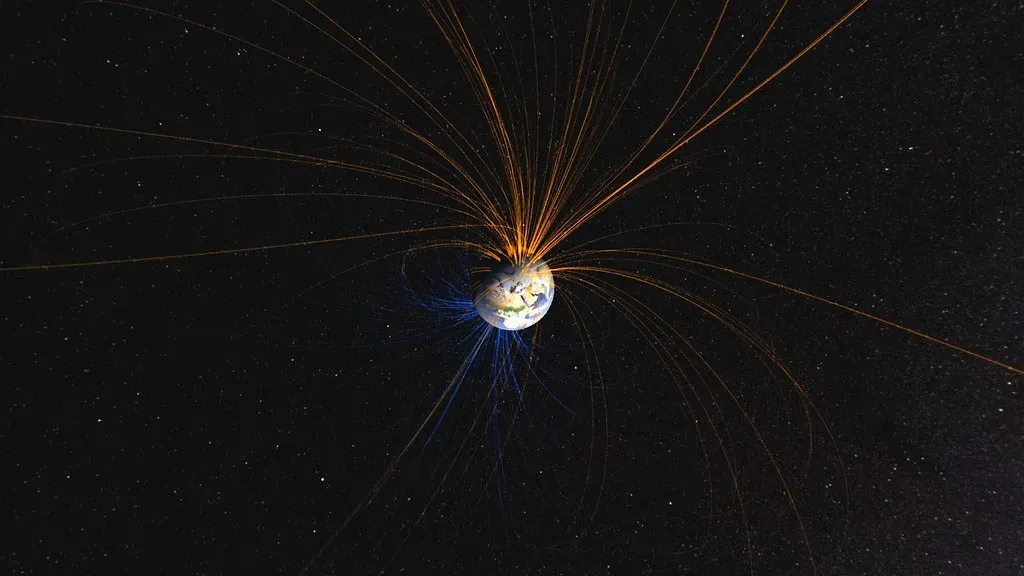
Earth’s magnetic field is a massive force field generated deep inside the planet by swirling molten iron in the outer core. You can think of it like a bar magnet running through the Earth from near the geographic south pole to near the geographic north pole, but far more complicated and constantly shifting. This magnetic field extends far out into space, shaping a protective bubble that shields us from much of the solar wind and charged particles from the sun.
Near the surface, the magnetic field has two important properties animals might use: its direction and its strength. The direction tells a compass needle which way is roughly north and south, while the strength and angle change depending on where you are on the globe. In principle, that means the planet itself carries a kind of built‑in coordinate system, like invisible contour lines on a map. The big mystery is how a living body, made of cells and water and soft tissue, could possibly read that subtle, silent pattern.
Navigating By Magnetism: Who Can Do It?

Scientists have known for decades that homing pigeons can find their way back from hundreds of kilometers away, even when released in unfamiliar places. At first, people blamed smells, landmarks, or the position of the sun, and those do matter, but experiments showed that when the magnetic field is disrupted, pigeons become confused. That was one of the first solid hints that birds carry an internal magnetic sense, something like an extra compass built into their bodies.
Since then, the list of magnetically sensitive animals has exploded. Sea turtles released as hatchlings on beaches crawl to the water and later return to the same coastline after crossing whole ocean basins, apparently guided partly by magnetic cues. Salmon, eels, sharks, lobsters, butterflies, and even some mammals like bats and possibly whales seem to respond to magnetic fields. Even tiny creatures like fruit flies and nematodes show magnetic responses in lab settings. The pattern is almost unsettling: from microscopic animals to giants of the sea, the magnetic sense seems to be everywhere, yet we still don’t really know how it works.
Iron In The Beak: The Magnetite Hypothesis

One of the earliest ideas about magnetoreception focused on tiny crystals of magnetite, a naturally magnetic mineral made of iron oxide. These crystals can physically align with an external magnetic field, just like a compass needle. For a while, scientists thought they’d found these particles clustered in the upper beaks of birds like pigeons and in the tissues of fish and other animals. The idea was simple and elegant: magnetite particles tug on nearby cell structures, and specialized nerve cells feel that tug and send a signal to the brain.
But as techniques improved, the story got messy. Some supposed magnetite‑containing cells in bird beaks turned out to be immune cells rather than dedicated sensory neurons. Other studies still support magnetite in some species, especially fish and certain invertebrates, but the evidence is not as clean or universal as once hoped. It’s like thinking you’ve found the master key and then realizing it only fits some of the doors. Many researchers now suspect magnetite might be part of the answer for some animals, especially for sensing magnetic intensity, but not the whole story for everyone.
Quantum Biology In The Eye: The Radical Pair Hypothesis

The other big idea is much stranger, almost sci‑fi: that some animals see the magnetic field using quantum chemistry inside their eyes. This is called the radical pair mechanism, and at the center of it is a light‑sensitive protein known as cryptochrome. When a photon of light hits cryptochrome, it can create a pair of molecules with unpaired electrons whose spins are sensitive to external magnetic fields. The state of this pair can influence downstream chemical reactions, essentially turning the magnetic field into a biochemical signal.
In some birds, cryptochrome is found in specific patterns in the retina, especially in the parts that receive light from the upper field of view. That has led to the idea that birds might perceive the magnetic field as a kind of dim, shifting pattern overlaid on their normal vision, perhaps as brighter or darker regions or subtle color changes. The wildest part is that this mechanism depends on quantum effects, which are notoriously fragile, yet somehow seem to survive long enough inside a warm, wet eye to guide a bird across continents. If that’s not mysterious, it’s hard to know what is.
Experiments That Bend Reality: How We Know It’s Real

Because we can’t ask a turtle whether it “feels north,” researchers have had to get creative. In labs, animals are often placed in special coil systems that let scientists change the direction or strength of the magnetic field without touching anything else. When birds in orientation cages suddenly turn and face the wrong direction after the field is quietly rotated around them, it’s hard to argue they’re not sensing magnetism. Similar setups with sea turtles show that they swim in different directions depending simply on how the magnetic field is tuned, as if responding to an invisible road sign.
There have also been experiments using very weak oscillating magnetic fields that interfere specifically with the radical pair mechanism, without affecting magnetite. In some of these tests, birds lose their ability to orient magnetically under certain radiofrequency fields, but regain it once the interference stops. That suggests the quantum eye‑based system is not just theory but an active, fragile channel of information. On the flip side, studies that involve altering iron‑rich structures point toward magnetite in some species. Put together, the data paints a complicated picture: multiple magnetic senses might coexist, and different animals might be using different tricks, or even a combination, to pull off their navigational feats.
Why This Mystery Still Isn’t Solved

For all the clever experiments and cleverer theories, there are still uncomfortable gaps. In many species, we don’t know where the magnetic sensors are located in the body, what cells actually do the detecting, or how the signals travel to the brain. It’s almost as if we’ve watched someone read a book flawlessly without having any idea where their eyes are focused or how their brain is decoding the letters. On top of that, Earth’s magnetic field is weak compared to many lab magnets, which makes the sensitivity of these animals even harder to explain in physical terms.
There’s also the problem that nature rarely sticks to just one solution. Birds, for example, might rely on cryptochrome‑based direction sensing when the sky is bright enough, then lean more on magnetite or other cues when light is poor. Some animals might use the magnetic field as a backup when landmarks are missing, while others might depend on it as a primary map. I often think of it like our own sense of direction: we mix memory, vision, smell, and a bit of gut feeling. Expecting a single neat answer for animals might simply be too tidy for how evolution really works.
What This Hidden Sense Reveals About Life On Earth

Once you accept that so many animals can tap into the planet’s magnetic field, the world feels different. A migrating bird isn’t just flying through the sky; it’s moving along gradients and contours we can’t perceive, like a hiker following trails marked in a color we’re blind to. A whale crossing the ocean may be gliding along invisible magnetic pathways shaped over geological time. Even humble creatures like worms and insects might be quietly aligning themselves with the same global structure.
There are also real‑world consequences to understanding this sense better. Human technology, from undersea cables to renewable energy infrastructure to shifting magnetic navigation systems, might unintentionally disturb these ancient compasses. If magnetic noise or rapid changes in the field confuse animals, that could affect migrations, breeding, and entire ecosystems. At the same time, learning how nature solves the problem of detecting such a faint signal could inspire new technologies for navigation or sensing. The deeper we look into magnetoreception, the more it feels like we’ve only just cracked open a door on a room full of hidden senses and strange physics we’re still far from fully grasping.