
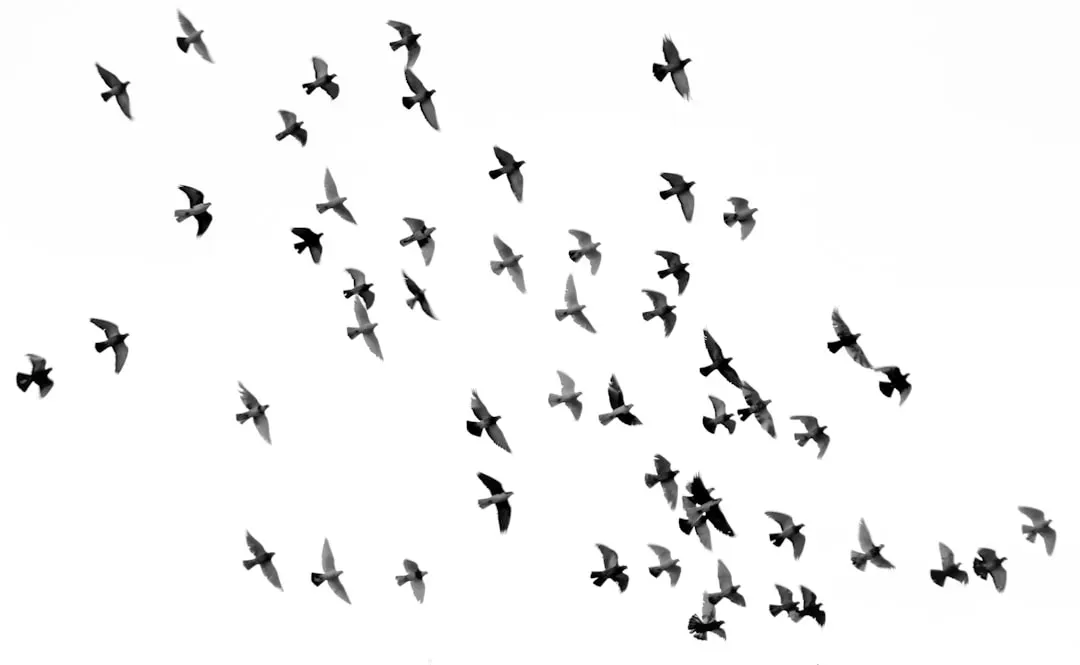
Every year, tiny songbirds weighing less than a slice of bread cross oceans and continents with eerie precision, often returning to the same patch of forest or backyard tree. They travel at night, through clouds, fog, and storms, as if they’re following an invisible map written into the sky. For a long time, scientists had no idea how they pulled this off with a brain smaller than a walnut.
Now, a startling idea has taken hold: some birds may literally see Earth’s magnetic field using quantum effects happening inside their own eyes. This sounds like science fiction, but in the last two decades, experiments have turned the weirdness of quantum physics into a very real part of biology. Once you see how it fits together, bird migration starts to look less like magic and more like one of the wildest tricks evolution ever pulled off.
The Strange Mystery Of Avian Navigation

Imagine flying thousands of kilometers in the dark, with no GPS, no road signs, and no landmarks you’ve ever seen before. That’s what migratory birds do routinely, and they somehow manage to hit roughly the same stopover sites every year. For decades, people guessed that they might be following stars, the sun, or even the smell of familiar landscapes, and it turns out they do use those cues, but none of them fully explained the accuracy of their routes.
Even more puzzling, experiments in controlled environments showed that birds could orient themselves correctly even when they couldn’t see the sun or stars. In some tests, young birds raised indoors, with no chance to learn the geography, still tried to fly in the right seasonal direction when placed in special orientation cages. That strongly suggested they were sensing something deeper and more global than just visual landmarks, like they were tapping directly into the planet itself.
Discovering A Built-In Magnetic Compass

By the late twentieth century, biologists started to zero in on Earth’s magnetic field as a prime candidate for this hidden sense. When they exposed birds to altered magnetic fields in the lab, the birds’ preferred directions shifted in predictable ways. This wasn’t a vague reaction; the animals behaved as if their internal compass had been twisted, and they tried to adjust their flight orientation to match what they “felt.”
Further experiments showed that this compass wasn’t just a backup system; for many migratory species, it was essential. When the magnetic field was scrambled enough, the birds became confused or restless, unable to settle on a clear direction. That supported the idea that, alongside the familiar five senses, birds have what’s sometimes called magnetoreception: a dedicated way to sense Earth’s magnetic field and use it as a large-scale navigation aid.
Light, Eyes, And The Quantum Compass Hypothesis

One of the strangest twists in this story is that birds seem to need light to use their magnetic sense properly. When scientists tested birds in total darkness, their magnetic orientation often collapsed, but under certain colors of light, especially in the blue-green range, it snapped back into place. This pointed away from a compass based only on iron particles in the beak and toward something happening in the eyes, triggered by incoming photons.
That led to a bold hypothesis: the bird’s magnetic compass could be a light-dependent chemical reaction inside the retina. The idea is that when light hits special molecules in the eye, it creates pairs of tiny particles called radical pairs whose behavior is influenced by magnetic fields. This would mean that the magnetic information is woven right into vision itself, turning the magnetic field into a kind of faint visual filter or pattern superimposed on the bird’s view of the world.
Radical Pairs: Quantum Weirdness Inside Living Cells

Radical pairs are at the heart of the quantum explanation, and they’re not just a fancy name for something abstract. They’re pairs of molecules or electrons that are created together and remain linked in a strange way, sensitive to magnetic influences. Their spins – a quantum property with no perfect everyday analogy, but sometimes compared to tiny spinning tops – can be correlated in a way that depends on the surrounding magnetic field, including Earth’s relatively weak one.
In the bird’s eye, when light hits certain pigments, it can create these radical pairs in specific proteins, and their quantum state can flip between different configurations. The key is that these flips change the chemical outcomes of the reaction. A slightly different magnetic field means a slightly different balance of chemical products, and those differences can be translated into signals the brain understands. It’s like having an invisible magnetic watermark changing how part of the visual system responds, without the bird ever being consciously aware of the physics behind it.
Cryptochrome: The Molecule That May Let Birds “See” Magnetism
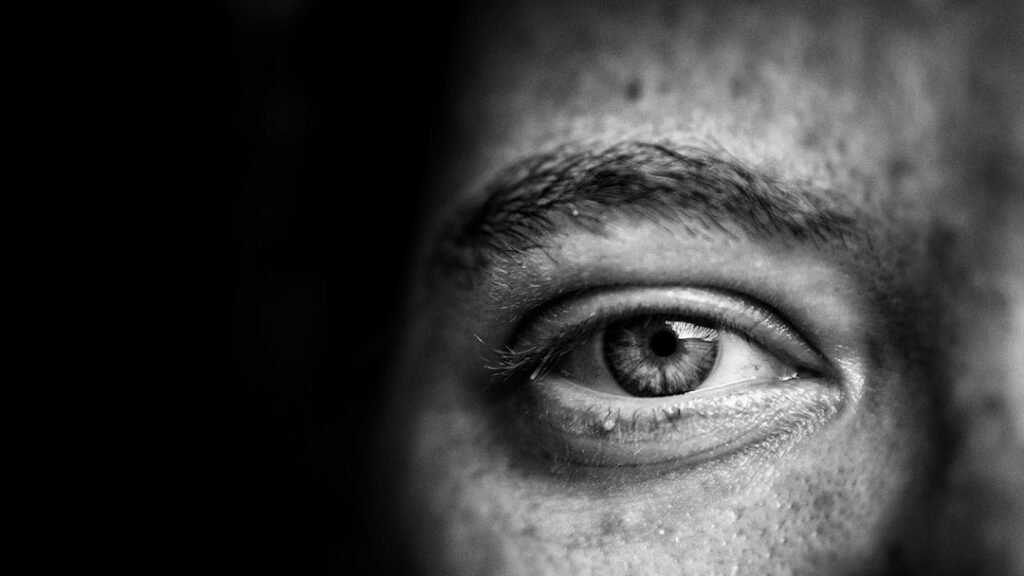
The leading candidate molecule behind this quantum compass is a protein called cryptochrome, found in the eyes of many animals, including humans. Cryptochromes play roles in circadian rhythms, helping bodies keep track of day and night, but in migratory birds, they seem to do more than that. Certain types of cryptochrome in their retinas are positioned and structured in ways that make them perfect for forming radical pairs that are sensitive to weak magnetic fields.
Studies have shown that disrupting cryptochrome in some species affects their ability to orient using the magnetic field, while adding bird cryptochrome to artificial systems can create magnetically sensitive reactions. The idea is that these proteins form a kind of layer across the retina, so that different viewing angles create different magnetic responses. The end result might be that a bird sees a subtle pattern – maybe a darkening or shading aligned with magnetic north – superimposed on the normal image of the landscape, like a built-in, ghostly head-up display.
Evidence From Behavior, Brain Signals, And Interference

Behavioral experiments have provided some of the strongest support for this quantum-based magnetic sense. When birds are exposed to weak radiofrequency fields or certain artificial electromagnetic noise, their magnetic orientation can break down even though the Earth’s field itself hasn’t changed. That fits with the idea that the quantum states inside radical pairs are delicate and can be disrupted by external signals, much like a radio picking up static.
Researchers have also tracked brain activity and found that specific areas respond differently when birds are using magnetic cues. This doesn’t prove exactly what the birds experience subjectively, but it shows that magnetoreception is not just a vague feeling; it’s a structured input, processed in defined neural circuits. To me, the most mind-bending part is that, in a sense, evolution has built a tiny quantum sensor network into a living brain, something engineers are still struggling to do reliably with modern technology.
What This Means For Quantum Biology And Human Technology

The idea that birds use quantum effects to navigate has helped kick-start a whole field called quantum biology. For years, people assumed quantum weirdness only mattered at ultra-small scales or near absolute zero, not in warm, messy living cells. But if radical pair reactions in cryptochrome really do stay quantum-coherent long enough to be useful, that means life has found ways to stabilize these fragile states in everyday conditions, which is a huge conceptual shift.
This isn’t just an academic curiosity. Understanding how birds pull this off could inspire new kinds of sensors and navigation tools that don’t rely on satellites or large power supplies. Engineers are already looking at biomimetic designs that mimic radical pair chemistry to build magnetically sensitive devices. It’s a bit humbling to realize that, while we’re busy launching space-based navigation systems, a robin in your backyard is running a quantum compass in its eyeballs, powered only by starlight.
A Planet-Wide Map Written In Quantum Ink

When you put everything together – the behavioral experiments, the light dependence, the role of cryptochrome, and the interference from weak radio fields – a compelling picture emerges. Many migratory birds seem to carry a quantum compass in their eyes that lets them sense Earth’s magnetic field and turn the entire planet into a navigable map. It’s not the only tool they use, but it’s one of the most surprising, blending physics, chemistry, and biology into a single elegant trick.
The next time you see a flock of birds heading purposefully across the sky, it’s worth pausing to imagine the invisible patterns they might be seeing, patterns you and I are blind to. Inside those tiny heads, quantum events are quietly tipping the balance of molecules, shaping choices that play out over thousands of kilometers. In a world obsessed with artificial navigation systems, there’s something deeply grounding in knowing that nature was using quantum physics for travel long before we even had compasses. Did you expect that?