
Have you ever stood beneath a starry sky and felt impossibly small? That feeling barely scratches the surface of just how vast our universe truly is. When you try to wrap your mind around cosmic distances, something peculiar happens. Your brain simply refuses to cooperate. Yet scientists have spent decades attempting to measure the immeasurable, and what they’ve discovered is both thrilling and deeply unsettling. The numbers are so staggering that even astronomers admit they can’t genuinely grasp them. Still, understanding these scales tells us something profound about our place in existence. Let’s dive into the astonishing reality of cosmic dimensions and explore what it really means when we ask how big the universe is.
The Observable Universe Has Mind Bending Dimensions
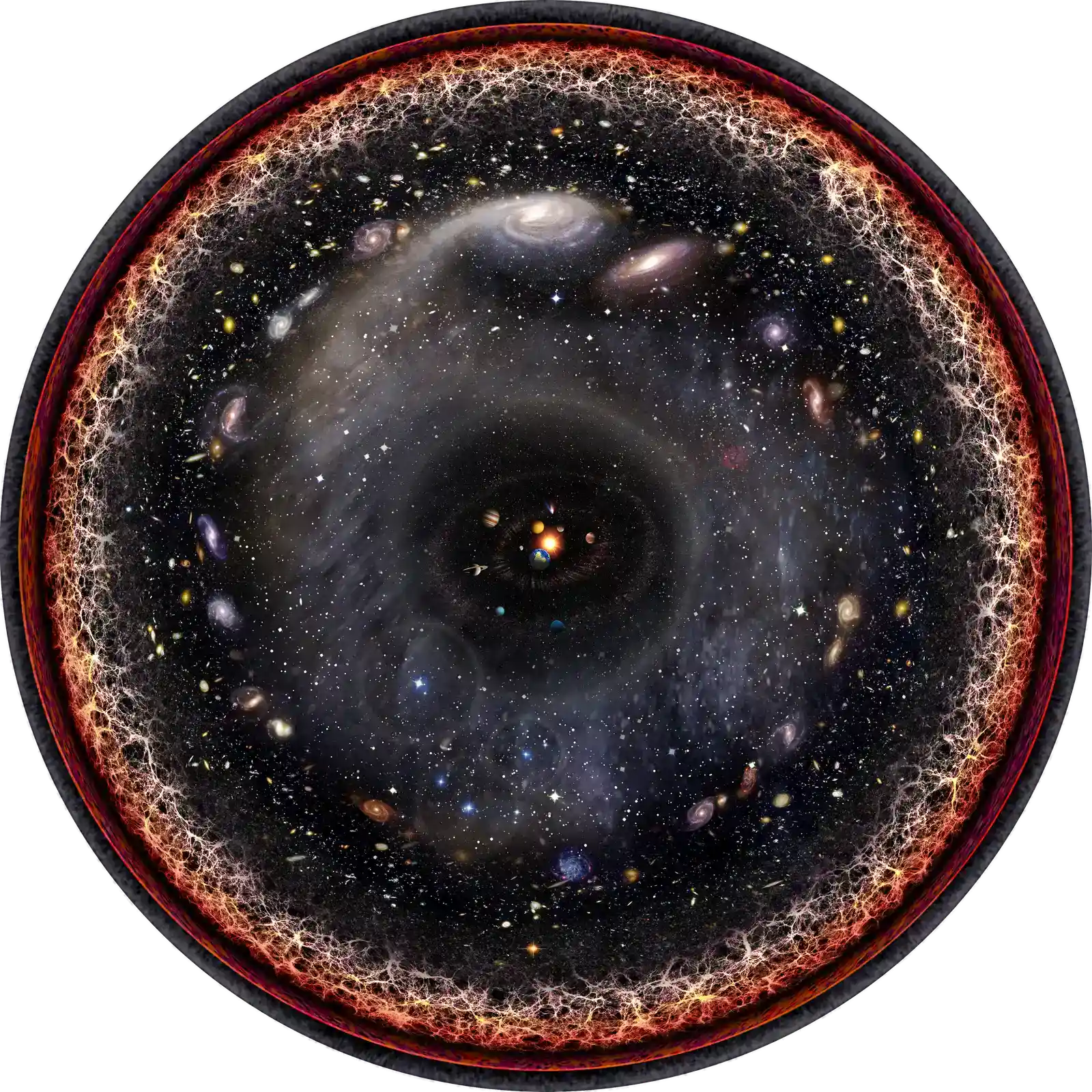
The observable universe is a sphere with a diameter of about 93 billion light years, which sounds impossible when you consider the universe occurred around 13.8 billion years ago. Here’s the thing that trips people up constantly: if the universe is only roughly fourteen billion years old, shouldn’t we only be able to see fourteen billion light years in any direction?
The answer reveals something fascinating about the nature of space itself. The universe has been expanding during this time, which causes very distant objects to be further away from us than their light travel time. Picture a photon racing toward Earth through space that’s simultaneously stretching like taffy. By the time that ancient light reaches your telescope, the object that emitted it has been carried much farther away by cosmic expansion.
Why Distance and Age Don’t Match Up

Let me be honest, this part still makes my head spin even after understanding the math. The radius of the observable universe is estimated to be about 46.5 billion light years, meaning you can see objects in every direction that are currently that far away. Yet the light travel distance to the edge of the observable universe is the age of the universe times the speed of light, 13.8 billion light years.
The universe is 13.8 billion years old, so you might think the most distant objects we can see are roughly that distance away in light years, but the cosmos is expanding, and in the time it’s taken for the light from distant objects to reach us, that expansion has swept them farther from us. This creates a bizarre situation where we’re looking at the ancient past of objects that are now unimaginably far away. The light shows us what those regions looked like billions of years ago, not what they look like today.
Space Itself Is Stretching Faster Than Light
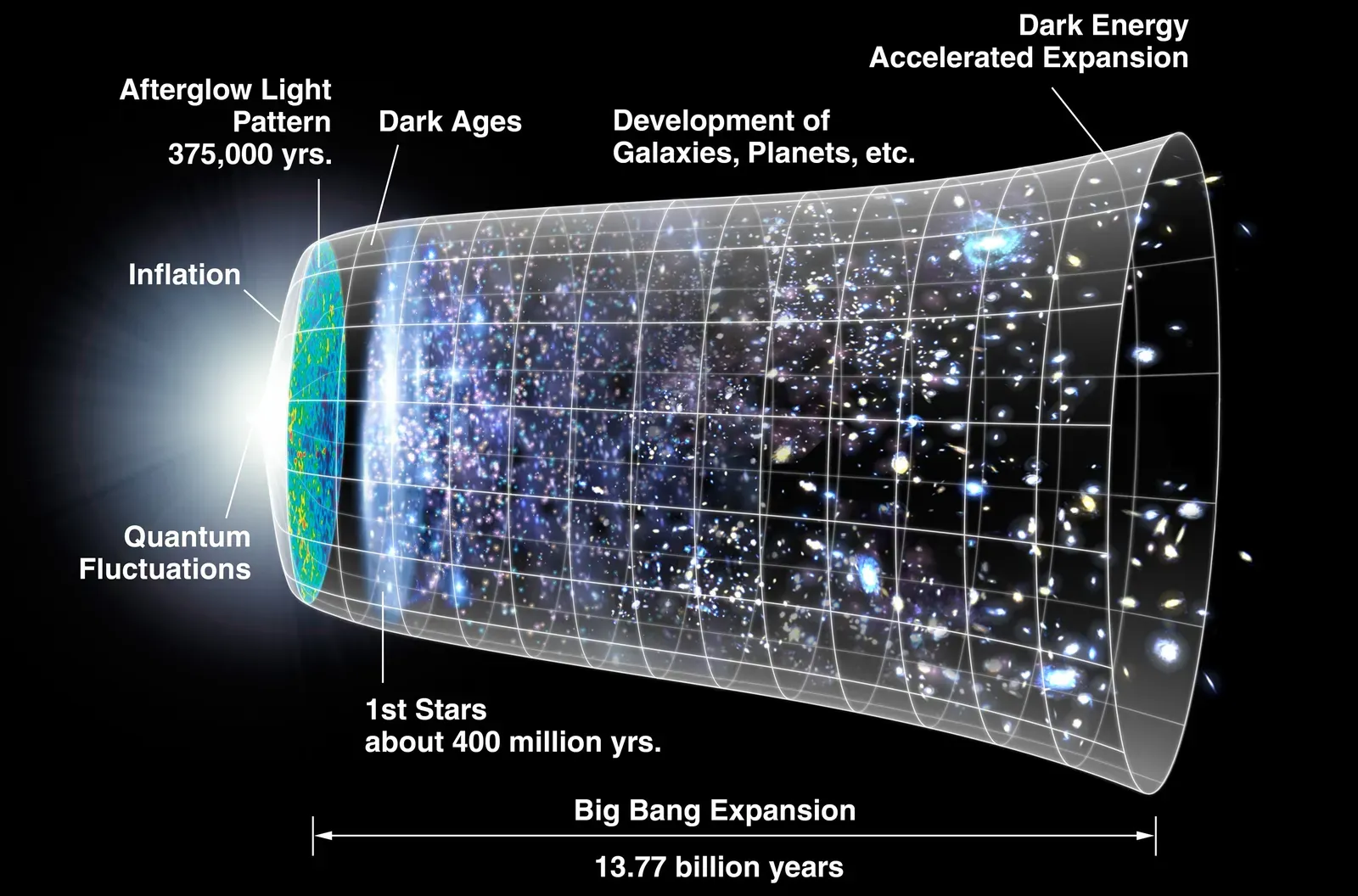
Now here’s where things get genuinely wild. You’ve probably heard that nothing can travel faster than light, right? Well, that’s true for objects moving through space. All but the nearest galaxies move away at speeds that are proportional to their distance from the observer, and while objects cannot move faster than light, this limitation applies only with respect to local reference frames and does not limit the recession rates of cosmologically distant objects.
Think of it like this: galaxies aren’t zooming through space at breakneck speeds. Instead, the space between us and them is expanding. It’s similar to dots on a balloon separating as you inflate it. The dots themselves aren’t moving across the rubber surface, yet the distance between them grows. The observable universe is estimated to be more like 90 or so billion light years across precisely because of this cosmic expansion that’s been happening since the beginning of time.
The Expansion Rate Mystery Deepens
Scientists measure how fast the universe expands using something called the Hubble constant, and honestly, they can’t agree on what it actually is. The Planck collaboration measured the expansion rate and determined it to be 67.4 kilometers per second per megaparsec, and there is a disagreement between this measurement and the supernova based measurements, known as the Hubble tension.
Different measurement techniques keep producing different answers. The early universe probe favors an expansion rate of roughly 67 kilometers per second per megaparsec, and the late nearby universe probe favors an expansion rate of 73 kilometers per second per megaparsec. This might not sound like much of a difference, but it’s huge. This Hubble tension is a cosmic disagreement that may point to new physics governing the universe, and confirming this tension would force scientists to rethink the very makeup of the cosmos.
What Actually Lies Beyond What We Can See
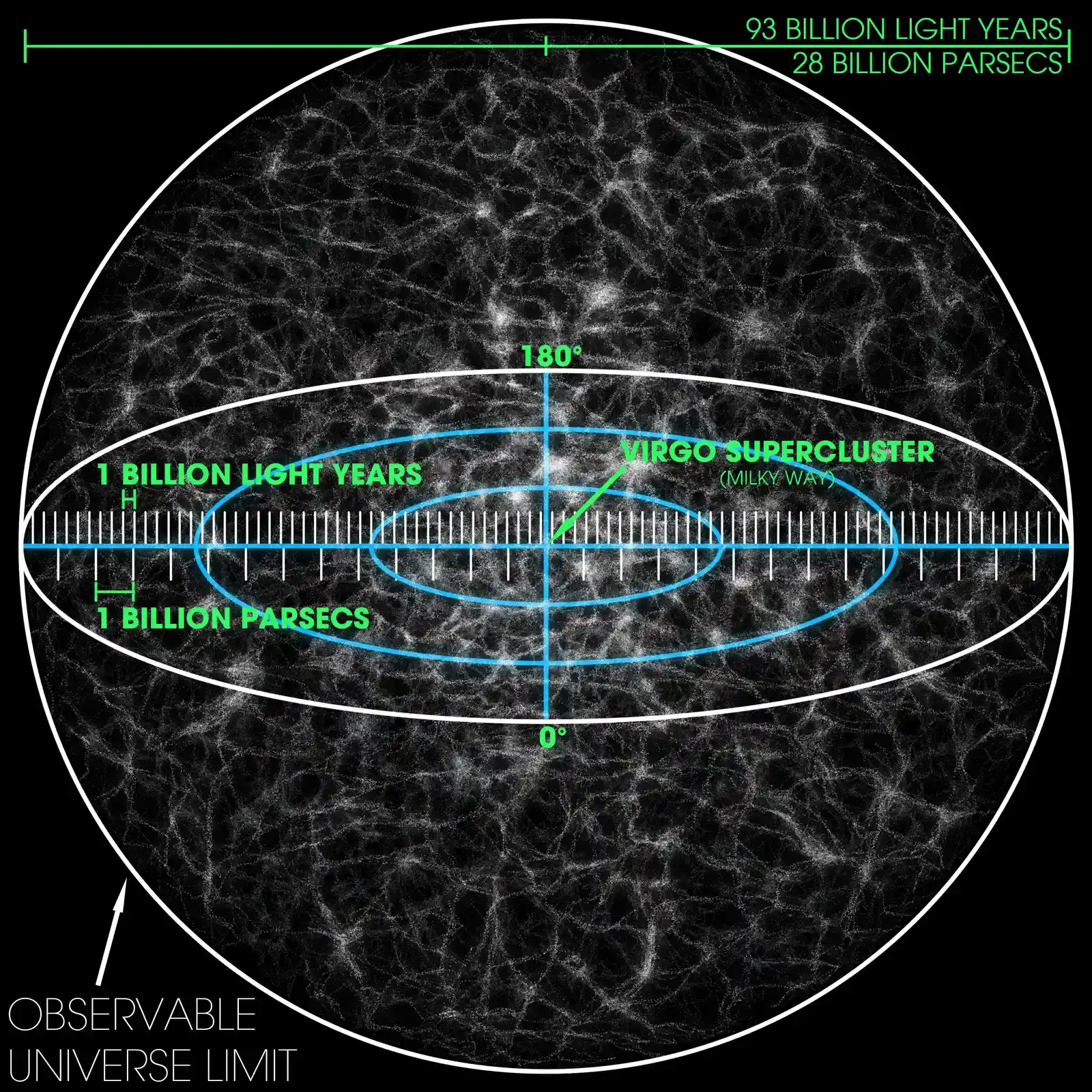
Here’s a question that keeps cosmologists up at night: what exists beyond the observable universe? The honest answer is we simply don’t know. There’s an outside to our observable patch of the universe because the cosmos is only so old, and light only travels so fast, so we haven’t received light from every single galaxy, and the current width of the observable universe is about 90 billion light years.
Astronomers think space outside of the observable universe might be an infinite expanse of what we see in the cosmos around us, distributed pretty much the same as it is in the observable universe. This seems reasonable. Why would one section be dramatically different from another? The universe’s size is unknown and it may be infinite in extent, as some parts of the universe are too far away for the light emitted since the Big Bang to have had enough time to reach Earth.
The Difference Between What We See and What We Can Ever See
Cosmologists distinguish between two cosmic boundaries that sound similar but represent fundamentally different limits. The particle horizon is the maximum distance from which light from particles could have traveled to the observer in the age of the universe, and it represents the boundary between the observable and the unobservable regions of the universe. That’s what we’ve been discussing so far.
The particle horizon represents the largest comoving distance from which light could have reached the observer by a specific time, while the cosmic event horizon is the largest comoving distance from which light emitted now can ever reach the observer in the future, and the current distance to our cosmic event horizon is about five gigaparsecs or 16 billion light years. Let that sink in for a moment. We can currently see objects that are roughly 46 billion light years away, but light leaving from objects more than 16 billion light years away right now will never reach us because space is expanding too quickly.
Comparing Cosmic Scales to Everyday Experience
Trying to understand these distances through regular comparisons is almost pointless, but let’s try anyway. If you think of the Earth as a tiny grain of sand, then our entire solar system would be about the size of a quarter, and in this comparison, the observable universe would be about the size of the Earth. Even this analogy barely helps because our brains aren’t wired to process such extremes.
Even astronomers can’t truly grasp these scales, as they work with them and can do math and physics with them, but our ape brains still struggle to comprehend even the distance to the moon, and the universe is two million trillion times bigger than that. I think that’s actually comforting in a strange way. You’re not failing to understand because you’re not smart enough. You’re failing to understand because humans simply aren’t built to intuitively grasp these scales.
Does the Universe Have an Edge or End
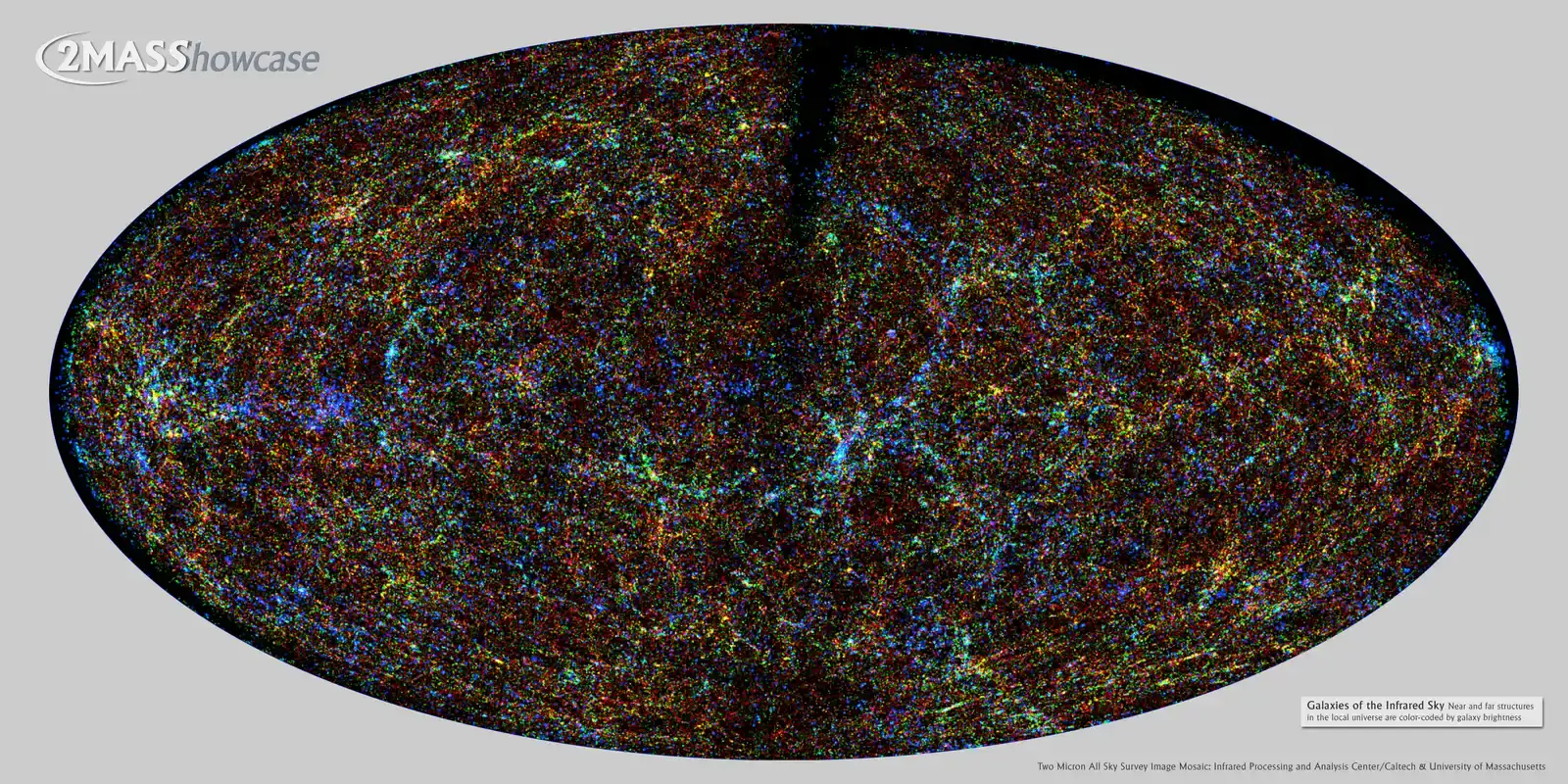
This might be the most philosophically troubling question in all of cosmology. The Universe does not have an edge, as there’s no physical boundary, no wall, no border, no fence around the edges of the cosmos, though this doesn’t necessarily mean that the Universe is infinitely large. You might find this confusing. How can something be finite without having an edge?
Even in the case of a flat universe, the cosmos doesn’t have to be infinitely big, as the surface of a cylinder is geometrically flat because parallel lines drawn on the surface remain parallel, yet it has a finite size, and the same could be true of the universe. Space could loop back on itself in ways that our three dimensional minds struggle to visualize. Current observations and measurements of the curvature of the universe indicate that it is almost perfectly flat, which suggests it could extend forever, but doesn’t prove it definitively.
The Universe Could Be Much Larger Than What We See
What we can observe might be an absolutely minuscule fraction of what actually exists. Statistical analysis found that the universe is at least 250 times larger than the observable universe, or at least 7 trillion light years across. That estimate is based on mathematical models rather than direct observation, obviously, since we can’t see beyond our cosmic horizon.
It is plausible that the galaxies within the observable universe represent only a minuscule fraction of the galaxies in the universe, and according to the theory of cosmic inflation, the entire universe’s size is at least 1.5 times ten to the power of 34 light years, which is at least 3 times ten to the power of 23 times the radius of the observable universe. Those numbers are so incomprehensibly large that they become almost meaningless. Yet they emerge from well established physics and careful mathematical reasoning.
What This All Means for Our Understanding
Standing beneath the stars takes on new meaning when you grasp just how much you’re not seeing. The universe is almost certainly far larger than what light has had time to reach us from. Space continues to expand, carrying distant galaxies away from us faster than their light can ever bridge the gap. We exist in a bubble of observability surrounded by realms we can never access or understand through direct observation.
Although the cosmos is immense beyond what we can grasp, by using math and physics and our brain, we can actually understand it. That’s the remarkable part. Even though your intuition completely fails at these scales, human reasoning and scientific method succeed. The universe may be unimaginably vast, but it’s not unknowable. Every measurement refines our understanding, every telescope pushes our cosmic horizon a bit further into the past, and every calculation brings us closer to grasping the true nature of reality. What do you think about our tiny place in this vast cosmos? Does it make existence feel more meaningful or less?
Hi, I’m Andrew, and I come from India. Experienced content specialist with a passion for writing. My forte includes health and wellness, Travel, Animals, and Nature. A nature nomad, I am obsessed with mountains and love high-altitude trekking. I have been on several Himalayan treks in India including the Everest Base Camp in Nepal, a profound experience.