
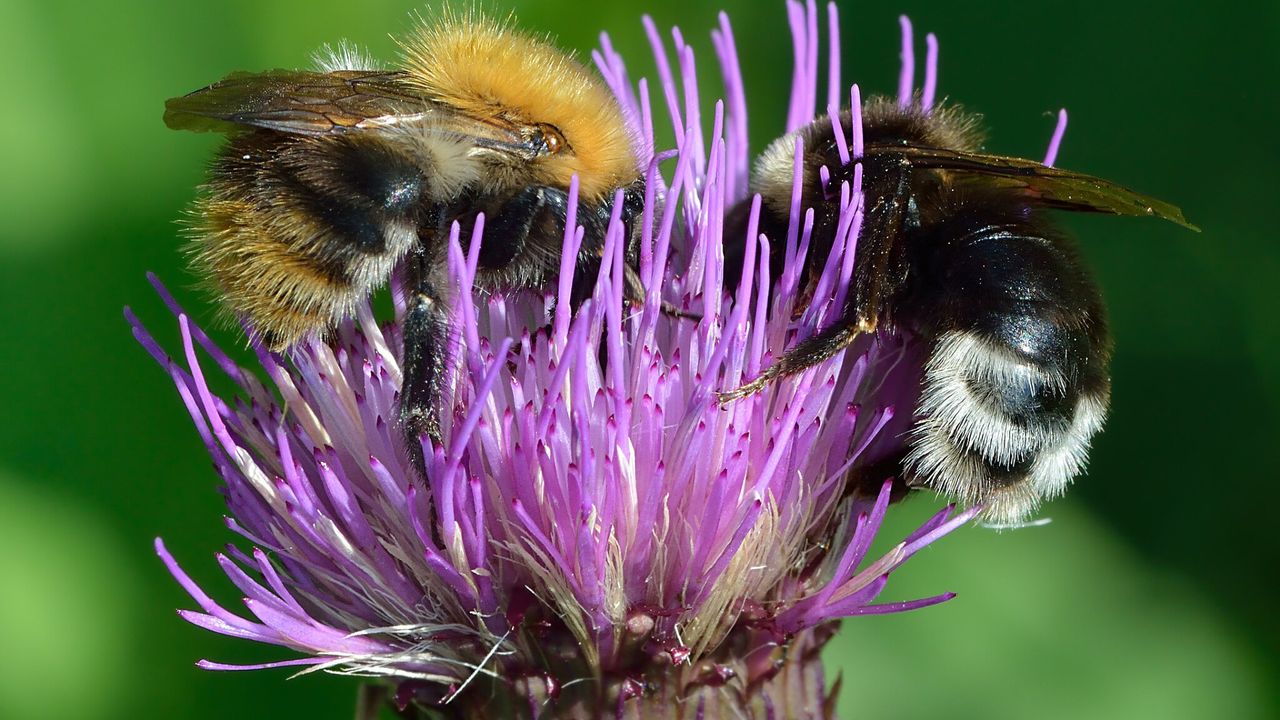
Alien Minds on Earth? (Image Credits: Cdn.mos.cms.futurecdn.net)
Researchers propose honeybees as a stand-in for extraterrestrial minds to test whether mathematics could serve as a shared language across the stars.
Alien Minds on Earth?
Humanity’s quest for extraterrestrial intelligence has long grappled with one core problem: how to bridge communication gaps with beings whose biology and culture remain unknown. Distances between stars, such as the 4.4 light-years to the nearest neighbor, demand signals that transcend spoken words or symbols.[1]
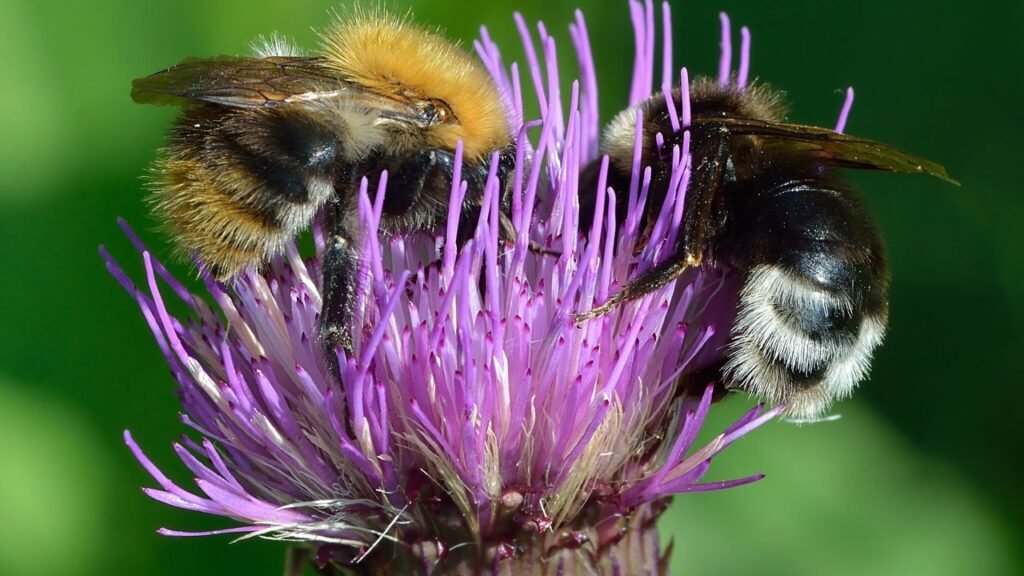
Bees emerge as compelling proxies. Their ancestors diverged from humans over 600 million years ago, yet these insects exhibit social structures, communication systems, and numerical cognition. Scientists view this evolutionary chasm as ideal for modeling truly alien thought processes.[1]
Honeybees perform the famous waggle dance to convey food source locations, including distance, direction relative to the sun, and resource quality. Such sophistication in a tiny brain suggests parallels to how advanced extraterrestrials might signal intent.
Bees Tackle Numbers Like Pros
Experiments conducted from 2016 to 2024 revealed honeybees’ grasp of basic arithmetic. Freely flying bees visited outdoor setups, earning sugar rewards for correct choices amid blue and yellow symbols representing quantities.[1]
These insects solved addition and subtraction problems, often by one, categorized odd versus even counts, ordered items by number, and even recognized zero as a quantity. They linked symbols to values, akin to early numeral learning in children.
- Simple addition: 2 + 1 = 3
- Subtraction: 4 – 1 = 3
- Odd/even discrimination
- Zero concept
- Symbol-number association
Adding or subtracting one theoretically equips bees to build all natural numbers, hinting at abstract potential despite limited neural hardware.
Math’s Stellar Track Record
Efforts to contact aliens have leaned on numbers for decades. The 1974 Arecibo message transmitted 1,679 binary digits depicting numbers one through ten and DNA’s atomic makeup.[1]
Voyager 1 and 2 probes, launched in 1977, carried Golden Records with etched diagrams of mathematical constants and physical units to decode humanity’s story. More recently, a 2022 project crafted binary code introducing extraterrestrials to human math, chemistry, and biology.
| Message | Year | Key Elements |
|---|---|---|
| Arecibo | 1974 | Binary numbers 1-10, DNA atoms |
| Voyager Golden Records | 1977 | Math constants, binary playback instructions |
| Binary Language Project | 2022 | Math, chemistry, biology intro |
Galileo Galilei once called the universe a book written in mathematics. Science fiction echoes this, from prime number signals in Contact to puzzles in The Three-Body Problem.
Toward a Cosmic Dialect
A recent paper in the journal Leonardo by Scarlett Howard, Adrian Dyer, and Andrew Greentree builds this case. Their analysis posits that if bees and humans converge on math, sophisticated alien brains likely would too.[1]
Still, variations might arise, like mathematical dialects. This framework bolsters SETI strategies, prioritizing numerical patterns in radio scans or optical signals.
Key Takeaways
- Bees master arithmetic despite tiny brains, mirroring potential alien cognition.
- Historical signals like Arecibo and Voyager used math as a universal starter.
- Math may transcend biology, enabling first contact across the void.
Honeybees remind us that intelligence often finds common ground in numbers. As searches for extraterrestrial signals intensify, this insect insight could redefine our cosmic outreach. What do you think – could math truly unite us with the stars? Share in the comments.