
Somewhere beneath the waves, a city waits. Its streets are silent, its temples swallowed by salt water and sediment, its stories buried under centuries of sand. You might think that’s purely the stuff of legend, the kind of tale Plato spun about Atlantis and sailors whispered in smoky harbors. The truth, however, is both stranger and more awe-inspiring than any myth.
Lost cities sunken beneath the waves are not just myths. Many coastal communities were swallowed up by the sea in the ancient world, with their streets, homes, and temples all submerged under relentless tides. What we’re still uncovering today about these places has the power to completely reshape how you understand human history. So let’s dive in.
Why Did Entire Cities End Up Underwater in the First Place?
If you’ve ever stood on a beach and watched the ocean creep a little closer with each wave, you’ve glimpsed the slow, relentless process that swallowed whole civilizations. As tectonic plates move, earthquakes, volcanoes, tsunamis, and other seismic phenomena can cause so-called solid ground to shake, crumble, liquefy, or even fall into the sea, taking whole coastal cities with them.
Seismic activity has repeatedly led to the disappearance of coastal areas and entire cities. Violent earthquakes or resulting tsunamis could wipe an entire city off the face of the Earth, as happened to the Greek city of Helike in 373 B.C. Other cities met their end more slowly, inch by inch, as rising sea levels gradually claimed them. It’s a sobering reminder that the ground beneath your feet is never quite as permanent as it feels.
In the past, people looked for religious explanations, usually some sort of divine punishment. From the Epic of Gilgamesh to Noah’s ark, stories from many civilizations feature a great flood set loose by a powerful deity. Today, people look to science for explanations behind these natural events that left whole cities underwater.
Pavlopetri: The Oldest Underwater City You’ve Probably Never Heard Of
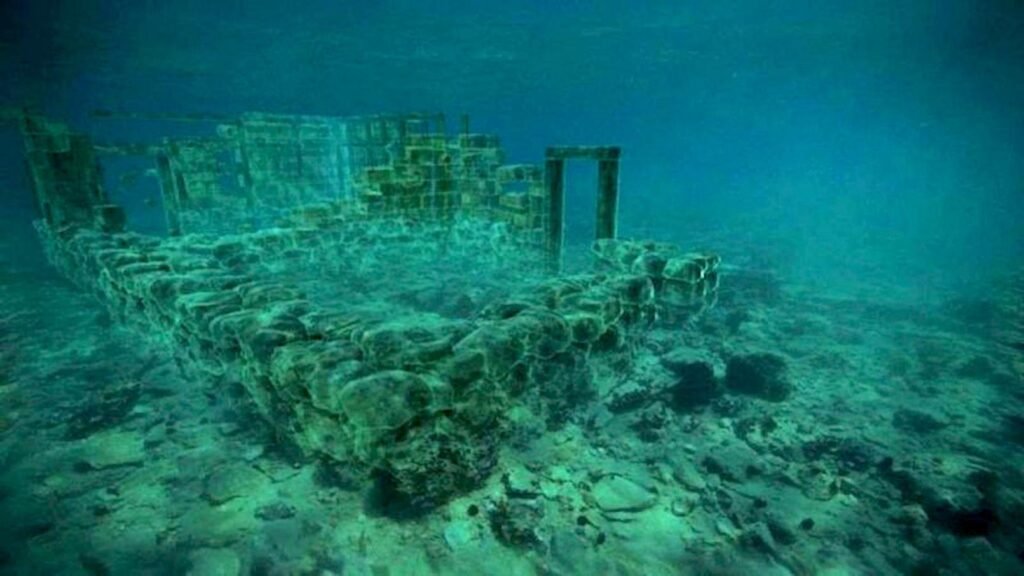
Here’s the thing about Pavlopetri, it’s one of the most extraordinary archaeological sites in the world, yet most people have no idea it exists. In the clear coastal waters off the Peloponnese region of southern Greece lie the remains of what some archaeologists believe is the oldest submerged city in the world. The Bronze Age site was occupied between 2800 and 1200 B.C., centuries before the Classical Greek period, and it appears to be the oldest planned city found underwater.
From what has been uncovered at the site, the ancient city’s layout resembles many modern-day cities. Well-designed roads, houses, gardens, temples, complex water management systems, and huge buildings have so far been found. The entire city is known to be at least 80,000 square meters in size, with a vast open plaza in the center of these sunken ruins. Think about that for a moment. People were designing cities with open plazas and organized road networks thousands of years before you might have assumed such urban thinking existed.
Excavations revealed a large number of Minoan-style loom weights, suggesting Pavlopetri was a thriving trade center with a robust textile industry. That’s not a primitive settlement. That’s a functioning economic hub. The fact that it’s been sitting quietly beneath the Aegean for millennia, largely unknown, is honestly a little mind-blowing.
Thonis-Heracleion: Egypt’s Mythical Gateway Rises from the Deep
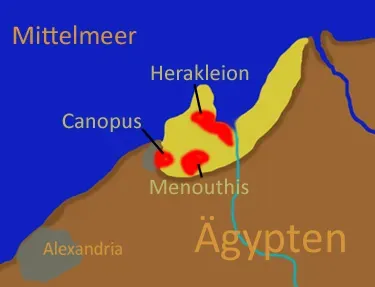
For more than 2,000 years, a legendary Egyptian city lay buried beneath both sand and sea at the mouth of the Nile River. The Greeks named the city Heracleion, after the mythical hero Herakles, and the Egyptians called it Thonis. During the Ptolemaic Dynasty, Thonis-Heracleion was the port of entry for all Greek ships traveling to Egypt and home to the magnificent temple of Amun, where the Ptolemaic pharaohs received their divine authority.
Recent phases of underwater missions documented new zones around the Amun temple complex and identified a Greek sanctuary dedicated to Aphrodite east of it. Finds from these missions include imported bronze and ceramic objects and Greek weapons, supporting the idea that Greek merchants and mercenaries operated within the city well before the Hellenistic era. The discoveries support Thonis-Heracleion’s role as a multicultural commercial gateway, with religious spaces and trade infrastructure intertwined within a port environment. You wouldn’t expect Greek weapons buried in an Egyptian harbor, would you? That’s exactly the kind of surprising cultural overlap that rewrites the textbooks.
Among the astounding finds hidden in the murky Mediterranean waters were two colossal red-granite statues of a Ptolemaic king and queen, each measuring 15 feet tall and weighing several tons. The most prized find was a fully intact, black-granodiorite stele covered in hieroglyphics. Entire chapters of cross-cultural trade and diplomacy are quietly preserving themselves on that seafloor.
Baiae: Rome’s Sunken Party City and Its Shocking New Secrets
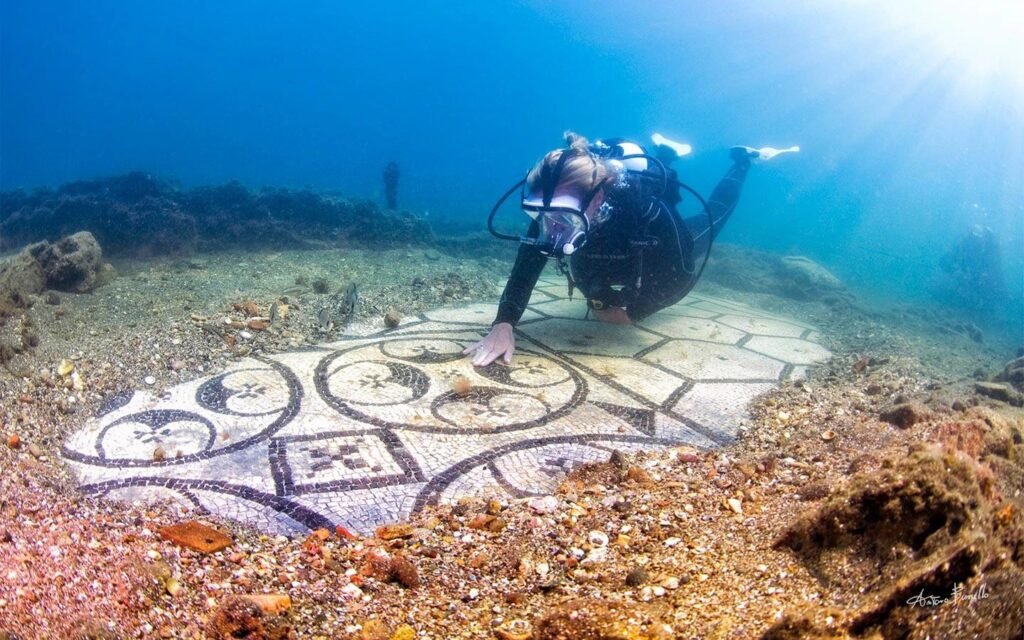
Honestly, if there were ever a Roman city that deserved to be immortalized in legend, it’s Baiae. Once known as the “Las Vegas of the Roman Empire,” the ancient submerged Roman city of Baiae is located in the Gulf of Naples, a few kilometers from Pompeii. Baiae was the place where Roman nobility escaped the hustle and bustle of Rome to unwind in pleasure palaces with stunning sea views, natural hot springs, and opulent villas. Cicero, Caesar, Mark Antony, Brutus, and Nero all had villas there.
Unlike the “sinful” city of Port Royal, Baiae wasn’t struck down by a devastating earthquake, but was slowly swallowed up by the sea through a geological process called bradyseism, in which the land above a hydrothermal zone periodically rises or subsides. Two thousand years ago, the ornately decorated villas and baths of Baiae were at sea level, but now they’re 20 to 30 feet beneath the Gulf of Pozzuoli.
In July 2024, researchers reported an ornate underwater mosaic floor linked to a Roman villa within the submerged archaeological park, highlighting the town’s elite architecture and expensive decorative techniques. In August 2025, archaeologists announced the discovery of a submerged Roman bathhouse with features consistent with Roman heating and bathing infrastructure, possibly relating to a high-status villa tradition associated with Rome’s political class. Together, these finds show Baiae isn’t just a known site – it’s still yielding new, headline-grade urban discoveries.
Atlit-Yam and Dwarka: Rewriting the Timeline of Human Civilization
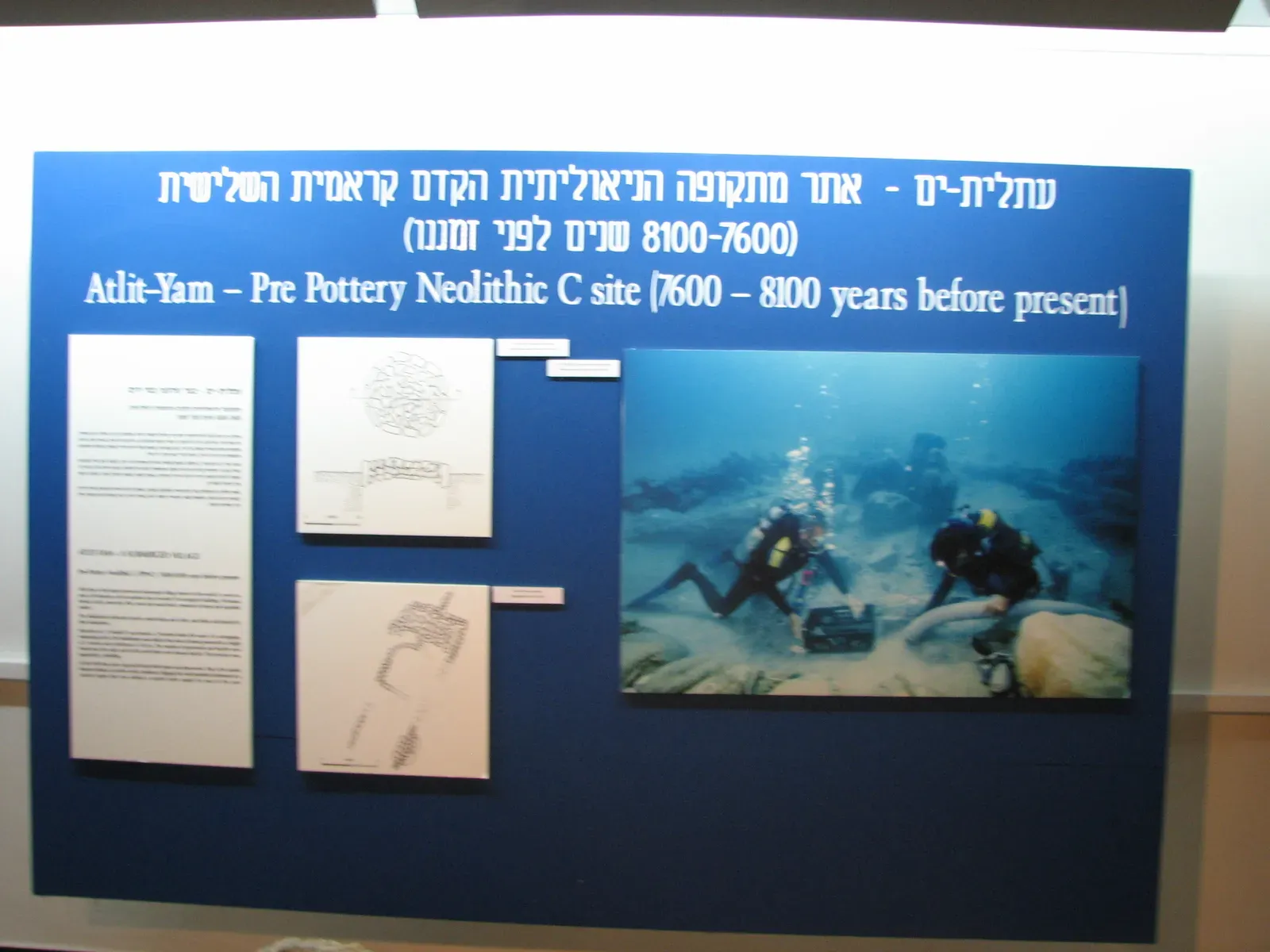
Prepare yourself, because this is where things get genuinely astonishing. Atlit-Yam, discovered in 1984 in the shallow coastal waters near Haifa, Israel, is a Neolithic site first settled around 6900 B.C., making it by far the oldest known human settlement found underwater. The inhabitants were farmers and fishermen who occupied a fertile stretch of land left behind by the receding Mediterranean Sea. They planted wheat and pastured animals, and dug deep wells lined with stone to reach freshwater aquifers more than 30 feet underground. A civilization that sophisticated, that far back in time, is genuinely humbling.
Atlit-Yam lies 12 meters below sea level and is the world’s oldest submerged site. Researchers subsequently found 65 human remains in graves, houses, tools, and seven megaliths forming half a circle, as well as remnants of plants, animal bones, and burial goods. That stone circle, comparable in its intention to Stonehenge, tells you that these were not primitive wanderers but organized, spiritually aware communities with complex social structures.
Then there’s Dwarka, off the coast of India, steeped in both legend and hard archaeology. The ancient city of Dwarka off the coast of Gujarat in western India has long been identified in archaeology and legend as a major Late Harappan or early historic port town. In early 2026, the Archaeological Survey of India announced a renewed program of deeper land and underwater exploration at the site, including the use of modern technologies to probe previously unexamined offshore sectors. Officials say the upcoming investigations will focus on mapped underwater zones near Bet Dwarka, where structural anomalies and stone features have been observed.
The Technology Unlocking Secrets the Ocean Has Kept for Millennia
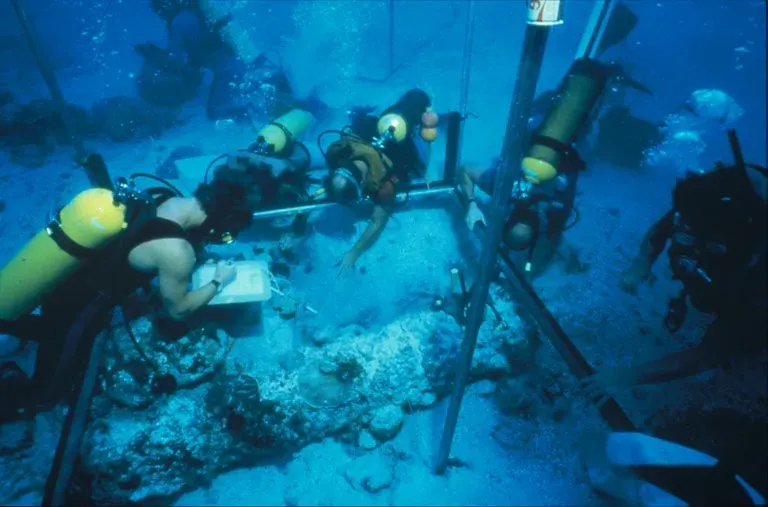
You might wonder how researchers even find these cities in the first place. It’s not as though someone stumbles across a golden gate post while snorkeling, though that kind of accidental discovery has happened. These sunken sites are now the “hunting grounds” for today’s underwater archaeologists using the latest technologies, including SONAR, robotics, 3D scanning, and underwater cameras. Think of it like trying to read a book in complete darkness while holding your breath. The technology finally gave researchers a flashlight.
Researchers first noticed hints of long-lost megaliths in LiDAR data collected by the Litto3D program, a national initiative to create a precise 3D digital reconstruction of the entire French coastline. The existence of the mysterious structures was confirmed and their locations mapped out across dozens of dives carried out between 2022 and 2024. LiDAR, the same laser scanning technology used in self-driving cars, is now revealing ancient ruins that no human eye ever physically located. The crossover between Silicon Valley innovation and Bronze Age archaeology is something nobody really predicted.
Researchers published a high-resolution 3D reconstruction of the submerged Japanese settlement of Hibara-juku using multibeam echo-sounder surveys combined with historical cadastral maps. The work identified town blocks, roads, waterways, and shrine approaches preserved on the lakebed, transforming written history into a mapped urban landscape. By aligning bathymetric data with pre-submergence land records, the study offers one of the most detailed reconstructions of a drowned historic townscape produced in recent years, demonstrating how modern technology is reshaping the field.
Conclusion: The Ocean Holds a Mirror to Our Past
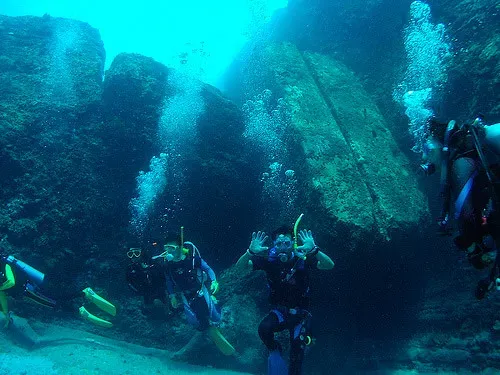
Every submerged city is, in its own way, a time capsule. A frozen moment that escaped the looting, the burning, and the gradual demolition that erased so many civilizations above the surface. Beneath the waves of oceans and seas lie the silent ruins of once-thriving cities, frozen in time, shrouded in mystery, and steeped in history. These ancient underwater cities, long lost to natural disasters or rising sea levels, offer rare and tantalizing glimpses into early human civilizations.
Studying ancient submerged cities helps scientists understand how human societies responded to environmental changes. Many of these ruins were found using advanced sonar and diving technology, pushing the boundaries of underwater archaeology. These sites reveal how people lived, worshipped, and interacted with nature, drawing direct lines from the past to modern coastal cultures. There’s a very real possibility that the ocean floor holds more evidence of ancient human civilization than everything we’ve found on land combined. It’s hard to say for sure, but the more you look, the more the ocean gives back.
What strikes me most is this: every single one of these cities was once someone’s entire world. Their marketplace, their temple, their home. Now they’re puzzles we’re slowly piecing together from the deep. The question worth sitting with is a simple one – how many more are still out there, waiting? What would you guess?