
In the early years of the Large Hadron Collider, physicists were hunting for one thing above all: the Higgs boson, the long-predicted particle that would finally explain why matter has mass. They found it in 2012, and for a brief moment it felt like the story was complete. Yet the more researchers have probed the Higgs and the fabric of space-time, the more a new mystery has emerged: what if the mass we measure is only the visible tip of a much stranger, higher‑dimensional iceberg? From tiny curled-up dimensions to vast, hidden geometries that bend gravity itself, a new generation of theories is daring to suggest that mass might not be a fundamental property at all. It could instead be a side effect of how our three-dimensional world slices through a richer, unseen cosmos.
The hidden clues in how mass misbehaves
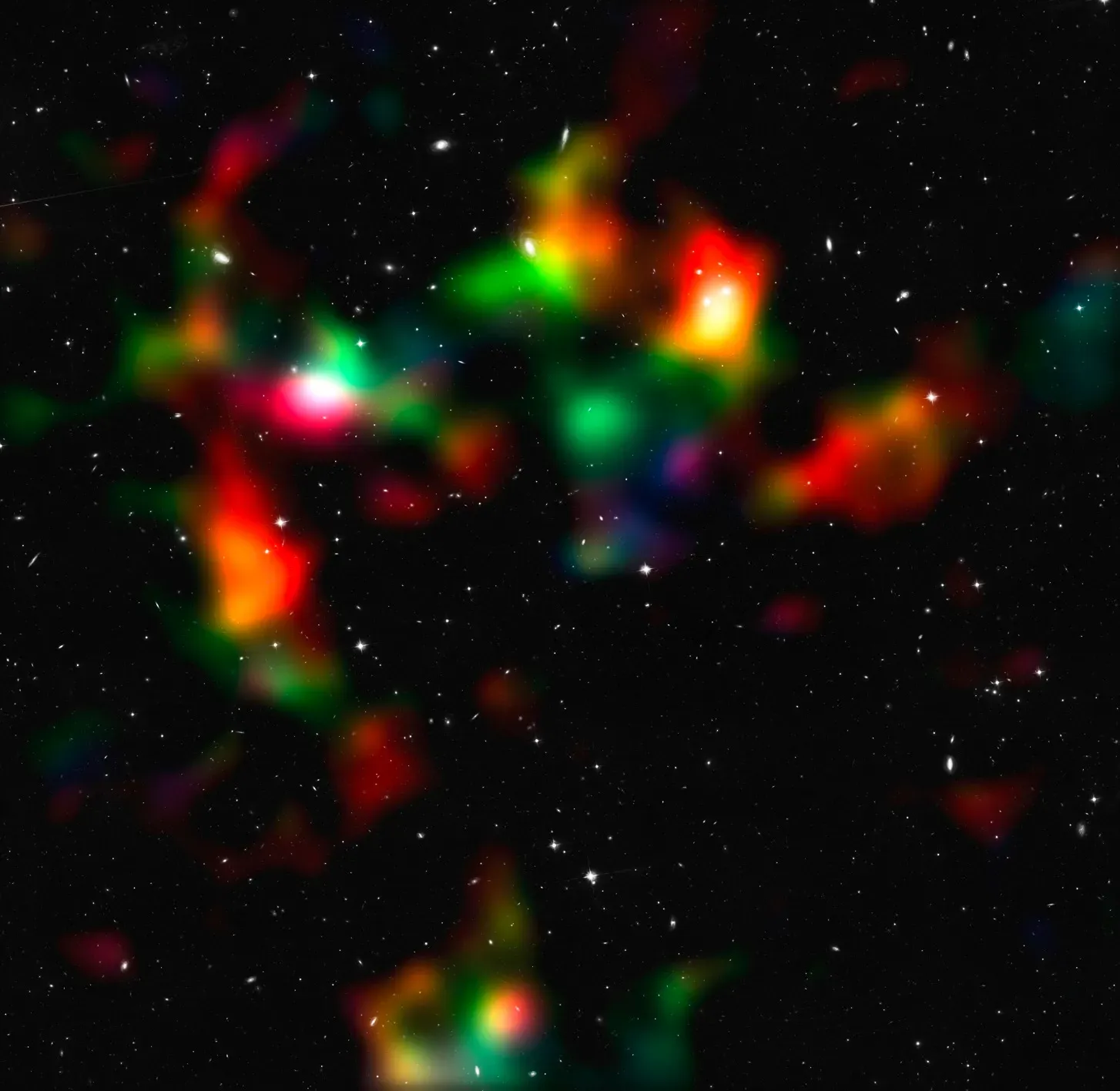
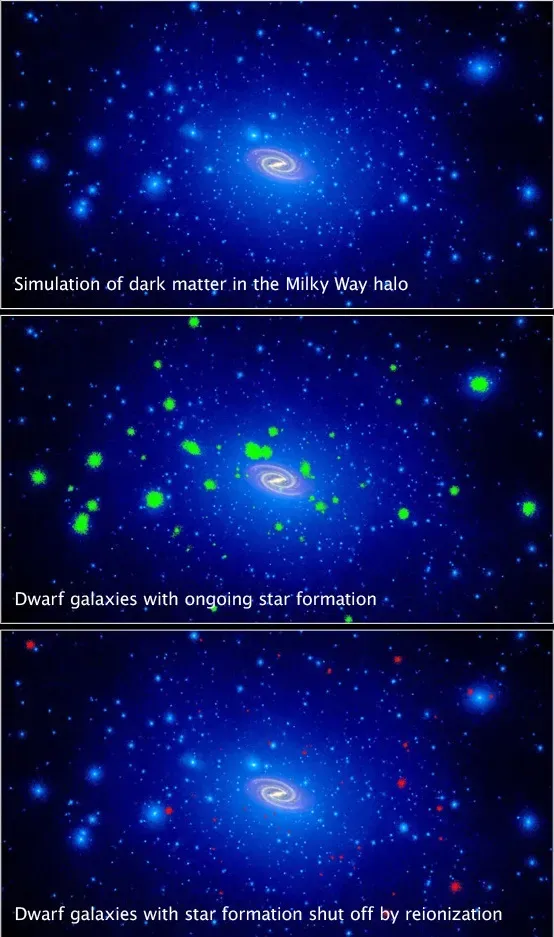
At first glance, mass seems boringly straightforward: you put something on a scale, you get a number, end of story. But on cosmic scales, gravity does something unsettling that quietly hints we might be missing a big piece of the puzzle. Galaxies spin too fast, clusters hold together too tightly, and the large-scale web of matter in the universe is more massive than the visible stars and gas can explain. Astronomers wrap all these mismatches into one eerie label, dark matter, but that name is more of a confession than an answer.
Hidden dimensions offer a radical alternative: maybe gravity appears weaker, or mass appears larger, because some of the gravitational field is leaking into unseen directions of space. In these models, our familiar universe is like a three-dimensional membrane, or “brane,” floating in a higher-dimensional arena. The particles we know are stuck to this brane, but gravity can wander off, changing how mass and motion look from our limited vantage point. Instead of adding mysterious new kinds of matter, this view rewrites what mass and gravity even mean.
From ancient weights to the Higgs field
Humanity’s relationship with mass started with stone weights and balance scales, not quantum fields and extra dimensions. Ancient traders only cared that a measure of grain matched a chunk of metal, not why either of them had mass to begin with. For centuries, mass was a practical concept, a way to price goods and predict how hard a cart was to push. Even Isaac Newton, who revolutionized physics, treated mass as a built‑in property – something objects simply possessed, like shape or color.
That picture cracked in the twentieth century when quantum theory and relativity collided with particle physics. The Standard Model introduced the Higgs field, an invisible energy field spread through all of space; particles interact with it and, through that interaction, acquire mass. When the Higgs boson was finally detected, it confirmed that this field is real. But it did not explain why the Higgs itself has the mass it does, or why the strength of its interactions seems exquisitely fine‑tuned. Those unresolved questions opened a door for more exotic ideas, including extra dimensions sculpting the properties of the Higgs and everything that feels heavy.
Warped dimensions: when geometry becomes a mass machine
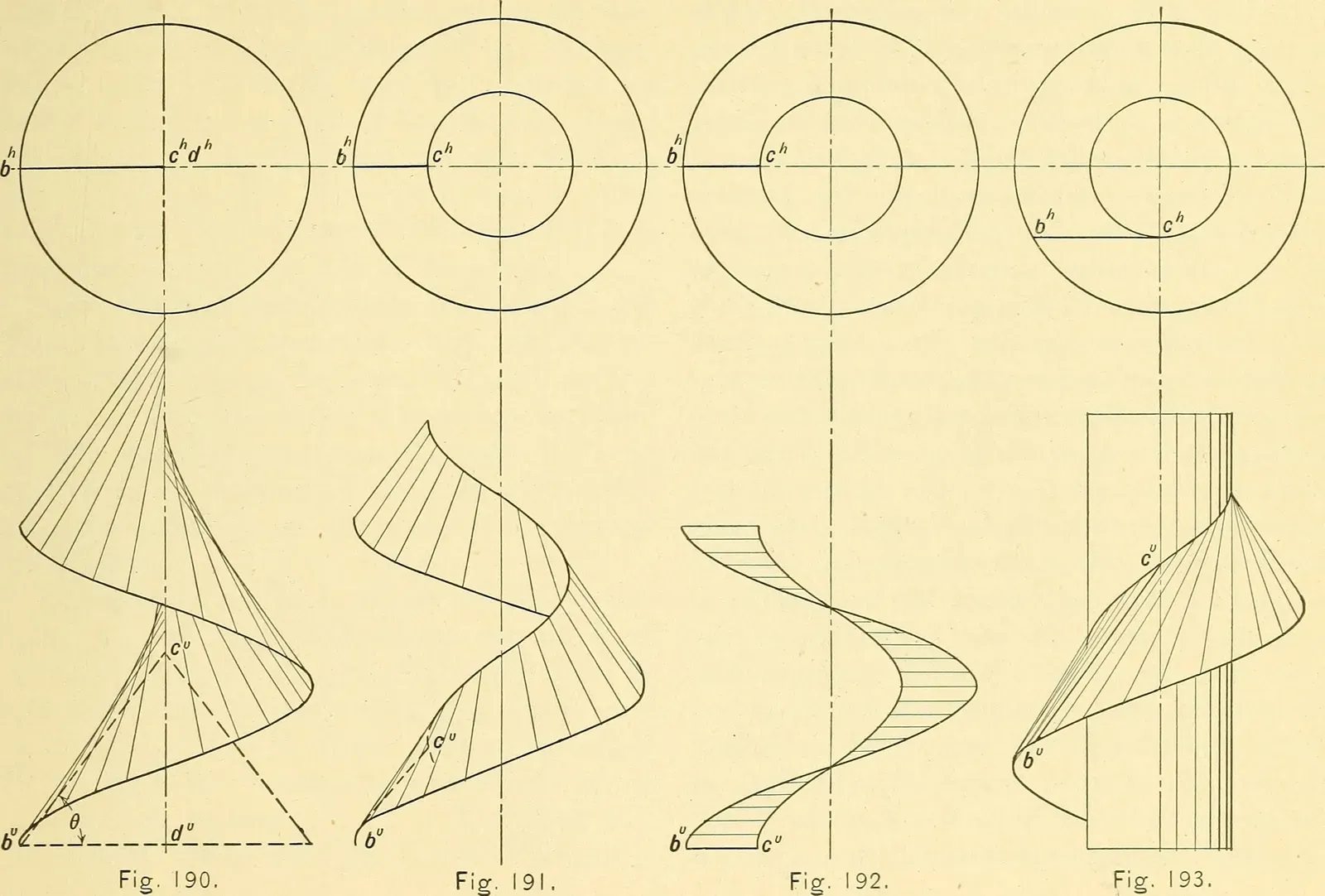
One of the most striking ideas about hidden dimensions suggests that extra space is not just tiny and curled up – it is warped, like a rubber sheet stretched unevenly. In so‑called warped extra-dimensional models, the geometry of the higher‑dimensional space changes the energy scales that particles feel on our brane. Imagine walking on a gently sloping landscape that is actually part of a steep canyon you cannot see; your sense of distance and effort would be subtly distorted. In physics terms, that distortion can make fundamental mass scales appear much smaller or larger than they “really” are in the full higher‑dimensional picture.
In some proposals, the true fundamental mass scale of the universe could be close to the familiar Planck scale, while the masses we observe for particles on our brane are dramatically reduced by this hidden warp. That twist of geometry offers one possible solution to the so‑called hierarchy problem, the puzzle of why gravity is so much weaker than the other forces. It also predicts that the Higgs and other particles might have higher‑dimensional partners, echoes of their presence in the extra directions of space. These partners have not been definitively seen, but they have provided clear targets for collider experiments and astrophysical searches.
Signals from the edge: what the LHC and the cosmos are whispering
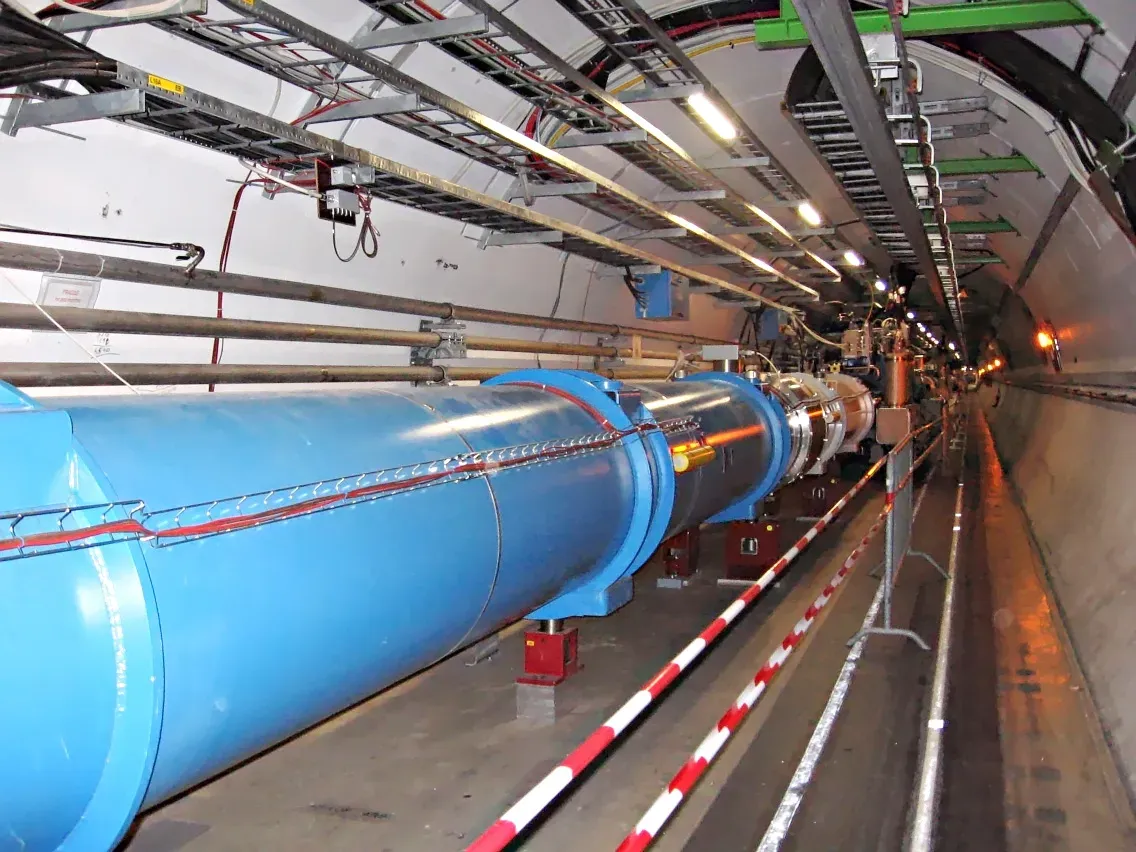
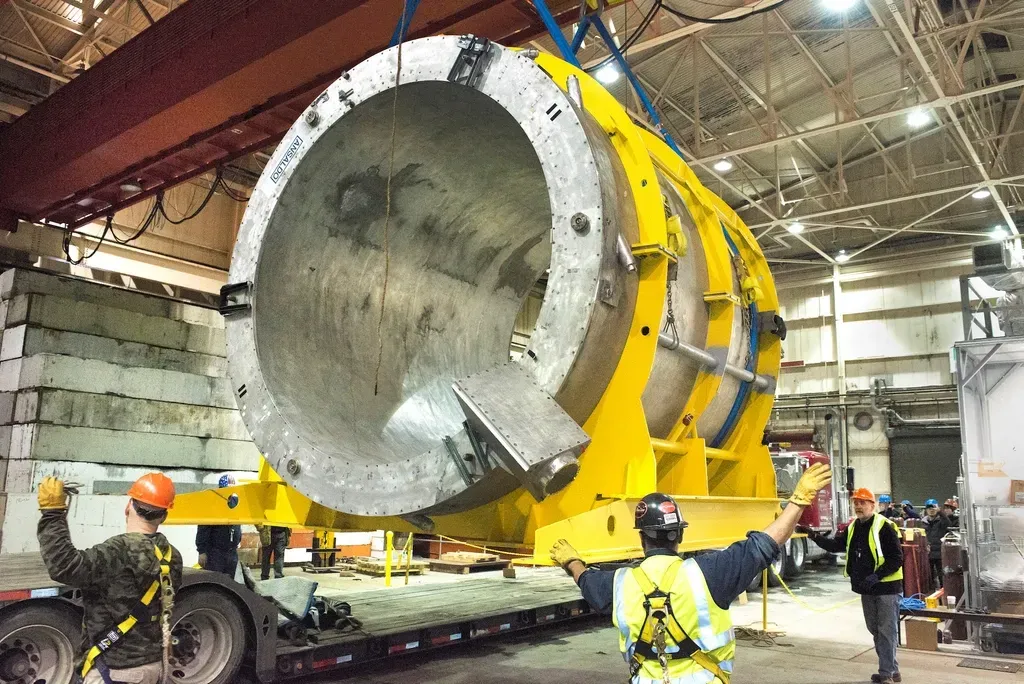
If extra dimensions really help set the masses of particles, they should leave fingerprints, and physicists have been hunting for those marks in both high‑energy collisions and the sky. At the Large Hadron Collider, proton‑proton collisions reach energies where, in some theories, gravitons or heavy resonances associated with extra dimensions might be produced. These would show up as missing energy, unusual patterns in how particles spray out, or unexpected heavy states decaying into familiar particles. So far, the data have placed tight constraints on the size and shape of certain extra‑dimensional models but have not ruled them all out.
Meanwhile, the cosmos itself acts as an enormous detector. Precise measurements of the cosmic microwave background, the large‑scale distribution of galaxies, and gravitational lensing reveal how mass and gravity behave over billions of light‑years. If gravity leaks into extra dimensions at large distances, it could subtly alter how structures grow or how light bends around clusters of galaxies. Researchers comb through this data, comparing it to detailed simulations, looking for any departure from the predictions of general relativity in three dimensions. Even a small, consistent discrepancy could be the first hint that mass is being shaped by a geometry we cannot yet see.
Why it matters: mass, meaning, and the architecture of reality
It might be tempting to file hidden dimensions under “fun but irrelevant,” yet this line of research cuts straight to the core of how reality is built. Mass is not just a number on a scale; it is what determines how stars burn, how planets form, and whether chemistry – and therefore life – can even exist. If mass is emergent from extra dimensions, then the conditions that allowed humans to arise might depend on the shape of spaces we never directly experience. That turns a philosophical question – why does anything weigh anything at all – into a concrete scientific one.
Compared with older views where mass is simply an intrinsic property, higher‑dimensional ideas suggest a more relational universe. Just as temperature emerges from the collective motion of atoms, mass might emerge from deeper fields and geometry interacting across dimensions. This shift also reframes the hunt for dark matter and dark energy: maybe some of what we attribute to unseen stuff is actually a sign that our picture of space itself is incomplete. Understanding which is which could influence everything from how we interpret cosmic history to how we design future experiments. It is not just an abstract puzzle – it is a question about what kind of universe we truly inhabit.
On the frontier: tools that could expose extra dimensions
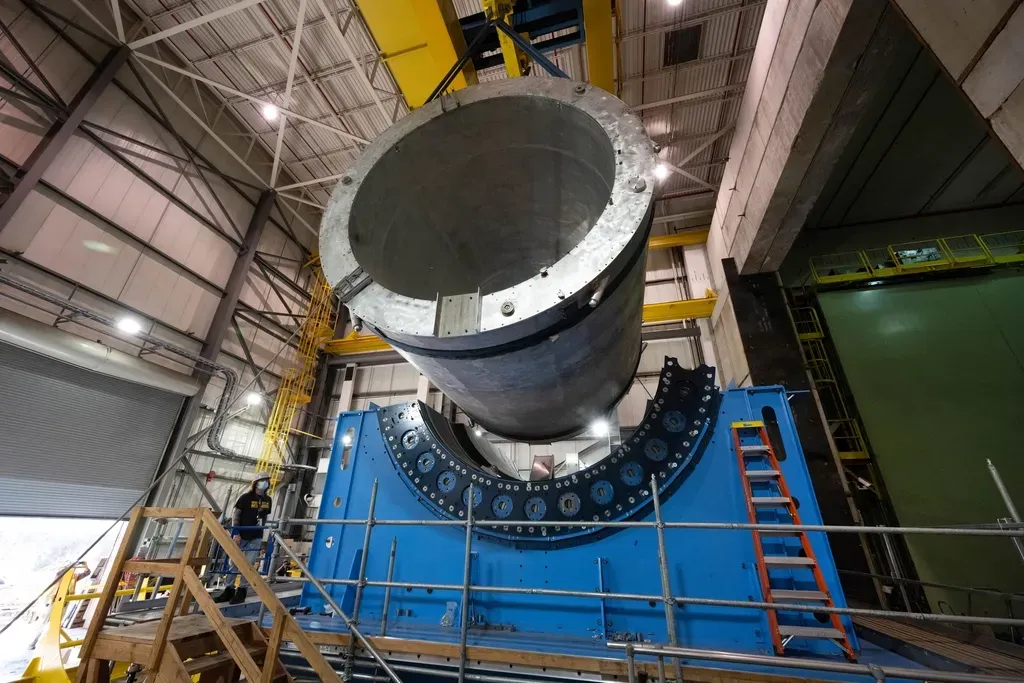
Testing ideas about hidden dimensions is hard, but not hopeless, and a whole ecosystem of instruments is being sharpened for the job. On the particle physics side, upgrades to the Large Hadron Collider are increasing the number and precision of collisions, allowing physicists to probe rarer processes and smaller deviations from the Standard Model. Proposals for next‑generation colliders, including electron‑positron machines and even more powerful proton colliders, would extend the reach further into energy scales where extra‑dimensional effects might become visible. Each new dataset slices away at the parameter space where these theories can hide.
At the same time, space‑based observatories and gravitational‑wave detectors are turning the cosmos into a laboratory for higher‑dimensional physics. Precise timing of pulsars, ultra‑sensitive measurements of gravitational waves from black hole mergers, and surveys of how gravity behaves in the outskirts of galaxies all act as cross‑checks on three‑dimensional gravity. On smaller scales, tabletop experiments use pendulums, torsion balances, and micro‑fabricated devices to test whether gravity deviates from the inverse‑square law at millimeter or even micrometer distances. Each of these approaches looks for subtle shifts that, together, could point toward or away from the existence of hidden dimensions shaping mass.
Beyond the Standard Model: where extra dimensions meet other wild ideas
Hidden dimensions are not the only game in town when it comes to explaining mass, but they often intertwine with other bold frameworks. In some versions of string theory, for example, the existence of extra dimensions is non‑negotiable; the way those dimensions are compactified determines the spectrum of particles and their masses. Different shapes correspond to different possible universes, like a menu of physical laws encoded in geometry. Our universe, in that view, is one particular choice where the pattern of masses happens to allow stars, planets, and observers.
Other theories, such as those involving composite Higgs models or new strong forces, try to explain mass without invoking extra space, instead building it from deeper interactions within our familiar dimensions. The tension and overlap between these ideas create a lively debate in theoretical physics. Hidden dimensions must not only match experimental data, they must also fit coherently with quantum field theory, cosmology, and the successes of the Standard Model. The result is a constantly shifting landscape where new models rise, are tested, and sometimes fall, gradually refining our understanding of how mass arises. Even when a particular idea fails, it often points the way to more robust and testable theories.
The future landscape: where we might discover the unseen
Looking ahead, the search for extra dimensions and the origin of mass is likely to be a marathon, not a sprint. Over the coming decades, planned facilities – more powerful colliders, next‑generation gravitational‑wave observatories, and massive sky surveys – will tighten the net around any deviations from three‑dimensional physics. Even null results will be valuable, forcing theorists to adjust or abandon models that no longer fit. In parallel, advances in quantum technologies may enable new kinds of precision measurements, from ultra‑stable atomic clocks to entangled sensors that could pick up faint signatures of exotic physics.
There is also a quieter revolution happening in how we sift through data. Machine‑learning tools are being trained to spot unusual patterns in collider events and astrophysical observations that humans might miss. If extra dimensions are subtly affecting the distribution of masses or decay channels, such tools could be the first to flag the anomaly. On the theoretical front, creative new frameworks are emerging that connect higher‑dimensional ideas with quantum gravity and holography, suggesting that the boundary between space, information, and matter might be thinner than we ever imagined. None of this guarantees that hidden dimensions are real, but it does mean that, for the first time, we have a realistic chance of finding out.
How you can stay connected to the next big discovery
For most of us, the idea that mass could come from hidden dimensions sounds remote from everyday life, but there are simple ways to stay engaged with this unfolding story. Following updates from major observatories, particle physics labs, and reputable science outlets turns the search for extra dimensions into an ongoing narrative rather than a distant abstraction. Many experiments now share open data and public tools, inviting curious non‑experts to explore real measurements. Public lectures, online courses, and citizen‑science platforms also lower the barrier to following cutting‑edge cosmology and particle physics.
Supporting science goes beyond attention, too. Advocating for research funding, visiting local planetariums and science museums, and encouraging science education in schools all help sustain the ecosystem that makes these ambitious experiments possible. Even small choices, like sharing a well‑explained article about the Higgs or dark matter instead of a sensational but misleading headline, shape how society thinks about big questions. The origin of mass might seem like an abstract puzzle, but the quest to understand it reflects something very human: a refusal to accept that what we see is all there is. As we keep pushing at the edges of the known universe, the next surprise might already be hiding in dimensions we have yet to uncover.
Suhail Ahmed is a passionate digital professional and nature enthusiast with over 8 years of experience in content strategy, SEO, web development, and digital operations. Alongside his freelance journey, Suhail actively contributes to nature and wildlife platforms like Discover Wildlife, where he channels his curiosity for the planet into engaging, educational storytelling.
With a strong background in managing digital ecosystems — from ecommerce stores and WordPress websites to social media and automation — Suhail merges technical precision with creative insight. His content reflects a rare balance: SEO-friendly yet deeply human, data-informed yet emotionally resonant.
Driven by a love for discovery and storytelling, Suhail believes in using digital platforms to amplify causes that matter — especially those protecting Earth’s biodiversity and inspiring sustainable living. Whether he’s managing online projects or crafting wildlife content, his goal remains the same: to inform, inspire, and leave a positive digital footprint.