
Few symbols in modern history have carried as much psychological weight as the Doomsday Clock. That simple, haunting image of a clock face inching toward midnight has loomed over public consciousness since the Cold War, shaping how generations of people understand the threat of global annihilation. It’s dramatic, it’s iconic, and honestly, it’s hard not to feel a chill when you hear the phrase.
Yet in 2026, a growing chorus of scientists, historians, and policy thinkers are asking a question that would have felt almost blasphemous decades ago: is the Doomsday Clock still doing its job? Or has it quietly crossed a line from meaningful warning system to something closer to background noise? Let’s dive in.
A Brief History of the Clock That Scared the World
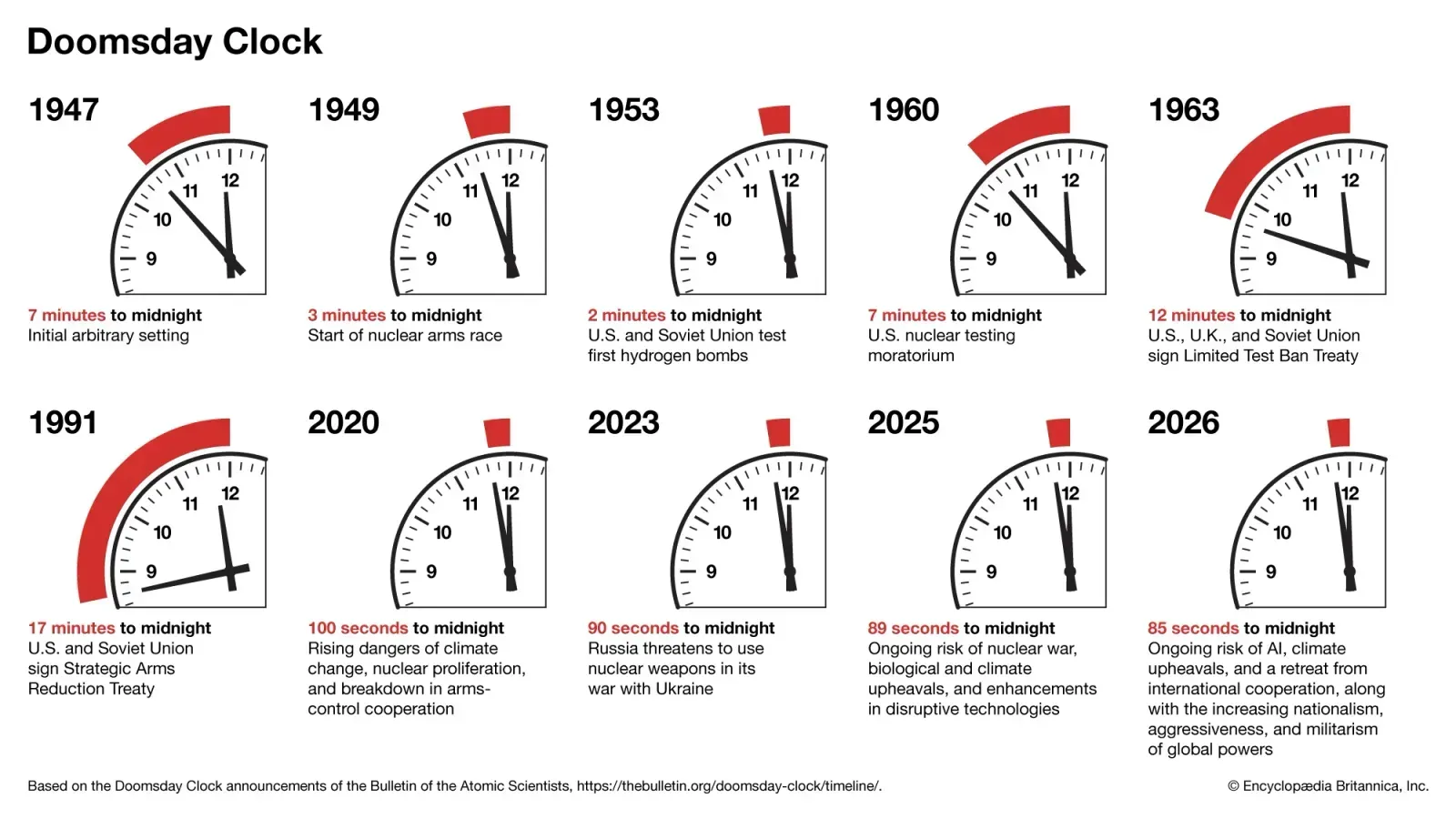
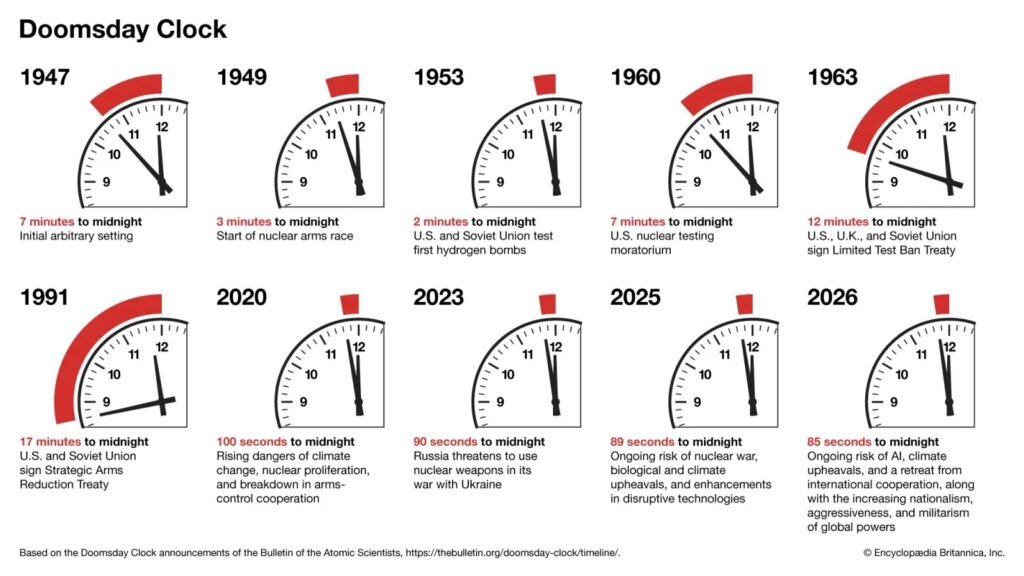
The Doomsday Clock was created in 1947 by the Bulletin of the Atomic Scientists, born out of the terrifying aftermath of Hiroshima and Nagasaki. Its original purpose was clear and urgent: warn the public and policymakers that nuclear weapons posed an existential threat to humanity. At its creation, the clock was set to seven minutes to midnight, and for decades, its movements were major international news events.
Over the years, the clock has swung back and forth depending on geopolitical tensions. It moved as far back as seventeen minutes to midnight in 1991, following the signing of the Strategic Arms Reduction Treaty between the United States and the Soviet Union. That felt like a genuine exhale for the world.
The clock has since crept steadily forward. In January 2023, it was moved to ninety seconds to midnight, the closest it has ever been set. The announcement sent shockwaves through media cycles globally, which is exactly the kind of reaction the Bulletin hoped to generate.
Why Critics Say the Clock Has Lost Its Edge
Here’s the thing: when something is always at its most alarming setting, it stops being alarming. That’s essentially the core criticism being leveled at the Doomsday Clock today. Researchers and commentators argue that by remaining perpetually close to midnight for years now, the clock has inadvertently fallen into a trap of its own making.
Think of it like a car alarm in a busy city neighborhood. The first time you hear it, you run to the window. By the hundredth time, you don’t even bother looking up from your coffee. Critics suggest the Doomsday Clock has become that car alarm, a signal so frequently triggered that people have learned to tune it out entirely.
There’s also a deeper methodological concern. The clock’s setting is determined by a board that includes Nobel laureates and security experts, which sounds authoritative. However, the criteria for adjusting the clock have never been fully transparent or quantified in a way that allows independent verification, and that ambiguity has frustrated scientists who prefer measurable, reproducible assessments of risk.
The Expanding Scope Problem
Originally, the clock was about one thing: nuclear war. That singular focus gave it a kind of brutal clarity that was hard to argue with. In more recent years, the Bulletin expanded the clock’s mandate to include climate change, disruptive technologies, and even biosecurity threats. Honestly, I think that’s where things started to get complicated.
Broadening the scope means the clock now tries to represent a cocktail of existential risks, each with vastly different timescales, probabilities, and policy implications. Nuclear war and climate change are both terrifying, sure, but they are not the same kind of threat, and collapsing them into a single symbolic metric arguably does a disservice to both.
It’s a bit like trying to describe the health of an entire ecosystem with just one number. The number might point in a general direction, but it can’t tell you whether the problem is the soil, the water, the temperature, or the wildlife. Nuance matters enormously in risk communication, and some experts feel the clock has sacrificed that nuance for symbolic power.
The Psychology of Doom Fatigue
There’s a well-documented psychological phenomenon often called “apocalypse fatigue,” and it plays directly into this conversation. When people are exposed to repeated, high-intensity warnings about catastrophic events without seeing those events materialize, they don’t just ignore the warnings. They often become actively resistant to them.
This isn’t irrationality, it’s a pretty understandable human coping mechanism. The brain simply cannot sustain a state of maximum existential dread indefinitely. So it adapts, recalibrates, and eventually dismisses the signal as noise. The Doomsday Clock, critics argue, may now be actively contributing to this fatigue rather than combating it.
What’s particularly troubling is that doom fatigue can bleed into policy apathy. If the public feels that the world is perpetually ninety seconds from annihilation but nothing catastrophic actually happens, they may start to doubt the credibility of the institutions making such claims. That erosion of trust could have genuinely dangerous consequences for future risk communication.
Defenders of the Clock Aren’t Backing Down
To be fair, the Bulletin of the Atomic Scientists and its supporters make a compelling counter-argument: the clock was never meant to be a precise scientific instrument. It’s a metaphor, a piece of public communication designed to make abstract existential threats emotionally legible to ordinary people. Judged on those terms, it has arguably been remarkably successful.
The clock has sparked countless news stories, educational discussions, and political debates that might never have happened without such a visceral symbolic anchor. It keeps nuclear risk on the public agenda at a time when many younger people grew up without the lived memory of Cold War tensions. That’s not nothing.
Supporters also point out that the clock’s credibility comes from the caliber of the people behind it. The Bulletin’s board includes some of the most respected scientific and security minds in the world, and their consensus deserves respect even if the methodology isn’t perfectly transparent. It’s hard to simply dismiss that kind of institutional weight.
What Could Replace It, If Anything?
This is where the conversation gets genuinely interesting. If critics are right that the Doomsday Clock has outlived its usefulness, what comes next? Some researchers advocate for more granular, quantitative risk indices that assess nuclear, climate, and biosecurity threats separately, with clearly defined metrics and regular third-party audits. That approach would trade symbolism for scientific rigor.
Others argue that the world actually needs more storytelling and emotion in risk communication, not less, and that the answer isn’t to abandon the clock but to reinvent it. Perhaps a redesigned framework could offer multiple indicators, displayed visually in a more nuanced way, allowing the public to understand that some risks are worsening while others are improving simultaneously.
It’s hard to say for sure what the right answer looks like. Risk communication is genuinely one of the most difficult challenges in science and policy, because you’re constantly balancing accuracy, accessibility, and emotional impact. Get the balance wrong in either direction and you either bore people to sleep or panic them into paralysis.
The Deeper Question About Science and Symbolism
Ultimately, the debate over the Doomsday Clock is really a debate about how science communicates with the public. Symbols are powerful, they can cut through noise and complexity in ways that data tables and technical reports simply cannot. Yet symbols can also distort, oversimplify, and eventually backfire if they’re not carefully managed.
The Doomsday Clock was created in a very different media environment, one where a single striking image could dominate public consciousness for years. In 2026, we live in a world of relentless information overload, where attention is fragmented across thousands of competing signals every single day. The question isn’t just whether the clock is accurate, it’s whether it can still function as intended in this radically changed landscape.
Let’s be real: there’s something both admirable and a little heartbreaking about a symbol that was designed to save the world but may now be losing its power to do so. The scientists who created it were right to be afraid. The question is whether their chosen tool is still sharp enough to cut through the noise.
Conclusion: Tick Tock, But Who’s Still Listening?
The Doomsday Clock represents one of humanity’s most sincere attempts to translate scientific fear into public action. Whatever its flaws, the intention behind it has always been genuinely noble. The people who move its hands are not alarmists for sport. They are deeply worried individuals trying to make an indifferent world pay attention.
However, good intentions don’t automatically produce good outcomes. If the clock has drifted into irrelevance or, worse, into actively undermining public trust in scientific risk assessment, that’s a serious problem worth taking seriously. Honest evaluation of our own tools, even the ones we’re emotionally attached to, is a sign of intellectual maturity.
I think the most honest takeaway here is this: the world still needs urgent, credible, emotionally resonant communication about existential threats. Whether the Doomsday Clock is still the right vessel for that message in 2026 is a question scientists and communicators can no longer afford to avoid. What do you think? Is the clock still a powerful warning, or has it become little more than a haunting piece of Cold War nostalgia?