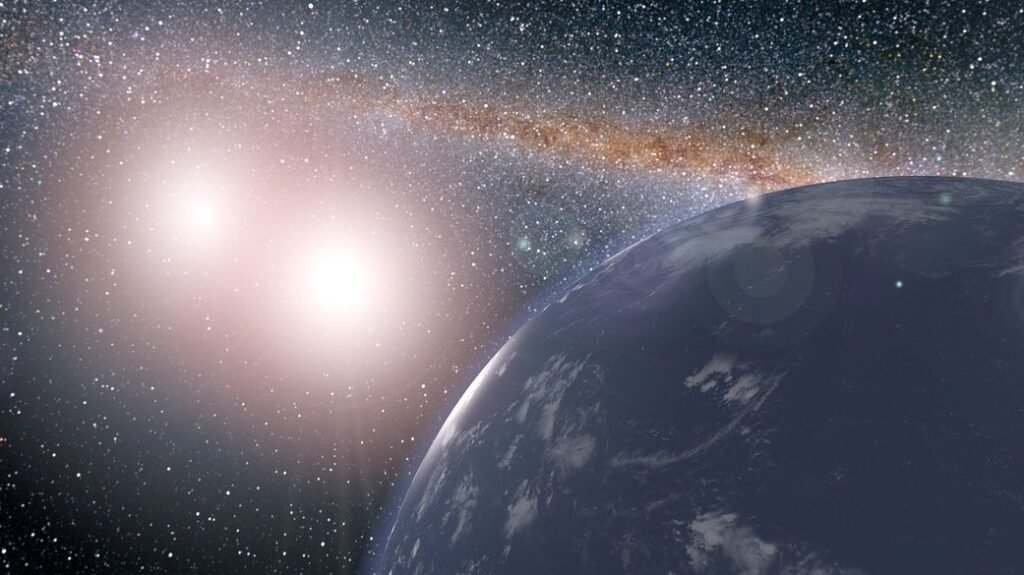

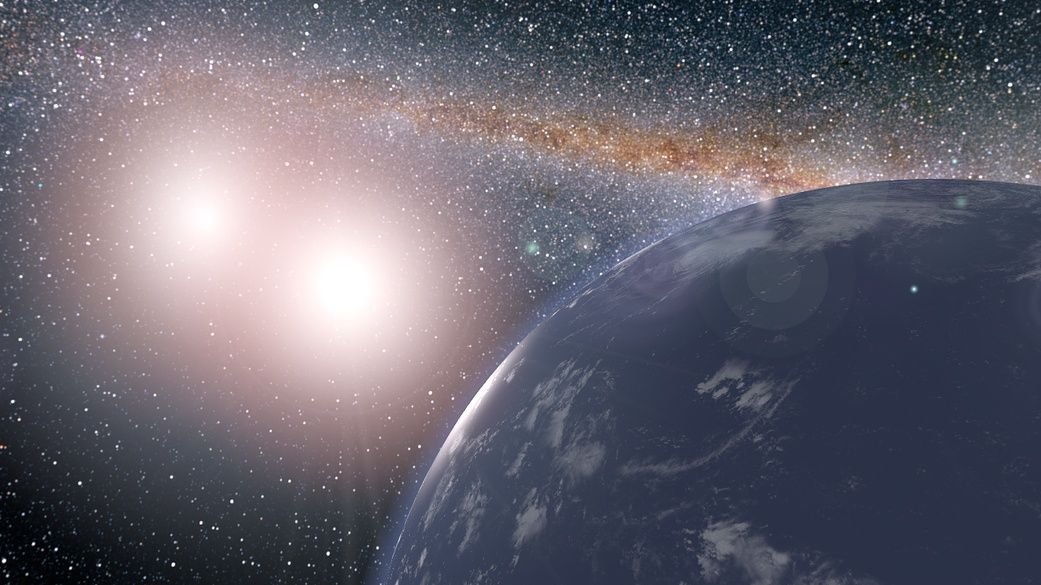
An Unexpected Cosmic Desert Emerges (Image Credits: Cdn.mos.cms.futurecdn.net)
Astronomers have discovered just 14 confirmed exoplanets orbiting pairs of stars – real-world counterparts to the double-sunset world of Tatooine in Star Wars – despite expectations of many more in the Milky Way.[1][2]
An Unexpected Cosmic Desert Emerges
Binary stars dominate the galaxy, accounting for roughly half of all stellar systems. Surveys like NASA’s Kepler and TESS missions identified thousands of exoplanets around single stars, yet circumbinary planets proved elusive. Kepler alone detected about 3,000 eclipsing binaries and expected around 300 large planets orbiting them, but only 47 candidates surfaced, with 14 confirmed.[1]
No such planets appeared around the tightest binaries, those with orbital periods under seven days. Researchers dubbed this gap an “absolute desert.” Mohammad Farhat, a Miller Postdoctoral Fellow at UC Berkeley, noted, “You have a scarcity of circumbinary planets in general and you have an absolute desert around binaries with orbital periods of seven days or less.”[1]
Precession and the Grip of General Relativity
The explanation lies in the subtle dynamics of orbits under Einstein’s general theory of relativity. In a binary system, gravitational pulls from the two stars cause a planet’s orbit to precess, much like a spinning top wobbles. The stars’ mutual orbit precesses primarily due to relativistic effects.[1]
Tidal forces gradually shrink the binary’s orbit. This speeds up the stars’ precession while slowing the planet’s, as the stars’ influence weakens. Eventually, the rates align in an apsidal resonance. The planet’s orbit elongates dramatically, swinging perilously close to the stars at periastron.[2]
Jihad Touma, a physics professor at the American University of Beirut, explained, “A planet caught in resonance finds its orbit deformed to higher and higher eccentricities, precessing faster and faster while staying in tune with the orbit of the binary, which is shrinking.”[1]
Simulations Expose Orbital Chaos
Mathematical models and computer simulations by Farhat and Touma revealed the toll. General relativity disrupts eight of every 10 exoplanets around tight binaries, with 75% destroyed outright – either engulfed, tidally shredded, or ejected.[1] Farhat added, “Two things can happen: Either the planet gets very, very close to the binary, suffering tidal disruption or being engulfed by one of the stars, or its orbit gets significantly perturbed by the binary to be eventually ejected from the system.”
Twelve of the 14 known planets hug the edge of this instability zone, likely migrating inward from safer distances. Planets cannot form there directly; Farhat likened it to “trying to stick snowflakes together in a hurricane.”[2]
- Tidal friction shrinks the binary orbit over millions of years.
- Relativistic precession accelerates for the binary but decelerates for the planet.
- Apsidal resonance locks the orbits, boosting planetary eccentricity.
- The planet enters the chaotic instability zone and meets its fate.
- Survivors orbit too distantly for transit detection.
Relativity’s Dual Nature in Planetary Systems
This work highlights general relativity’s double-edged influence. It stabilized Mercury’s orbit against chaos, yet here it clears close-in planets from binaries. Touma observed, “General relativity is stabilizing systems in some ways and disturbing them in other ways.”[1]
The findings, published in The Astrophysical Journal Letters, extend to binary pulsars and supermassive black hole pairs. Distant Tatooine worlds likely exist, beyond current telescopes’ reach.[1]
Key Takeaways
- Only 14 confirmed circumbinary exoplanets exist among over 6,000 discovered.
- General relativity dooms 80% of close-in planets around tight binaries.
- Most survivors lurk too far for transit surveys like Kepler and TESS.
Einstein’s century-old theory continues to reshape our view of the cosmos, turning a galactic puzzle into profound insight. What surprises might future missions uncover? Share your thoughts in the comments.