
A telescope perched high in the Chilean Andes has delivered findings that are quietly reshaping how scientists think about planets beyond our solar system. It’s not a dramatic explosion or a collision in space. It’s something far more subtle – and honestly, far more fascinating.
Researchers using the Gemini South telescope have uncovered a striking link between the chemical makeup of stars and the kinds of planets that form around them. If that sounds like a niche discovery, think again. This could change the entire framework we use to understand how worlds are built. Let’s dive in.
The Telescope That Made It Possible

Gemini South is no ordinary instrument. Operated by the international Gemini Observatory and located in the Atacama Desert of Chile, it sits at an altitude of roughly 2,700 meters, well above most atmospheric interference. That elevation gives it an extraordinarily clean view of the universe.
The telescope is part of the broader NOIRLab network funded by the National Science Foundation. Its capabilities in high-resolution spectroscopy make it especially suited for analyzing the light signatures of distant stars and, by extension, what those stars and their surrounding systems are made of. Think of it like using a prism to split light into its chemical fingerprints.
What Scientists Were Actually Looking For
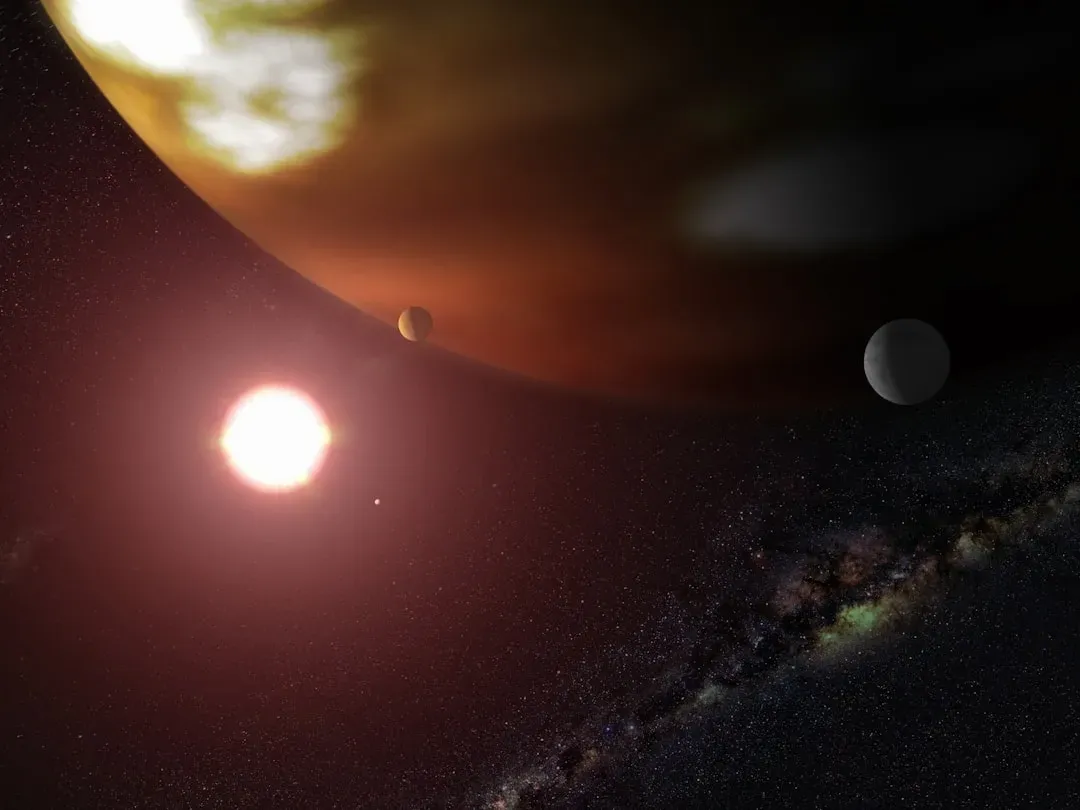
The research team focused on a deceptively simple question: does the elemental composition of a star predict what kinds of planets will orbit it? It sounds almost philosophical, but the science behind it is deeply empirical.
By examining how elements like carbon, oxygen, magnesium, and silicon are distributed in a star’s spectrum, astronomers can infer what raw materials were present during planetary formation. Here’s the thing – planets don’t just appear from nothing. They condense out of the same protoplanetary disk that the star itself formed from. So the star’s chemistry is essentially a recipe for what its planets will become.
The Surprising Connection They Found
Here’s where things get genuinely exciting. The study, published in early April 2026, found a measurable statistical relationship between the elemental abundances in host stars and the bulk compositions of their orbiting exoplanets. Stars rich in certain rock-forming elements tended to host planets with denser, more rocky interiors.
That might sound intuitive, but verifying it with real observational data is a completely different matter. For years, this idea existed largely as a theoretical assumption. Now it has real, telescope-backed evidence behind it. It’s a bit like suspecting a certain chef always uses the same spices and then finally getting access to their kitchen to confirm it firsthand.
Why Planetary Composition Is So Hard to Measure
Let’s be real – figuring out what an exoplanet is made of is extraordinarily difficult. You can’t land a probe on a world orbiting a star hundreds of light-years away. Instead, scientists use indirect methods, primarily measuring how much a planet’s gravity tugs on its star and how much light it blocks during a transit.
Combining those two measurements gives you mass and radius, which together can suggest density. From density, you start inferring composition. It’s genuinely impressive detective work, but the margin for error is wide. That’s why having the stellar composition data as an independent cross-reference is such a meaningful step forward. It’s like solving a puzzle where you suddenly find an extra piece you didn’t know existed.
What This Means for Rocky Planets and Habitability
One of the most intriguing implications of this research involves habitability. Honestly, that word gets thrown around carelessly sometimes, but in this context it carries real weight. If we can use a star’s composition to predict whether its planets are likely to be rocky or gaseous, we can dramatically improve target selection for future telescopes hunting for Earth-like worlds.
A planet needs to be rocky to have a surface, and a surface is a prerequisite for the kind of liquid water chemistry we associate with life as we understand it. This research creates a potential shortcut. Rather than waiting years for transit and radial velocity data on every planet candidate, astronomers may be able to prioritize based on what the host star’s spectrum tells them upfront. That’s a huge deal for missions like the future Habitable Worlds Observatory concept being discussed by NASA.
The Broader Scientific Context
This discovery doesn’t exist in a vacuum. It builds on decades of work in stellar astrophysics and planet formation theory. Over the past twenty years or so, the exoplanet field has exploded. Missions like Kepler and TESS have now confirmed thousands of planets beyond our solar system. The challenge has shifted from finding planets to actually understanding them.
What studies like this one do is connect two previously somewhat separate disciplines: stellar spectroscopy and planetary science. That interdisciplinary bridge is where some of the most interesting science is happening right now. It’s hard to say for sure just how transformative this particular finding will be in the long run, but the fact that a ground-based telescope in Chile is helping decode planetary interiors from thousands of light-years away still feels kind of astounding when you stop and think about it.
What Comes Next for This Research
The team behind this work is not stopping here. Future observations are expected to expand the sample size of star-planet systems analyzed, which will either strengthen or complicate the correlations identified so far. Science always needs more data, and this field is no exception.
Upcoming facilities like the Extremely Large Telescope, also being built in Chile and expected to come online in the late 2020s, will push this kind of analysis to an entirely new level of precision. The combination of better instruments and smarter analytical frameworks means the next decade could genuinely rewrite the textbook on how planets form. For those of us who grew up staring at the night sky wondering what was out there, that’s not just science news. It’s something close to wonder.
A Finding That Deserves More Attention
Honestly, this is the kind of research that should be front-page news but tends to quietly slip past most people. We live in a moment where the tools and techniques to decode the universe are advancing faster than at any point in human history, and discoveries like this one from Gemini South are proof of that momentum.
The idea that a star’s chemical signature essentially contains the blueprint for its planets is both elegant and profound. It suggests the universe operates with a kind of deep internal consistency, a logic baked into the laws of physics and chemistry from the very start. I think that’s worth pausing on. What would you have guessed about how much a star’s recipe shapes the worlds around it? Tell us in the comments.