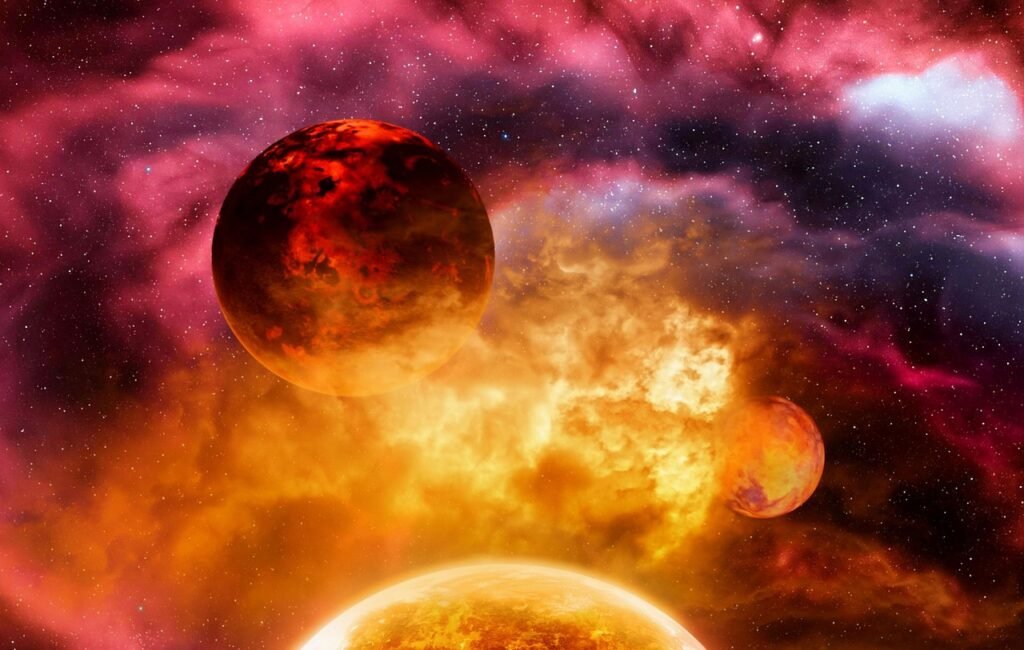


The Big Bang as the Ultimate Catalyst (Image Credits: Pixabay)
Scientists have introduced a pioneering approach that traces the universe’s journey from its explosive beginning to the emergence of advanced technologies, revealing hidden patterns that bind cosmic and computational realms.
The Big Bang as the Ultimate Catalyst
Picture the universe’s birth not as a singular explosion, but as the inaugural pulse in an intricate rhythm of growth and change that echoes through time. This perspective emerged from recent research, where experts analyzed the initial expansion following the Big Bang and identified fundamental dynamical processes driving structure formation. Those early instabilities, as particles clumped into galaxies, set the stage for escalating complexity across vast scales.
The framework highlights how these primordial dynamics – marked by adaptation and feedback loops – mirrored later developments in the cosmos. Researchers noted that the same mathematical recurrences appeared in the aggregation of matter, fostering stars and planetary systems. This continuity suggests the universe operated under a consistent set of rules from its outset, challenging fragmented views of cosmic history.
Recurring Patterns in Cosmic and Biological Realms
As the universe matured, those initial dynamics extended into the formation of life, where similar principles governed evolutionary leaps. The study connected astrophysical phenomena, such as the clustering of dark matter, to biological processes like cellular adaptation and species diversification. By examining data from cosmology and evolutionary biology, the team uncovered shared instabilities that propelled systems toward greater organization.
Key examples of these patterns include:
- The rapid coalescence of gas clouds into stars, akin to genetic mutations sparking biodiversity.
- Feedback mechanisms in galactic mergers, paralleling ecological balances in ecosystems.
- Adaptive responses to environmental pressures, evident from solar system formation to neural network development in organisms.
- Emergent complexity in filamentary structures of the cosmic web, resembling branching in evolutionary trees.
- Threshold crossings where simple interactions yield novel behaviors, as seen in both supernova remnants and symbiotic relationships.
This interplay underscores a seamless progression, where astrophysical laws informed the preconditions for life without requiring separate explanations.
Extending the Thread to Human Innovation and AI
The framework reaches its most intriguing extension in human culture and artificial intelligence, portraying them as natural outgrowths of universal dynamics. Cultural evolution, with its waves of technological advancement, reflected the same adaptive instabilities that shaped earlier cosmic events. The research illustrated how societal structures evolved through feedback and complexity, much like planetary atmospheres stabilizing over eons.
In the realm of AI, these patterns manifested in machine learning algorithms that self-organize data into intelligent outputs. Developers observed parallels between neural network training – where layers adapt to inputs – and the universe’s progression from chaotic plasma to ordered galaxies. This connection positioned AI not as an anomaly, but as the latest chapter in a 13.8-billion-year narrative of dynamical refinement.
Bridging Disciplines for Future Insights
By synthesizing insights from astrophysics, biology, and computer science, the unified dynamics model promised to reshape interdisciplinary research. Traditional silos often hindered progress, but this approach encouraged integrated analyses of complex systems. For instance, simulations incorporating cosmic-scale equations could now inform AI robustness against instabilities.
Experts anticipated applications in predicting evolutionary trajectories, from climate models to next-generation computing. The framework, detailed in a study published on Quantum Zeitgeist, invited further validation through observational data and computational experiments. Ultimately, it fostered a holistic understanding, revealing the universe as a single, evolving entity.
This unified view not only demystifies the cosmos’s arc but also prompts reflection on humanity’s place within it – urging us to see innovation as part of an ancient continuum. What aspects of this framework intrigue you most? Share your thoughts in the comments below.
Key Takeaways
- The model identifies instability and adaptation as core drivers linking Big Bang expansion to AI development.
- Recurring mathematical patterns span cosmology, biology, and machine learning, enabling cross-field predictions.
- This perspective frames intelligent systems as inevitable outcomes of universal evolution, opening new research avenues.
Jan loves Wildlife and Animals and is one of the founders of Animals Around The Globe. He holds an MSc in Finance & Economics and is a passionate PADI Open Water Diver. His favorite animals are Mountain Gorillas, Tigers, and Great White Sharks. He lived in South Africa, Germany, the USA, Ireland, Italy, China, and Australia. Before AATG, Jan worked for Google, Axel Springer, BMW and others.