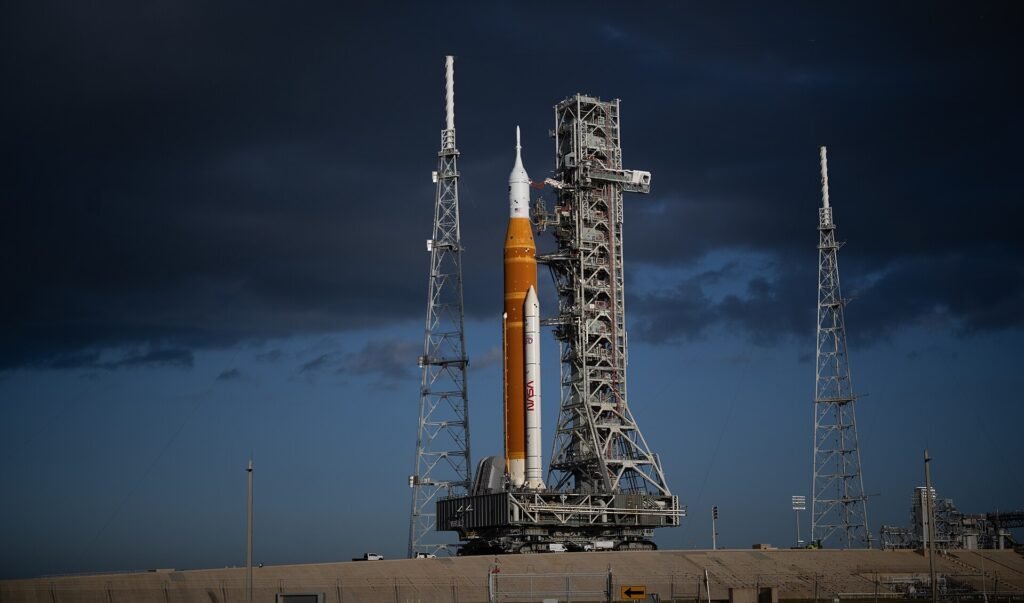
Artemis Emerges as the Turning Point (Image Credits: Wikimedia Commons)
Humanity’s last steps on the Moon occurred during Apollo 17 in December 1972, capping a remarkable era of exploration. Excitement waned soon after as national priorities evolved amid economic pressures and geopolitical shifts. Decades later, NASA’s Artemis initiative signals a determined push to reestablish a human presence on the lunar surface, prompting reflection on the prolonged absence.
The Apollo Endpoint and Immediate Fallout
Apollo 17 astronauts Eugene Cernan and Harrison Schmitt departed the Moon as the program’s finale, leaving behind a legacy of six successful landings. Public fascination diminished rapidly once the Cold War space race objectives were met. Congress slashed NASA’s funding from its peak of 4% of the federal budget to under 1%, forcing a reevaluation of ambitious goals.
Leaders at the time redirected resources toward more immediate technological pursuits. The agency pivoted from deep-space endeavors to projects promising nearer-term benefits. This transition effectively paused lunar ambitions for generations.
Redirection to Shuttle and Station Priorities
NASA launched the Space Shuttle program in 1981, emphasizing reusable spacecraft for low-Earth orbit operations. Missions focused on satellite deployment, scientific experiments, and construction support. The International Space Station, approved in the 1990s, further concentrated efforts on collaborative orbital research involving multiple nations.
These initiatives demanded vast investments and sustained political support. Lunar missions, by contrast, offered no comparable short-term payoffs. Funding allocations reflected this preference, with billions poured into shuttle development and station assembly over lunar hardware.
Lost Expertise and Faded Infrastructure
Over decades, the specialized knowledge from Apollo engineers retired with its pioneers. Saturn V rocket blueprints gathered dust, and manufacturing techniques for lunar modules faded from active use. Supply chains for rare materials and components dissolved as commercial interest shifted elsewhere.
Rebuilding required not just money but institutional memory. Younger generations entered the field without hands-on lunar experience. Universities and contractors adapted to new paradigms, leaving gaps in capabilities once routine.
- Retirement of key Apollo-era personnel eroded tacit knowledge.
- Disbanded factories and tooling increased restart costs.
- Shifted vendor networks prioritized shuttle and satellite parts.
- Documentation alone proved insufficient for complex recreations.
- Modern regulations added layers of safety and environmental compliance.
Artemis Emerges as the Turning Point
The Artemis program, announced in 2017, aims to land the first woman and next man on the Moon by the late 2020s. It builds on lessons from past delays, incorporating commercial partnerships like SpaceX and Blue Origin. New rockets such as the Space Launch System and Orion capsule address previous shortcomings.
International collaboration expands involvement beyond the U.S., mirroring ISS success. Sustainable lunar presence goals, including a gateway outpost, differentiate it from Apollo’s flags-and-footprints approach. Progress includes uncrewed tests and habitat prototypes, though timelines have slipped amid technical hurdles.
Key Takeaways
- Budget constraints post-1972 pivoted NASA from Moon to orbit.
- Expertise loss demanded full-scale reinvention.
- Artemis integrates private sector to accelerate return.
The 50-year interlude underscores how fleeting political will and resource scarcity can stall even monumental achievements. Artemis now tests whether sustained commitment can bridge that gap. What aspects of this lunar journey intrigue you most? Share your thoughts in the comments.