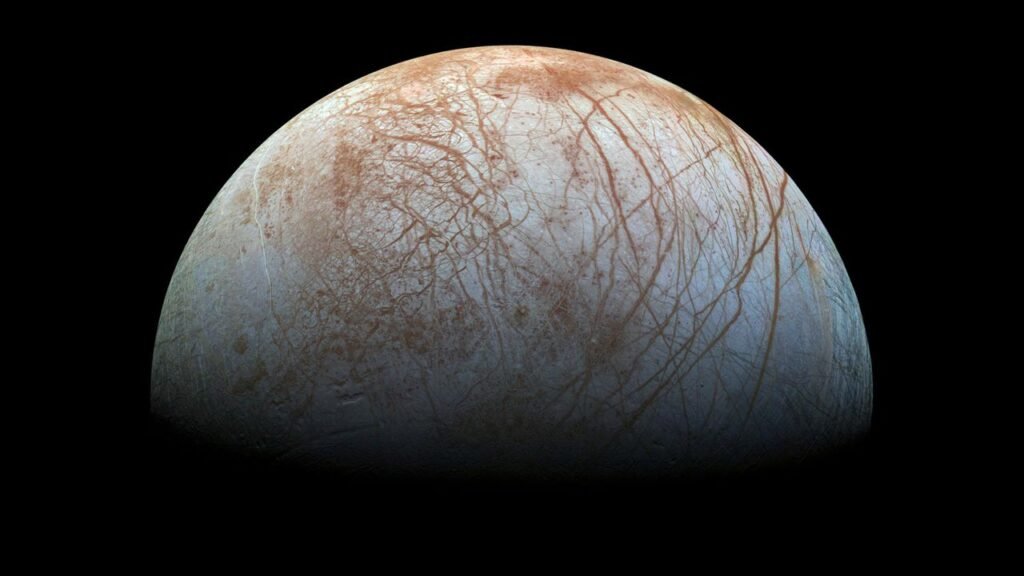

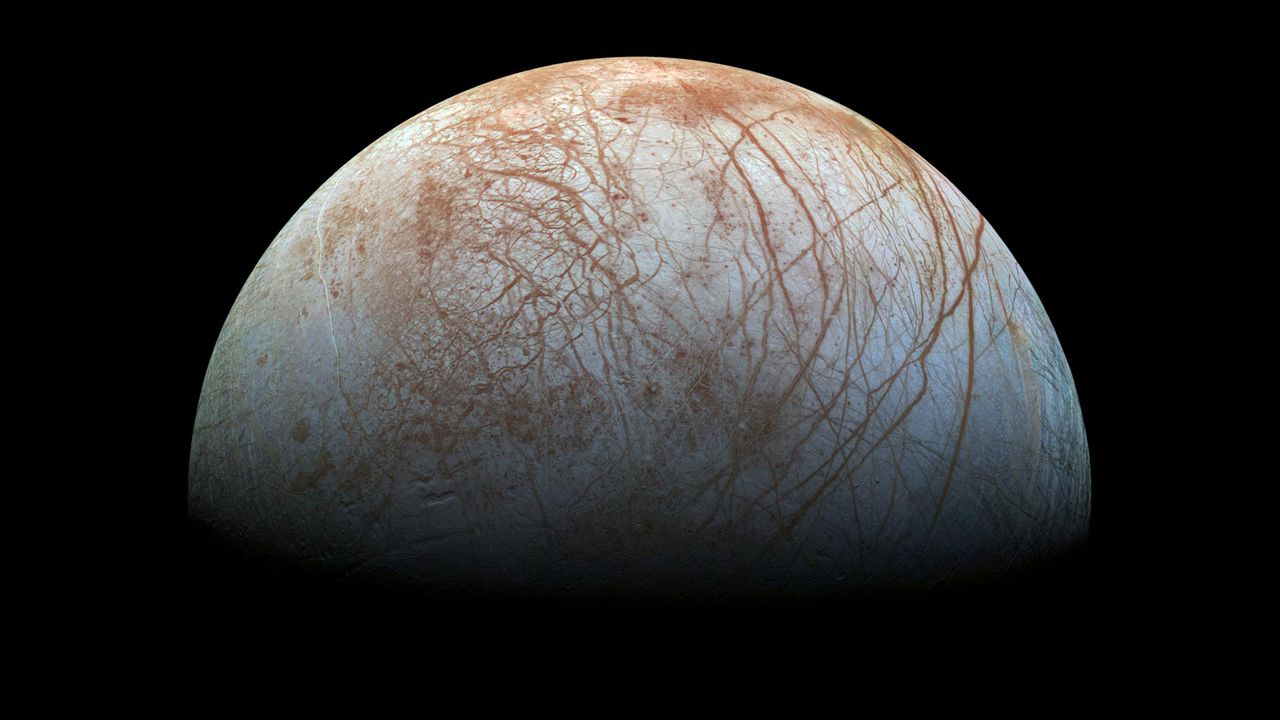
Ice Dynamics Reshape Europa’s Surface (Image Credits: Cdn.mos.cms.futurecdn.net)
Jupiter’s moon Europa harbors a vast ocean beneath its icy crust, where sinking ice formations may gradually supply the chemical ingredients necessary for life.
Ice Dynamics Reshape Europa’s Surface
Researchers observed that the moon’s surface features large, plate-like ice slabs that periodically collapse and sink. This process exposes fresh ice to Jupiter’s intense radiation, generating oxidants such as oxygen and hydrogen peroxide. Those chemicals then plunge toward the underlying ocean.
Satellite imagery from past missions revealed chaotic terrains where such sinking occurs. The ice movement creates a dynamic exchange between surface and depths. Scientists modeled this as a slow but persistent mechanism, operating over geological timescales.
Radiation Fuels Chemical Production
Jupiter’s magnetic field bombards Europa with high-energy particles. These interactions break molecular bonds in the ice, producing reactive compounds. The sinking slabs carry these materials downward efficiently.
Without this delivery system, oxidants might remain trapped on the surface. Instead, they reach the ocean, where they could react with reducing agents from hydrothermal vents. This combination provides energy sources akin to those on Earth.
Key Ingredients for Potential Habitats
The process delivers several critical elements. Oxidants mix with organics potentially present in the ocean, fostering conditions for microbial life. Models suggest this happens at rates sufficient to sustain ecosystems.
- Oxygen: Essential for aerobic respiration.
- Hydrogen peroxide: Breaks down to release oxygen and water.
- Other oxidants: Drive geochemical reactions.
- Salts and minerals: Transported via brine within ice.
- Potential organics: From surface bombardment or cometary delivery.
Insights from Recent Modeling
Advanced computer simulations confirmed the sinking mechanism. Ice slabs, up to tens of kilometers wide, fracture and descend through convection currents. This circulation prevents stagnation in the ocean layers below.
Previous studies hinted at ocean-surface exchange, but new analyses quantified the oxidant flux. The findings align with observations from NASA’s Galileo spacecraft, which flew by Europa in the 1990s. Surface spectra showed elevated oxidant signatures in disrupted regions.
| Surface Feature | Role in Delivery |
|---|---|
| Chaos terrains | Sites of frequent sinking |
| Lineae cracks | Channels for radiation exposure |
| Plateaus | Source of sinking slabs |
Pathways to Discovering Life
Upcoming missions like NASA’s Europa Clipper, set to launch soon, will probe these processes further. Instruments will map ice composition and ocean plumes. Confirmation of active exchange could elevate Europa’s astrobiological priority.
Though direct evidence of life remains elusive, the sinking ice model strengthens the case for habitability. It demonstrates a natural recycling system that mimics Earth’s ocean chemistry.
Key Takeaways
- Sinking ice transports radiation-produced oxidants to Europa’s ocean.
- This provides energy for potential life forms.
- Missions will test these models in the coming years.
Europa’s icy sinkholes reveal a moon actively mixing its chemistry, hinting at hidden vitality beneath. What implications do these discoveries hold for the search for extraterrestrial life? Share your thoughts in the comments.