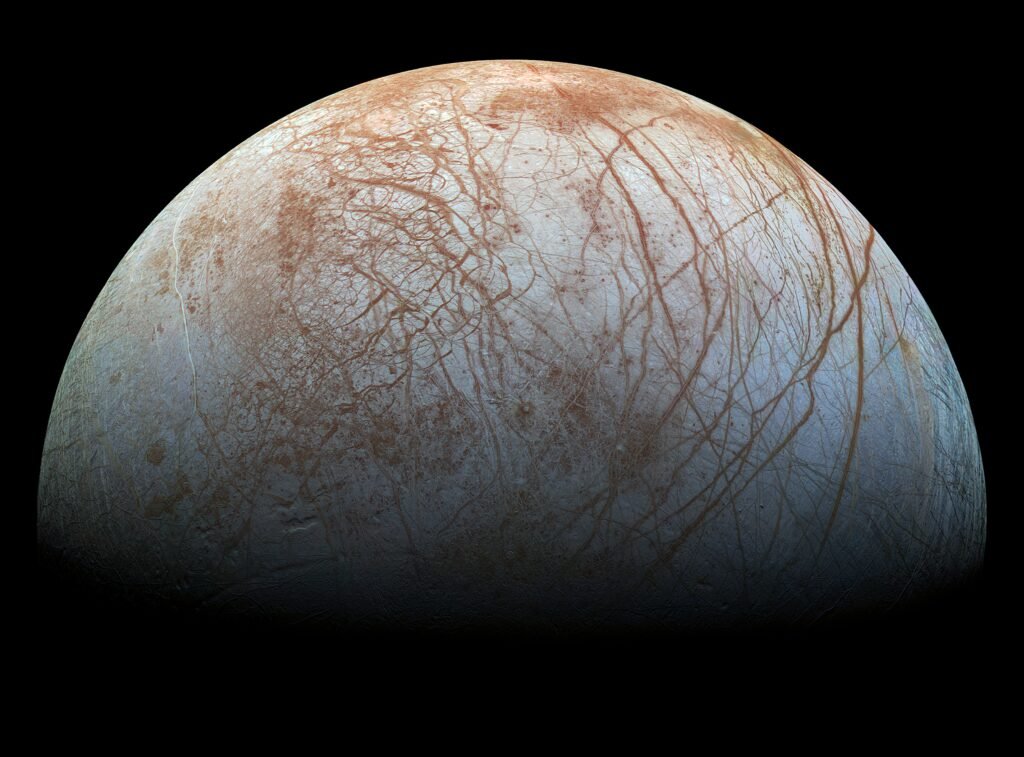


A Moon Unlike Any Other (Image Credits: Upload.wikimedia.org)
Scientists modeling conditions on Jupiter’s moon Europa have identified intriguing possibilities for life in its vast hidden ocean.
A Moon Unlike Any Other
Among Jupiter’s nearly 100 known moons, Europa stands out for its potential to harbor extraterrestrial life. Researchers long suspected a global ocean lurked beneath its icy surface, and recent estimates suggest this salty reservoir holds twice the water volume of all Earth’s oceans combined. This discovery reframed Europa from a frozen world to a prime target in the search for life beyond our planet.
The icy crust, estimated at 10 to 30 kilometers thick, insulates the ocean from the harsh radiation of Jupiter’s magnetosphere. Tidal forces from the gas giant flex the moon’s interior, generating heat that keeps the water liquid. Yet, surface observations revealed little evidence of geological drama breaking through.
Modeling the Hidden Depths
A recent study led by Washington University, in partnership with Woods Hole Oceanographic Institution, used advanced computer models to probe Europa’s seafloor. The research highlighted a surprisingly quiet environment down there, with minimal volcanic or hydrothermal activity compared to expectations. This dormancy, far from diminishing prospects, pointed to stable conditions that could foster chemical processes essential for life.
Traditional views held that vigorous seafloor volcanism drove habitable environments on ocean worlds. Europa’s models challenged that, showing how subdued activity might still circulate nutrients and energy sources through the ocean. The findings emerged from simulations incorporating tidal heating, ice-ocean interactions, and geochemical cycles.
Why Quiet Could Mean Potential
The seafloor’s tranquility suggests a balanced ecosystem rather than chaotic upheaval. Without constant eruptions, organic compounds could accumulate over time, shielded from surface extremes. This setup mirrors Earth’s deep-sea habitats, where life thrives independently of sunlight.
Key factors include the ocean’s salinity, which stabilizes it against freezing, and potential upwelling of minerals from the rocky mantle. The study emphasized how even low-level heat flux sustains habitability without overwhelming the system.
Comparing Ocean Worlds
Europa’s ocean dwarfs Earth’s in scale, offering a unique laboratory for astrobiology.
| Celestial Body | Water Volume |
|---|---|
| Earth | All surface oceans |
| Europa | Twice Earth’s total |
This table underscores the moon’s immense capacity. Unlike more active neighbors like Io, Europa’s subdued geology preserves its subsurface realm intact.
- Global ocean spans the entire moon.
- Icy shell protects against radiation.
- Tidal heating maintains liquidity.
- Salty composition supports complex chemistry.
- Quiet seafloor enables long-term stability.
- Europa’s ocean volume exceeds Earth’s by double.
- Modeling reveals quiet seafloor aids life potential.
- Washington University and WHOI collaboration drives new insights.
These revelations position Europa at the forefront of upcoming missions, urging a closer look at its subsurface secrets. As models refine our understanding, the quiet seafloor emerges not as a barrier, but as a promising haven. What are your thoughts on Europa’s life potential? Share in the comments below.