
Perseverance Rover Captures First Direct Evidence (Image Credits: Unsplash)
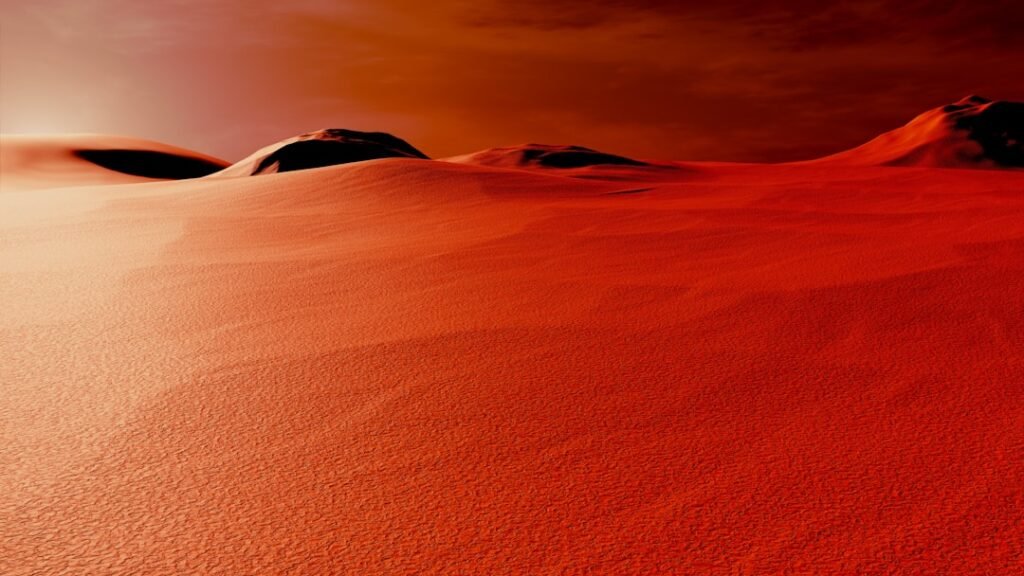
Mars – Vast dust storms and swirling dust devils electrify the Red Planet’s thin atmosphere, producing static charges that spark tiny discharges akin to miniature lightning. These events, confirmed by NASA’s Perseverance rover, ignite chemical reactions that alter the surface and air in unexpected ways.[1][2] Scientists now link this electrical activity to the production of reactive compounds and distinctive isotopic patterns observed across the planet.
Perseverance Rover Captures First Direct Evidence
The Perseverance rover provided groundbreaking proof of electrical activity on Mars. Its SuperCam instrument’s microphone, originally designed for rock analysis, recorded crackling sounds during dust events near Jezero Crater.[1] Over two Martian years, the team identified 55 distinct discharges: 16 from dust devils passing overhead and 35 tied to convective fronts of regional storms.
These sparks occurred primarily on windy days amid turbulence, not just high dust levels. Audio captured snaps from arcs just inches away, alongside dust devil roars and particle impacts. Researcher Baptiste Chide noted that Mars’ low-pressure atmosphere requires far less charge for discharges than Earth’s.[1]
How Friction Powers Martian Electricity
Triboelectric charging drives this phenomenon. Dust grains collide and rub in storms and devils, transferring electrons and building potentials up to thousands of volts. In Mars’ sparse CO2 air, fields break down easily, releasing high-energy electrons that collide with gas molecules.
Dust devils form from heated ground air rising in rotating columns, lifting fine particles. Storms amplify this globally. Unlike Earth, where discharges are rare in dust, Mars favors them due to lower breakdown voltage. Recent Nature publication detailed these acoustic and electromagnetic signatures.[1]
Laboratory Simulations Uncover Reaction Products
Planetary scientist Alian Wang recreated these conditions using specialized chambers at Washington University in St. Louis. PEACh and SCHILGAR mimicked Mars’ low pressure, dry air, and dusty regolith. Stirring dust generated discharges that yielded diverse chemicals.
Products included volatile chlorine species, activated oxides, airborne carbonates, and perchlorates. These match rover observations and explain surface deposits from the Amazonian era.[3] Wang’s team quantified outputs, linking them to Mars’ chlorine cycle without relying on water or volcanism.
Isotopic Fingerprints Reveal Ongoing Processes
Discharges fractionate isotopes, depleting heavier ones in chlorine (³⁷Cl), oxygen (¹⁸O), and carbon (¹³C). This mass-dependent effect leaves “fingerprints” in perchlorates, carbonates, and gases. Patterns align with Curiosity rover’s low δ³⁷Cl values down to -51‰ and Trace Gas Orbiter data.[2]
Wang described it as a “smoking-gun” for dust electrochemistry dominating the surface-atmosphere system. Her Earth and Planetary Science Letters study modeled cycles where aerial products redeposit, forming minerals subsurface. Associate professor Kun Wang praised the work for tracing chlorine evolution.[3]
Implications for Martian Habitability and Exploration
Reactive oxidants like perchlorates and hydrogen peroxide destroy organics, potentially erasing biosignatures. They may also consume fleeting methane, solving a detection puzzle. Climate models must now factor dust electricity for accurate weather and dust lifting predictions.
- Perchlorates break down organics on surfaces.
- Volatile chlorines alter atmospheric balance.
- Carbonates form airborne then deposit as salts.
- Oxidants explain methane’s rapid loss.
- Electrochemistry shapes modern mineralogy.
Future missions face risks to electronics from charging dust. Yet, these insights refine habitability assessments and resource strategies.
Key Takeaways
- Dust storms produce 55+ confirmed sparks, driving electrochemistry.
- Lab sims confirm perchlorates, carbonates, chlorine gases as products.
- Isotopic depletions fingerprint dust as major chemical driver.
Mars emerges not as a static desert but a dynamically charged world where dust storms sculpt chemistry daily. This electrified activity underscores the planet’s complexity, challenging assumptions about its past life potential. What do you think this means for future Mars missions? Tell us in the comments.