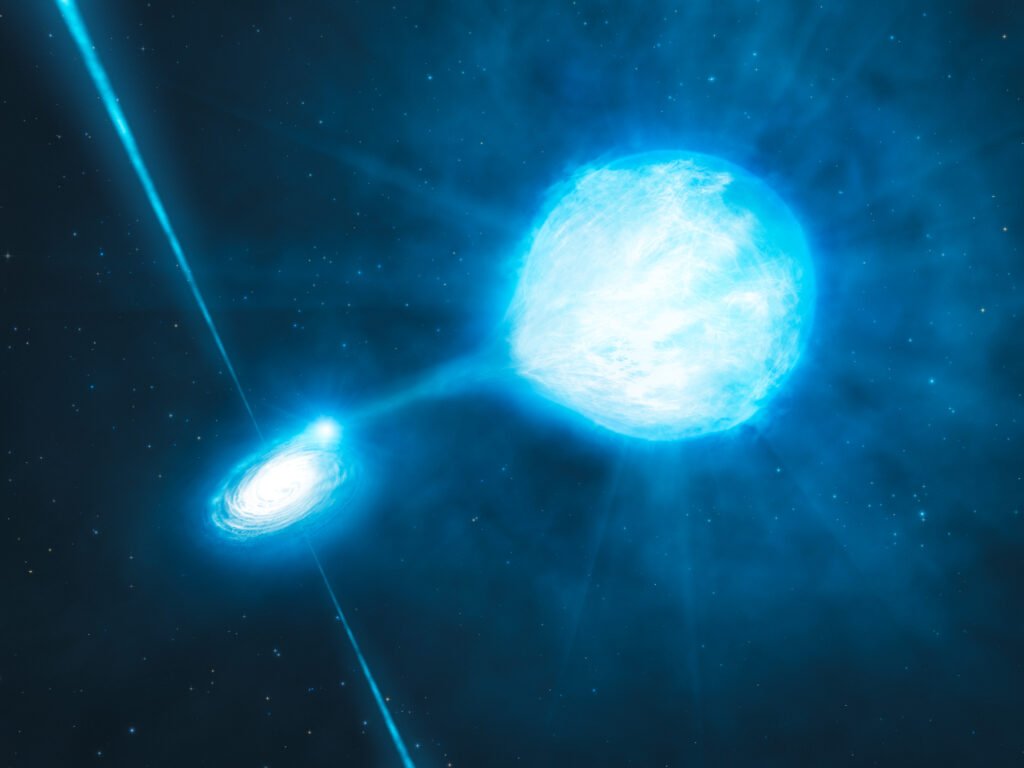

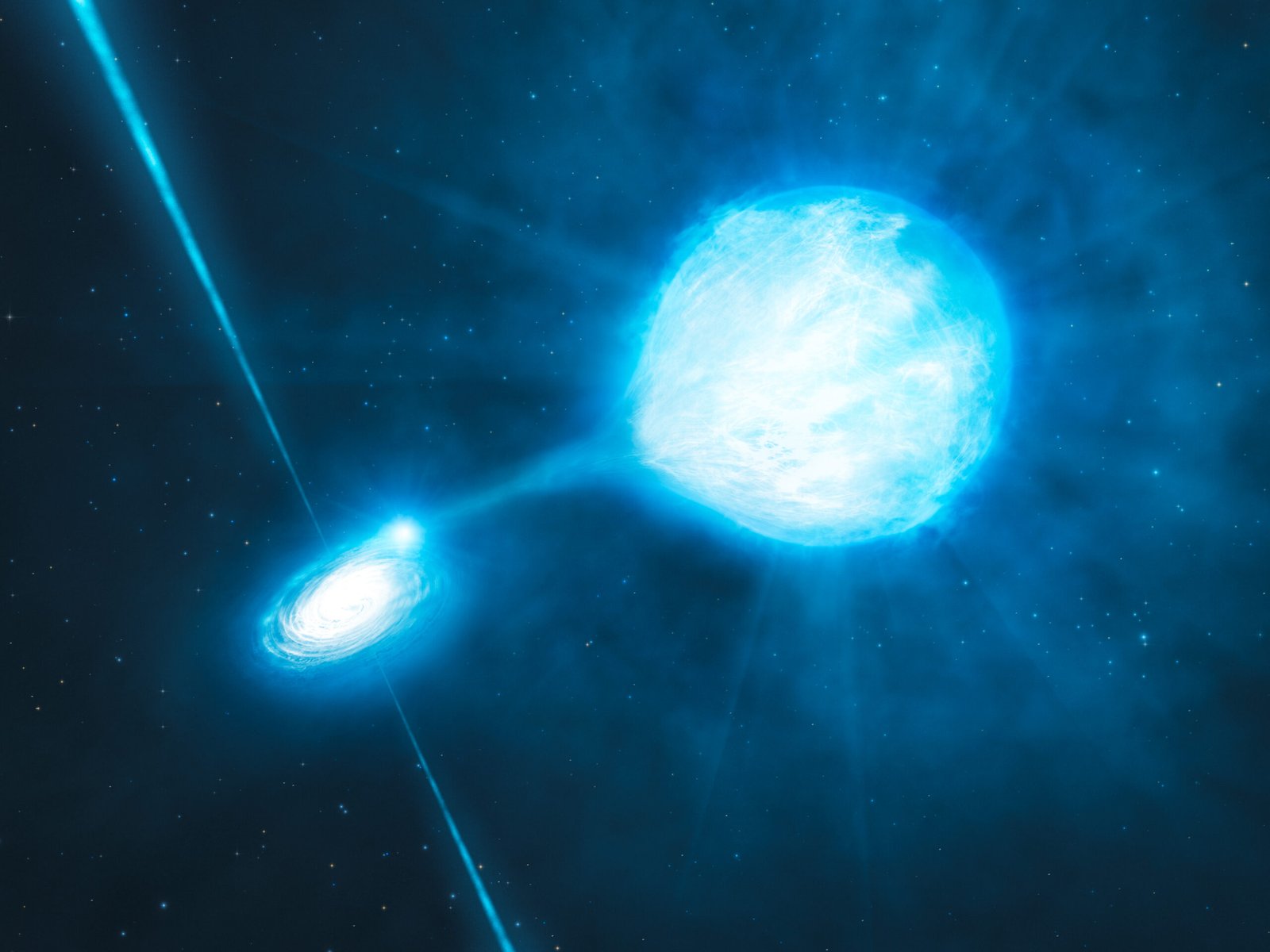
A Sudden Cosmic Flare Ignites Global Attention (Image Credits: Upload.wikimedia.org)
Tokyo, Japan – China’s Einstein Probe telescope captured a brilliant X-ray transient on July 2, 2025, that scientists interpret as an intermediate-mass black hole shredding a white dwarf star.[1][2]
A Sudden Cosmic Flare Ignites Global Attention
The Wide-field X-ray Telescope aboard the Einstein Probe spotted a rapidly varying X-ray source during a routine sky survey. This signal stood out immediately from typical cosmic phenomena and prompted alerts to observatories worldwide. NASA’s Fermi Gamma-ray Space Telescope recorded gamma-ray bursts from the same sky region almost simultaneously.[1]
Analysis later revealed steady X-ray emission from the location about a day earlier. Roughly 15 hours after the initial detection, the source unleashed powerful X-ray flares. These reached a peak luminosity of about 3 x 1049 erg per second, ranking among the universe’s brightest known outbursts.[2] The Follow-up X-ray Telescope on Einstein Probe then monitored the event for around 20 days. During this period, the source’s brightness plummeted by more than a factor of 100,000, while its X-ray spectrum shifted from hard to soft emissions.
Pinpointing the Source’s Mysterious Origin
Multi-wavelength observations quickly located the transient, designated EP250702a or GRB 250702B, in the outskirts of a distant galaxy. This peripheral position set it apart from central galactic explosions like standard gamma-ray bursts or typical tidal disruptions. The event’s rapid evolution and extreme brightness defied existing models for high-energy transients.[3]
Astronomers noted several distinctive traits:
- Precursor X-ray emission one day before gamma-ray bursts.
- Peak X-ray luminosity exceeding many known events by orders of magnitude.
- Fast decay over days, not years.
- Hard-to-soft spectral transition with recurrent flares.
- Relativistic jet inferred from gamma-ray extensions to tens of MeV.
These features pointed to a rare scenario beyond ordinary stellar disruptions.[4]
Simulations Bring the Disruption to Life
Teams from the University of Hong Kong and others ran detailed numerical simulations. They proposed an intermediate-mass black hole, weighing between 100 and 100,000 solar masses, had tidally torn apart a white dwarf. The white dwarf’s extreme density, a million times that of typical stars, fueled a powerful relativistic jet matching the observed timescales and energies.[5]
Dr. Jinhong Chen of the University of Hong Kong stated, “Our computational simulations show that the combination of the tidal forces of an intermediate-mass black hole, combined with the extreme density of a white dwarf, can produce jet energies and evolutionary timescales that are highly consistent with the observational data.”[2] Professor Lixin Dai added that this model “most naturally explains the observations.” Fermi data constrained the black hole’s mass to under 75,000 solar masses, ruling out supermassive candidates. The findings appeared in Science Bulletin.[4]
Global Effort Unlocks Astrophysics Frontiers
More than 300 scientists from over 40 institutions collaborated on the analysis. Partners included China’s National Astronomical Observatories, the European Space Agency, and Germany’s Max Planck Institute. Professor Weimin Yuan of the National Astronomical Observatories noted, “The discovery of EP250702a fully demonstrates our capability to be the first to capture the universe’s most extreme moments.”[1]
This detection, if confirmed, marks the clearest evidence yet of a white dwarf-intermediate black hole tidal disruption. It bridges gaps in black hole populations and highlights white dwarfs’ fates near such beasts.
Key Takeaways
- First potential direct observation of white dwarf shredded by intermediate-mass black hole.
- Reveals relativistic jets and rapid accretion processes in extreme gravity.
- Opens doors to studying elusive intermediate black holes and gravitational waves.
Such events promise deeper insights into black hole growth, compact object evolution, and multi-messenger astronomy. What do you think this means for future black hole hunts? Tell us in the comments.