

A Surprising Echo of Saturn on Early Earth (Image Credits: Dailygalaxy.com)
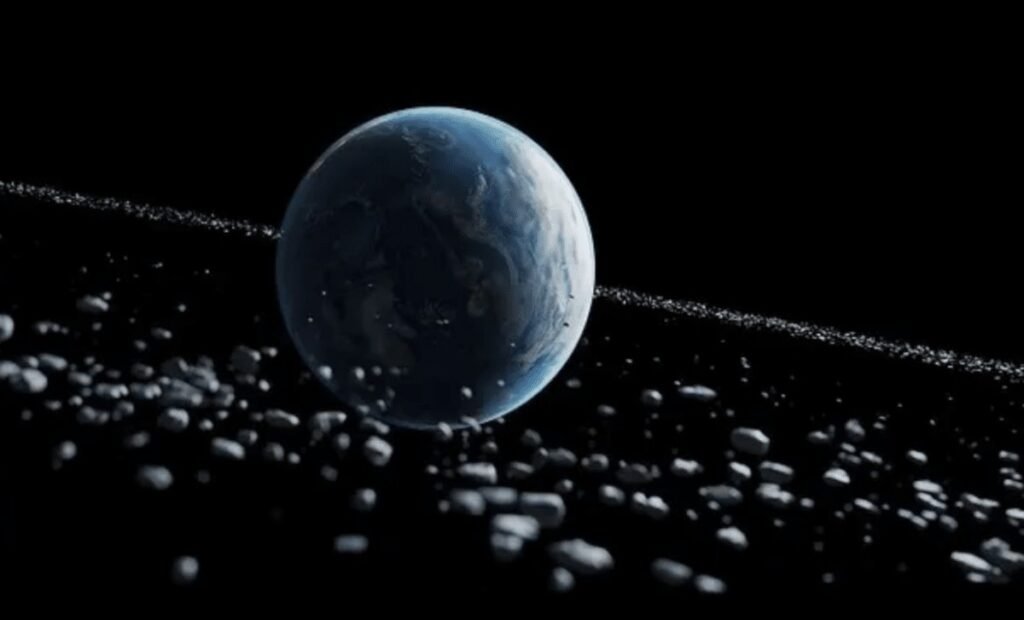
Scientists have uncovered evidence suggesting that Earth once featured a dramatic ring system similar to Saturn’s, potentially altering the planet’s climate during a pivotal era hundreds of millions of years ago.
A Surprising Echo of Saturn on Early Earth
Researchers from Monash University proposed in a recent study that Earth harbored a temporary ring made of asteroid debris around 466 million years ago. This structure, spanning thousands of kilometers, would have encircled the planet like a cosmic halo. The idea emerged from analyzing patterns in ancient meteorite impacts, which clustered in ways that defied simple explanations.
The ring likely formed when a large asteroid ventured too close to Earth and shattered under gravitational forces. Fragments then settled into a stable orbit, creating a debris disk visible from the surface. Such a configuration mirrored Saturn’s iconic rings but on a smaller scale, lasting for tens of millions of years before dispersing.
The Formation of an Unlikely Cosmic Accessory
Asteroids approaching Earth during the Late Ordovician period faced intense tidal stresses, leading to their breakup. The resulting particles, ranging from dust to boulder-sized chunks, coalesced into a flat ring aligned with the planet’s equator. This event coincided with a spike in impacts, as ring material gradually rained down as meteorites.
Geological records from that time show an unusual concentration of craters near the equator, supporting the ring hypothesis. Unlike random cosmic debris, these impacts followed a predictable path, hinting at an orbiting source. The study’s models indicated the ring extended far enough to influence Earth’s rotational dynamics subtly.
Climate Chaos Triggered by Celestial Debris
The ring’s presence could have triggered significant environmental shifts. Dust and particles from the ring might have blocked sunlight, contributing to a global cooling event known as the Ordovician glaciation. This period marked one of the earliest major ice ages, disrupting marine ecosystems and leading to widespread extinctions.
Additionally, the influx of meteorites delivered water-rich materials, potentially altering ocean chemistry and atmospheric composition. Scientists noted that the ring’s shadow effects varied by latitude, creating uneven cooling patterns across continents. These changes exacerbated weather extremes, from prolonged droughts to sudden freezes, reshaping life on the planet’s surface.
- Increased meteorite flux: Hundreds more impacts than expected, concentrated equatorially.
- Solar dimming: Ring particles reduced incoming sunlight by up to 10%, per simulations.
- Ocean acidification: Debris introduced minerals that shifted pH levels in ancient seas.
- Biodiversity loss: Linked to the extinction of about 85% of marine species during the glaciation.
- Long-term effects: Contributed to the rise of new life forms in cooler conditions.
Evidence Unearthed from Ancient Rocks
Fossil records and isotopic analysis provide key clues to the ring’s existence. Sedimentary layers from 466 million years ago contain elevated levels of extraterrestrial materials, consistent with ring-derived meteorites. Crater distributions on preserved landmasses, such as in modern-day Australia and North America, align with equatorial bombardment patterns.
Comparative studies with Saturn’s rings bolster the theory. Both systems involve icy and rocky particles trapped in resonance orbits, though Earth’s would have been denser due to proximity to the planet. Ongoing research uses computer simulations to refine these timelines, confirming the ring’s role in the era’s climatic instability.
Lessons from Earth’s Ringed Past
This ancient ring episode highlights how cosmic events can profoundly influence planetary habitability. It underscores the dynamic nature of Earth’s history, where external forces like asteroid disruptions played a crucial role in shaping climates and life. As astronomers search for ringed exoplanets, such findings offer a blueprint for understanding distant worlds.
Key Takeaways
- Earth’s proposed ring lasted 20-40 million years, ending around 430 million years ago.
- It amplified a natural cooling trend, leading to the Ordovician mass extinction.
- Modern observations of Saturn inform models of ancient Earth systems.
The possibility of Earth once resembling a ringed giant invites reflection on our planet’s vulnerability to space weather. What other secrets from deep time might still influence us today? Share your thoughts in the comments.
Jan loves Wildlife and Animals and is one of the founders of Animals Around The Globe. He holds an MSc in Finance & Economics and is a passionate PADI Open Water Diver. His favorite animals are Mountain Gorillas, Tigers, and Great White Sharks. He lived in South Africa, Germany, the USA, Ireland, Italy, China, and Australia. Before AATG, Jan worked for Google, Axel Springer, BMW and others.