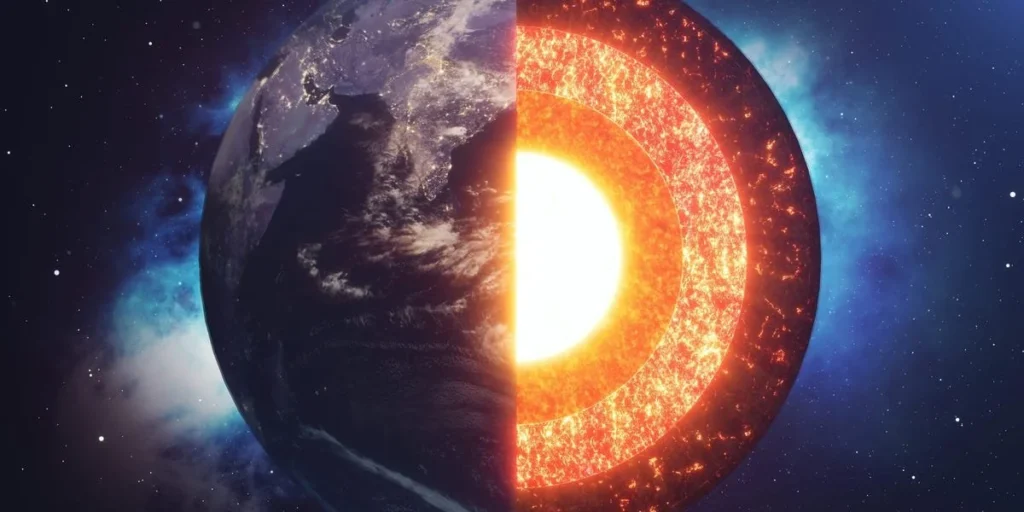

Think about it for a moment. You are standing on the ground right now, and roughly 3,000 miles directly beneath your feet, a world of almost incomprehensible heat, pressure, and mystery is quietly doing something scientists never expected. The center of our planet is not the simple, well-understood ball of metal textbooks once described. It turns out, we barely know it at all.
Recent discoveries have shaken up the geological community in ways that feel more like science fiction than peer-reviewed science. From shape-shifting cores to hidden oceans of hydrogen, from an entirely new state of matter to ancient rock structures taller than Everest, Earth’s deep interior is revealing itself to be spectacularly, stubbornly strange. Get ready, because what researchers have uncovered will genuinely surprise you. Let’s dive in.
A Solid Core That Is Not Quite Solid
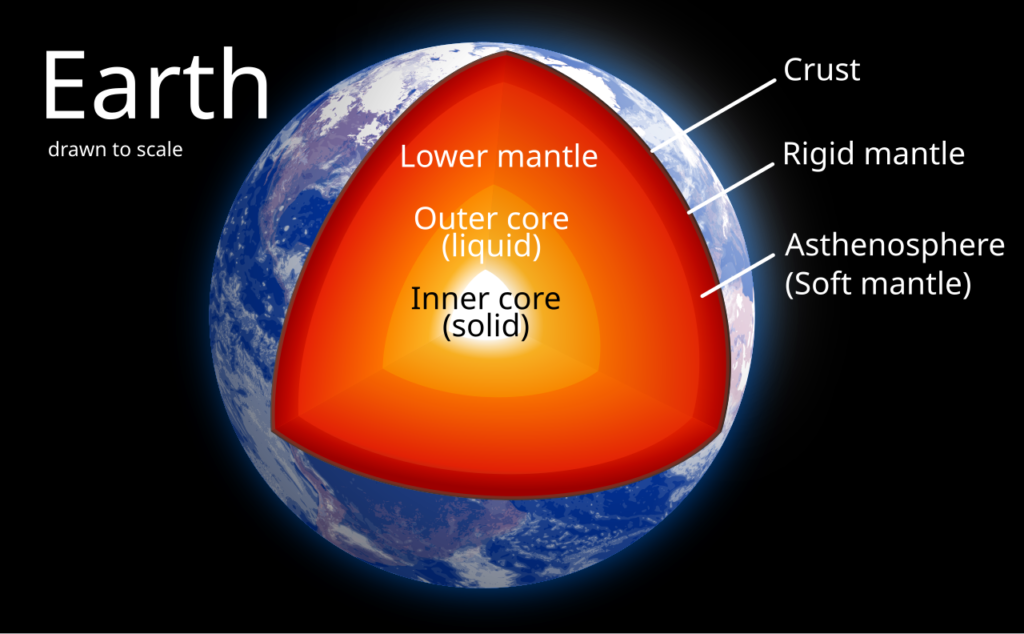
Here is the thing most of us were taught in school: Earth has a solid inner core made of iron and nickel. Simple enough. Except it turns out that story is far from complete. New research reveals that Earth’s solid inner core is actually in a superionic state, where carbon atoms flow freely through a solid iron lattice, and this unusual behavior makes the core soft, matching seismic observations that have puzzled scientists for decades.
Think of it like butter. It’s technically solid, but poke it the wrong way and it yields in a way steel never would. Even though the inner core is solid, it behaves like a softened metal, slowing seismic shear waves and displaying a Poisson’s ratio more similar to butter than to steel – a paradox that raises a fundamental question about how the planet’s solid center can appear firm yet strangely pliable. Honestly, once you understand just how “soft” the center of our planet really is, you start to question everything geology class ever told you.
The Inner Core Is Actually Changing Its Shape
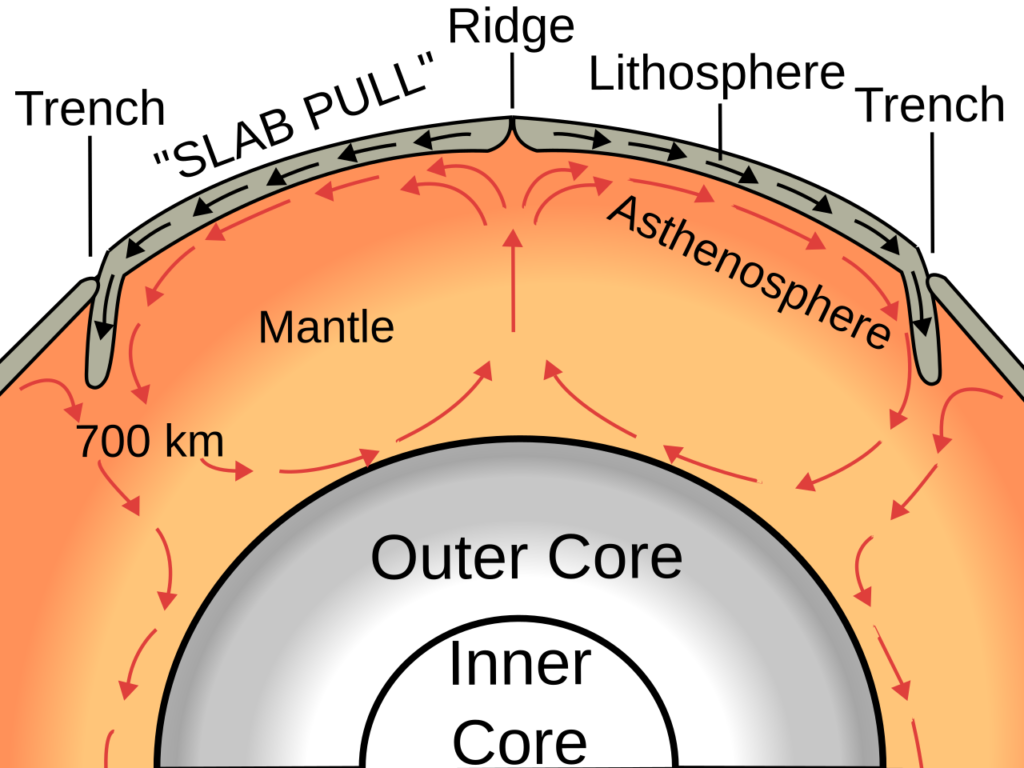
If the superionic discovery wasn’t enough, consider this: your planet’s core is physically shape-shifting. Scientists who confirmed that Earth’s inner core recently reversed its spin have a new revelation about our planet’s deepest secrets – they have now identified changes to the inner core’s shape, which is a hot, solid ball of metal surrounded by a liquid metal outer core. This is not some slow geological process playing out over millions of years, either.
The physical activity is best explained as temporal changes in the shape of the inner core, and the new study indicates that the near surface of the inner core may undergo viscous deformation, changing its shape and shifting at the inner core’s shallow boundary. Scientists used an extraordinary dataset to reach this conclusion. The study utilized seismic waveform data, including 121 repeating earthquakes from 42 locations near Antarctica’s South Sandwich Islands that occurred between 1991 and 2024, to give a glimpse of what takes place in the inner core. The core, it seems, is far more dynamic than anyone previously dared to suggest.
Carbon: The Hidden Architect of Earth’s Solid Heart
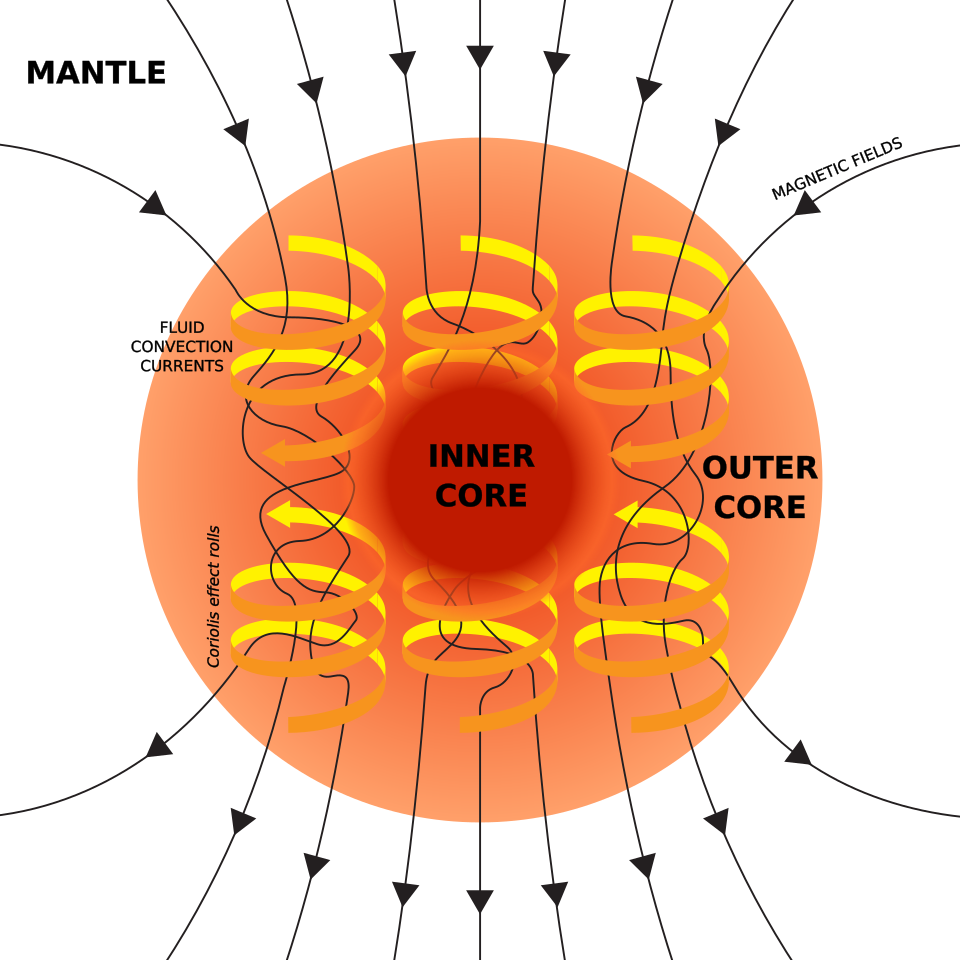
You already know carbon as the element in your pencil or in every living cell in your body. But scientists now believe it is also the reason Earth has a solid core at all. Researchers have long struggled to explain how Earth’s solid inner core formed, cooled, and crystallized without undergoing extreme supercooling, but a recent study published in Nature Communications reveals that carbon may play a far more significant role than previously believed, with an international team from the University of Oxford, University of Leeds, and University College London using atomic-scale simulations to show that carbon accelerates the nucleation process necessary for the core to freeze.
What makes this even more surprising is which elements did not help. While silicon and sulfur, long thought to be important core components, actually slowed the crystallization process, carbon had the opposite effect. The stakes here go well beyond geology. Without carbon, Earth might have failed to develop a solid inner core, potentially compromising the generation of the planet’s magnetic field, which shields us from harmful solar radiation, and the presence of carbon thus has broader implications for Earth’s habitability over geological timescales. In other words, without a seemingly ordinary element, life on this planet might never have had a chance.
Hidden Oceans of Hydrogen Locked Deep Inside the Core
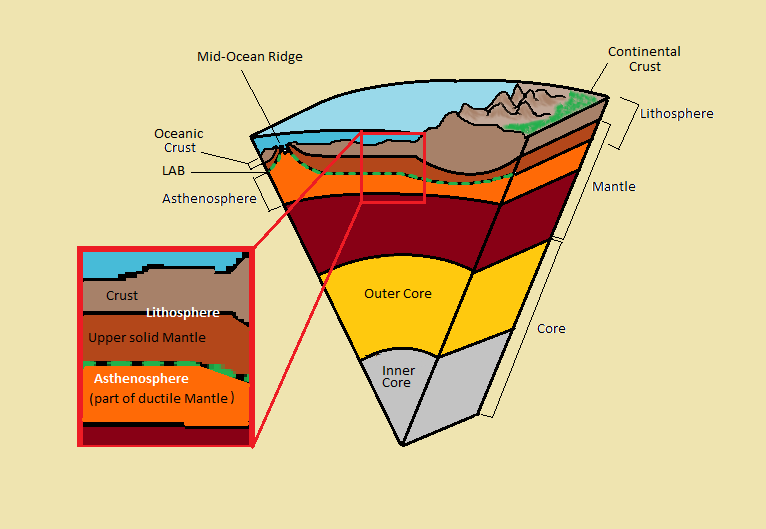
You would never guess it, but scientists now suspect there are vast oceans of hydrogen locked away inside Earth’s core, in quantities that dwarf everything sitting on the surface. Scientists have provided some of the best experimental evidence yet that the density deficit in Earth’s core can be explained by vast oceans of hydrogen locked within the core, significantly lowering its overall density, and the research reveals new insights about another persistent mystery: the original source of Earth’s liquid water, the key ingredient that enabled life on our planet to emerge.
Let’s be real. The idea that the water you drink might have originally come from deep inside the planet’s iron core sounds completely wild. The results revealed that the core’s hydrogen percentage sits between roughly 0.07 to 0.36 percent, which works out to roughly nine to 45 times the amount of hydrogen in all of Earth’s oceans. The scale of that figure is almost impossible to comprehend. Data suggests that roughly three to five percent of the inner core is mixed with light elements, and according to research from 2025, hydrogen may play a major role, while oxygen, chromium, nitrogen, and silicon could also be involved. The core, it seems, is a chemical vault we are only now beginning to crack open.
Towering Mountains and Mysterious Structures at the Core’s Edge

When you picture the boundary between Earth’s core and its mantle, you probably imagine a smooth, featureless divide. You would be wrong. Recent studies of seismic waves travelling through Earth’s layers paint a picture of the core’s edges so dramatic that it rivals the topology of the surface, with the core seeming to have its own landscape of mountains, valleys, landslides, and perhaps even volcanoes – and studies have revealed giant structures projecting into the lower mantle that are significantly taller than Mount Everest.
Deeper still, two colossal blobs of superheated rock are quietly running the show in ways scientists are only beginning to understand. In a study published in Nature Geoscience, a research team found magnetic evidence that two massive, intensely hot rock formations at the base of Earth’s mantle influence the liquid outer core beneath them, sitting about 2,900 kilometers below Africa and the Pacific Ocean, and the findings suggest that these enormous bodies of solid, superheated rock have played a role in shaping Earth’s magnetic field for millions of years. Scientists may finally be closing in on the origins of these two colossal, mysterious structures buried nearly 1,800 miles inside Earth, hidden formations that have puzzled researchers for decades. It is like discovering that someone has been pulling strings behind the scenes this whole time.
The D” Layer: Where Solid Rock Flows Like a River
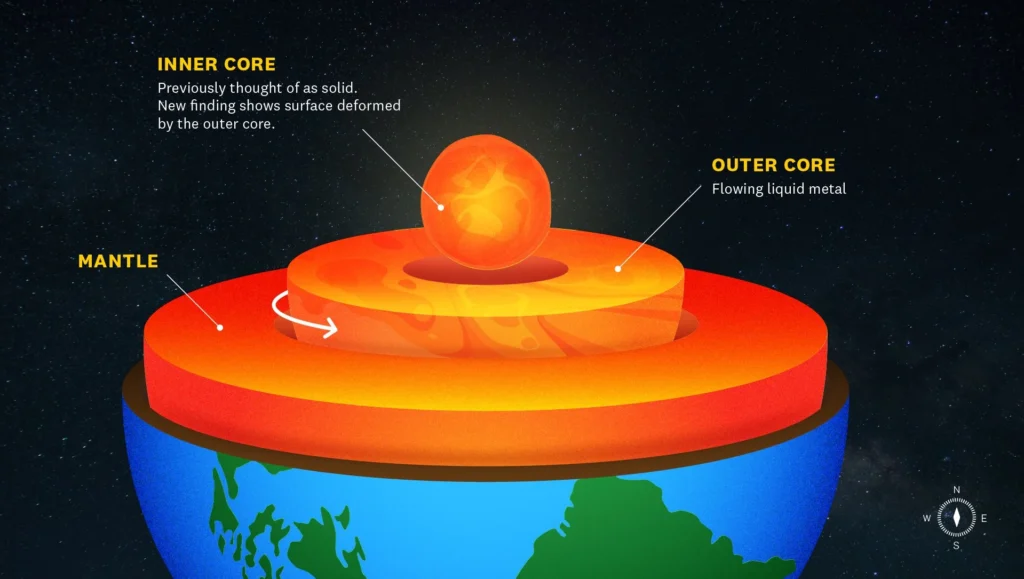
Nearly 3,000 kilometers below your feet lies a region so strange that it defied scientific explanation for more than half a century. Beneath Earth’s surface, nearly 3,000 kilometers down, lies a mysterious layer where seismic waves speed up inexplicably – for decades scientists puzzled over this so-called D” layer, and now groundbreaking experiments by ETH Zurich have finally revealed that solid rock flows at extreme depths, acting like liquid in motion, with horizontal mantle flow aligning mineral crystals called post-perovskite in a single direction and explaining the seismic behavior.
Imagine a river, except it is made of solid rock, flowing sideways in the pitch black at temperatures that would vaporize steel. That is roughly what is happening down there. It is a stunning leap in understanding Earth’s deep inner mechanics, transforming a long-standing mystery into a vivid map of subterranean currents that power volcanoes, earthquakes, and even the magnetic field. Direct observation of Earth’s core is impossible, and scientists typically study it by analyzing changes in the size and shape of seismic waves as they pass through the core. The sheer ingenuity required to uncover secrets this deep is honestly as impressive as the secrets themselves.
Conclusion: The Planet Beneath Your Feet Is Full of Surprises
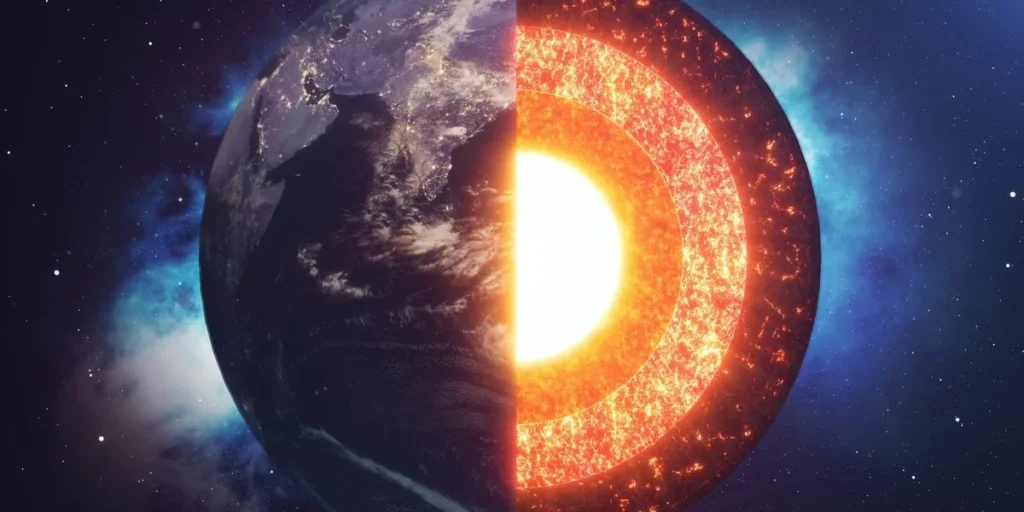
It is a humbling thought. Reaching the deepest parts of Earth is far more difficult than traveling through space, as humans have journeyed roughly 25 billion kilometers beyond the planet, yet drilling beneath Earth’s surface has only reached a depth of just over 12 kilometers – an extreme limitation meaning scientists still know relatively little about what lies far below the crust. We have mapped the surface of Mars more thoroughly than our own backyard, geologically speaking.
Yet what researchers are uncovering right now is extraordinary. A core that shape-shifts, flows carbon like a liquid, hides oceans of hydrogen, and hosts mountains taller than Everest at its boundaries. Slowly but surely, geologists and seismologists are piecing together the clues that will allow them to pull back the proverbial curtain and learn the hidden secrets of Earth’s inner layers, having revealed a region more mysterious and confounding than they had imagined. The deeper we look, the less certain our picture becomes, and somehow, that makes it all the more exciting.
Earth has been keeping its deepest secrets for 4.5 billion years. We are only just getting started on uncovering them. What do you think is still waiting to be found down there? Tell us in the comments.