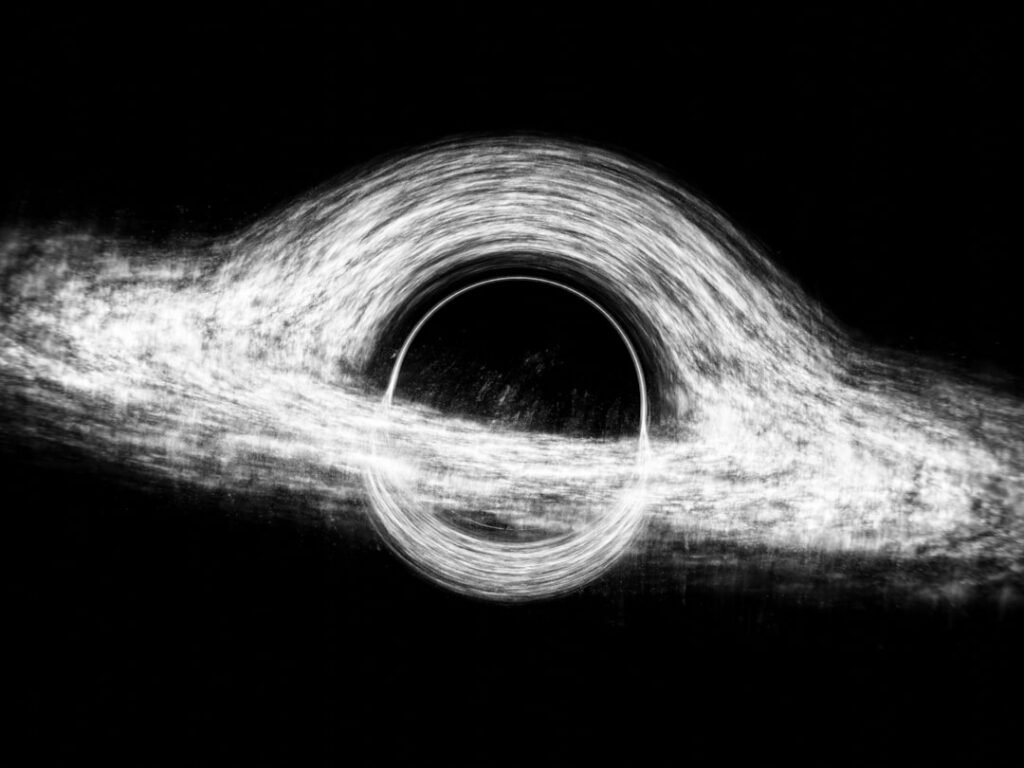


Challenging a Cosmic Assumption (Image Credits: Unsplash)
Astronomers have long assumed that supermassive black holes lurk at the heart of nearly every galaxy, but recent observations challenge that view for the universe’s smaller cosmic structures.
Challenging a Cosmic Assumption
Researchers uncovered a surprising gap in the distribution of supermassive black holes when they analyzed data from over 1,600 galaxies spanning more than two decades of observations.
The study, led by Fan Zou from the University of Michigan, focused on galaxies from massive giants exceeding 10 times the Milky Way’s size down to dwarf galaxies with stellar masses just a few percent of our own.
Results revealed that while larger galaxies consistently host these enormous entities, dwarf galaxies tell a different story.
Only about 30 percent of these smaller systems showed evidence of supermassive black holes, a finding that upends previous models of galactic evolution.
This disparity emerged from X-ray data captured by NASA’s Chandra X-ray Observatory, which detects the high-energy signatures of material swirling around black hole cores.
Unveiling the Data from Chandra
The Chandra mission provided the key insights, scanning galactic centers for telltale X-ray emissions that signal active black holes accreting gas and dust.
In massive galaxies, such emissions appeared reliably, confirming the presence of black holes millions to billions of times the sun’s mass.
Dwarf galaxies, however, often lacked these bright spots, suggesting many operate without a central supermassive anchor.
The peer-reviewed paper appeared in The Astrophysical Journal on October 6, 2025, with NASA highlighting the discovery in a December 11, 2025, press release.
Astronomers noted that this pattern holds across a diverse sample, strengthening the case against universal black hole occupancy.
One example, PGC 03620, a compact galaxy far smaller than the Milky Way, showed no X-ray source, underscoring the absence in many such cases.
Implications for Black Hole Origins
This finding fuels debate over how supermassive black holes form, with two leading theories now under scrutiny.
The direct collapse model posits that vast gas clouds in the early universe crumpled into black holes weighing thousands of solar masses from the outset.
Alternatively, smaller black holes – born from collapsing massive stars – might grow through mergers and accretion over time.
The scarcity in dwarf galaxies supports the direct collapse idea, as such events would favor denser, larger environments over sparse, small ones.
Anil Seth, a professor at the University of Utah and study co-author, explained that big black holes likely form preferentially in the most massive galaxies being built.
This selective process could explain why smaller galaxies miss out, reshaping our understanding of cosmic assembly lines.
Broader Cosmic Connections
Beyond formation, the results hint at how galaxies evolve without central black holes driving their dynamics.
In larger systems, these black holes regulate star formation by heating gas and quenching excessive growth.
Dwarf galaxies, free of such influences, might sustain steadier star birth rates, influencing their overall structure.
Future telescopes like the James Webb Space Telescope could probe deeper, spotting fainter signatures in distant dwarfs to test these patterns across cosmic time.
The study draws from diverse galaxy types, including those in mergers, yet the trend persists.
Key Takeaways
- Only 30% of dwarf galaxies likely host supermassive black holes, per Chandra data.
- Larger galaxies show near-universal black hole presence, highlighting size-based differences.
- Findings bolster direct collapse theory for black hole origins in massive environments.
As astronomers refine these insights, the universe appears even more varied than imagined, with small galaxies carving their paths independently of supermassive overlords. What implications might this hold for the Milky Way’s own history? Share your thoughts in the comments.