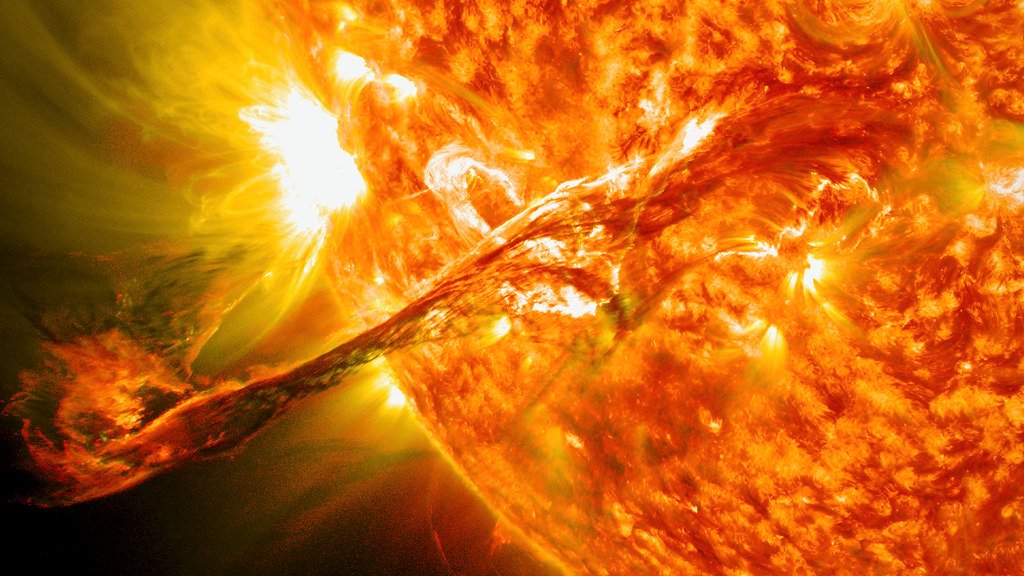


Unleashing Solar Fury: The Birth of These CMEs (Image Credits: Flickr)
Astronomers tracked two coronal mass ejections erupting from the sun’s active region AR4334 on January 7, 2026, as they barrel toward Earth with expected glancing blows around January 9.
Unleashing Solar Fury: The Birth of These CMEs
Solar activity intensified recently when active region AR4334, a cluster of sunspots on the sun’s surface, released bursts of plasma and magnetic energy. These eruptions formed two distinct coronal mass ejections, or CMEs, which scientists detected through satellite observations. The events marked a continuation of moderate solar behavior observed in the preceding days, including multiple C-class flares from the same region.
Unlike more dramatic X-class flares, these C-class events produced ejections that expanded outward at speeds typical for such phenomena, carrying billions of tons of solar material. Forecasters noted the partial halo nature of the CMEs, indicating they would not strike Earth head-on but could still influence our planet’s magnetic field. This development followed a period of low-to-moderate solar output, highlighting the sun’s unpredictable cycles during its current active phase.
Decoding Active Region AR4334’s Activity
AR4334 emerged as a hotspot on the sun’s near side, drawing attention for its potential to generate space weather events. Over the past week, it contributed to at least 14 C-class flares, with the strongest peaking at C3.0 on January 6. Such regions form when magnetic fields twist and reconnect, propelling charged particles into space.
Experts at space weather centers analyzed imagery from solar observatories, confirming the region’s orientation favored Earth-directed ejections. While not the most powerful sunspot group recorded, AR4334’s output aligned with broader trends in solar maximum, a phase where such outbursts become more frequent. Monitoring teams updated models throughout the day, refining predictions based on the ejections’ trajectories.
Potential Ripples for Earth and Technology
As the CMEs approach, they could compress Earth’s magnetosphere, leading to minor geomagnetic disturbances. Glancing impacts like these often enhance auroral displays at high latitudes, potentially visible from northern regions such as Canada and Scandinavia. However, stronger effects remain unlikely given the ejections’ peripheral paths.
Beyond visuals, these events pose risks to satellite operations and power grids through induced currents. Radio communications in polar areas might experience brief blackouts, and astronauts on the International Space Station could face elevated radiation levels. Space weather forecasters issued alerts for possible G1-level storms, the mildest category, urging vigilance without widespread alarm.
- Aurora visibility: Enhanced in Arctic and sub-Arctic zones.
- Satellite impacts: Possible disruptions to GPS and navigation signals.
- Power systems: Minor risks to unshielded infrastructure.
- Radiation: Increased for high-altitude flights over poles.
- Communications: Temporary interference in high-frequency bands.
Global Efforts to Monitor and Mitigate
Agencies like NOAA’s Space Weather Prediction Center coordinated with international partners to track the incoming CMEs using coronagraph data and solar wind models. These tools simulate particle flows, estimating arrival times within hours. Updates from observatories such as SOHO and SDO provided real-time visuals of the sun’s corona, aiding precise forecasts.
In response, operators of critical infrastructure prepared contingency plans, including backup systems for vulnerable networks. Public outreach emphasized the event’s educational value, as it offered a glimpse into the sun’s influence on daily life. Scientists stressed that while impacts would be subtle, they underscored the need for ongoing space weather research.
Key Takeaways
- Two CMEs from AR4334 could arrive by January 9, prompting minor geomagnetic activity.
- Auroras may brighten high-latitude skies without major disruptions.
- Monitoring ensures timely warnings for technology sectors.
These solar events remind us of the sun’s dynamic power and its subtle ties to Earth. As we await the CMEs’ passage, they invite reflection on our planet’s place in the cosmos. What aurora sightings have you witnessed lately? Share your thoughts in the comments.