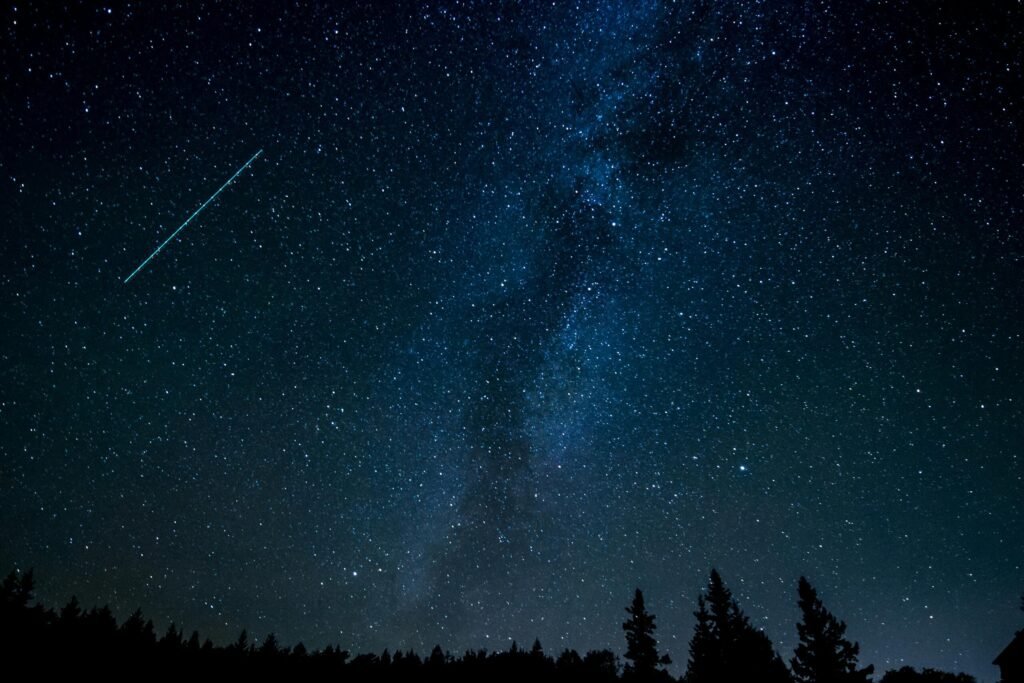
A Detector in Japan may Soon Capture Signals from Neutrinos Released by Supernova Explosions (Image Credits: Pexels)
The universe is filled with invisible messengers that carry stories from cosmic events billions of years in the past. Among the most elusive are neutrinos—subatomic particles often called “ghost particles” because they pass through nearly all matter without leaving a trace. Scientists believe these particles hold vital clues about some of the most powerful events in the universe, including the deaths of massive stars.
Now researchers say a massive underground detector in Japan may soon capture signals from neutrinos released by supernova explosions that occurred billions of years ago. If successful, the experiment could allow astronomers to detect the faint echo of stars that died long before Earth even formed, offering a new window into the deep history of the cosmos.
The Invisible Messengers of the Cosmos
Neutrinos are among the most abundant particles in the universe, yet they are also some of the hardest to detect. Trillions of them pass through our bodies every second, traveling almost unaffected through planets, stars, and even entire galaxies.
Because they rarely interact with matter, neutrinos can travel enormous distances without losing information about where they came from. That makes them incredibly valuable to scientists seeking to understand cosmic events that are otherwise hidden from view.
Detecting the Echoes of Dead Stars
When massive stars explode as supernovae, they release enormous amounts of energy—and most of that energy escapes as neutrinos. These particles race through the universe at nearly the speed of light, carrying direct information about the explosion that created them.
Astronomers believe a faint background of such neutrinos exists throughout the universe, produced by every supernova that has ever occurred. Detecting this “cosmic neutrino background” would allow scientists to study the collective history of stellar explosions across billions of years.
A Giant Telescope Hidden Underground
To detect these nearly undetectable particles, scientists rely on detectors placed deep underground. Layers of rock shield the instruments from cosmic radiation and other interference that could overwhelm the extremely faint neutrino signals.
One of the most famous of these observatories is the Super-Kamiokande detector in Japan, a vast tank filled with ultra-pure water surrounded by sensitive light detectors. When a neutrino interacts with water molecules, it produces a tiny flash of light that researchers can measure.
A Major Upgrade Boosts Detection Power
The Super-Kamiokande facility has recently undergone an upgrade designed to improve its ability to identify neutrinos from distant supernovae. The upgrade enhances the detector’s sensitivity, allowing scientists to distinguish these rare signals from background noise.
Researchers say this improvement could finally enable the first clear detection of neutrinos from ancient stellar explosions. Some of these signals may have been traveling through space for more than 10 billion years, carrying information from stars that lived and died long before our solar system existed.
Reading the History of Stellar Explosions
If scientists succeed in detecting this faint neutrino background, it would provide a completely new way to study the life cycles of stars across cosmic history. Instead of observing only nearby supernovae, astronomers could analyze signals from countless stellar explosions throughout the universe.
This information would help researchers better understand how often stars explode, how they distribute heavy elements into space, and how galaxies evolved over billions of years. Such discoveries could reshape our understanding of how the universe built the chemical ingredients necessary for planets and life.
A New Era for Neutrino Astronomy
The effort to detect these ancient neutrinos represents a rapidly growing field known as neutrino astronomy. Unlike traditional telescopes that observe light, neutrino detectors study particles that can escape dense regions where light cannot.
As new detectors are built around the world—deep underground, underwater, or beneath mountains—scientists hope to transform neutrinos into powerful cosmic messengers that reveal hidden events across the universe.
Listening to the Universe’s Oldest Echoes
The idea that a telescope buried deep underground could detect particles from stars that died billions of years ago is nothing short of astonishing. It reminds us that the universe constantly sends out messages about its past—we simply need the right tools to hear them.
In my view, the search for these stellar “ghosts” represents one of the most poetic frontiers of modern astronomy. While traditional telescopes show us what the universe looks like, neutrino detectors may soon tell us what the universe remembers—a hidden archive of explosions, transformations, and cosmic history written in particles that have been quietly crossing space for billions of years.