
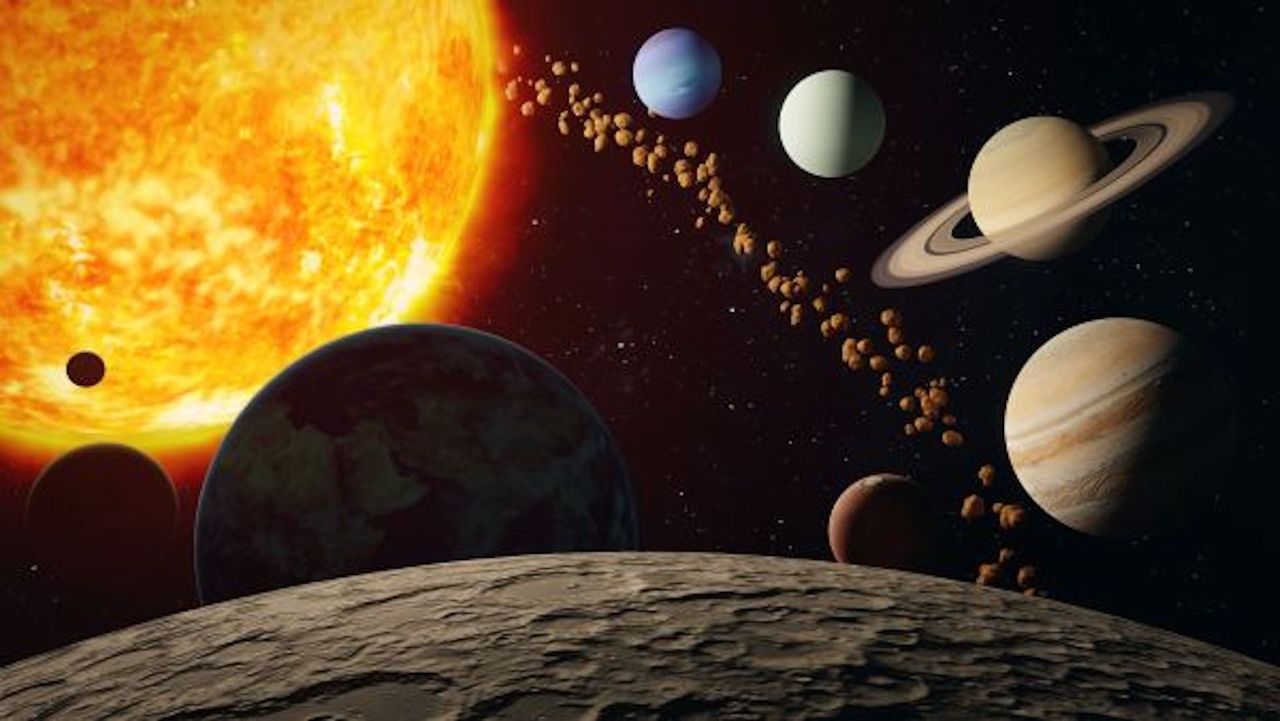
The Ecliptic Plane: Earth’s Orbital Foundation (Image Credits: Cdn.mos.cms.futurecdn.net)
Space stretches infinitely in all directions, challenging our earthly sense of up and down as we ponder Earth’s position within it.
The Ecliptic Plane: Earth’s Orbital Foundation
Earth’s journey around the Sun follows a specific path known as the ecliptic plane, a flat disk that defines the solar system’s layout. This plane emerged from the gravitational collapse of a vast cloud of gas and dust billions of years ago, aligning the orbits of planets, asteroids, and comets in a relatively orderly fashion. Astronomers refer to it as the reference for celestial navigation, much like a cosmic equator.
From Earth’s vantage, the Sun appears to trace this path annually, passing through constellations of the zodiac. This alignment means that when we look “out” into space, most of our solar system’s neighbors cluster near this plane. Yet, the concept of “below” shifts dramatically once we consider the three-dimensional nature of space. Directions like north, south, east, and west apply locally on our planet, but in the void, they dissolve into relative orientations based on our position.
A professor from the University of Tennessee highlighted how this plane influences our view of the sky, noting that space expands outward from Earth in ways that defy simple verticality. The solar system’s structure, with its disk-like formation, creates an illusion of a “below” toward the plane’s underside, though nothing truly occupies a fixed spot there.
Beyond the Solar System: Galactic Perspectives
Zooming out to the Milky Way, Earth’s home galaxy presents an even more complex directional puzzle. Our planet resides in a spiral arm, orbiting the galactic center every 225 million years at about 828,000 kilometers per hour. The galaxy itself tilts relative to the ecliptic plane, meaning what seems “below” Earth in solar terms points toward denser star fields or interstellar voids in galactic coordinates.
Directions in this vast structure depend on one’s location. For instance, from Earth’s south pole, the night sky reveals a different array of stars compared to the north, altering perceptions of depth and position. Space remains isotropic – uniform in all directions – yet local structures like the galactic plane impose their own layers of orientation. Scientists use tools like the Gaia spacecraft to map these positions with precision, revealing how our solar system bobs slightly above and below the Milky Way’s midplane over cosmic timescales.
This galactic context underscores that “below” Earth equates to the direction opposite our orbital motion around the Sun, but it varies with scale. In the broader universe, such terms become arbitrary as we encounter galaxy clusters and superclusters.
Cosmic Expansion and the Illusion of Direction
The universe’s ongoing expansion, first observed in the 1920s through redshift measurements, further complicates directional thinking. Space itself stretches, carrying galaxies away from each other at accelerating rates due to dark energy. From Earth’s perspective, no absolute “below” exists; instead, every point moves relative to others in an ever-growing fabric.
Astronomers explain that while the solar system lies within the Local Bubble – a cavity of hot, low-density gas sculpted by ancient supernovae – our position offers no privileged down. The cosmic microwave background radiation, a relic of the Big Bang, provides a universal reference frame, showing Earth moves at about 370 kilometers per second relative to it. This motion defines a subtle “forward” and “backward,” but up, down, left, and right remain observer-dependent.
- The ecliptic plane orients solar system paths.
- Galactic coordinates highlight our spiral arm position.
- Universal expansion renders fixed directions obsolete.
- Local gravity wells, like the Sun’s, temporarily impose structure.
- Human intuition, shaped by Earth’s gravity, misleads in space.
Implications for Space Exploration
Understanding these directional nuances guides modern missions. Spacecraft like Voyager 1 and 2, launched in 1977, ventured beyond the heliosphere – the Sun’s influence bubble – into interstellar space, where directions align more with galactic flows than solar ones. Future probes, such as those targeting Lagrange points, exploit stable gravitational balances far from Earth’s “down.”
Telescopes like the James Webb Space Telescope, positioned at the L2 point a million miles from Earth, observe the universe without atmospheric interference, revealing structures that challenge our parochial views. These efforts remind us that space’s isotropy means exploration heads “outward” in all senses, unbound by terrestrial constraints.
Key Takeaways
- Earth’s “below” points toward the ecliptic plane’s underside in solar terms.
- Galactic and universal scales make directions relative and scale-dependent.
- Space’s uniformity invites us to rethink orientation beyond gravity’s pull.
As we grasp the fluidity of directions in space, the question of what’s “below” Earth evolves from a simple query into a profound insight into our cosmic neighborhood. This perspective not only enriches astronomical study but also humbles our place in the universe. What aspects of space’s vastness intrigue you most? Share your thoughts in the comments.