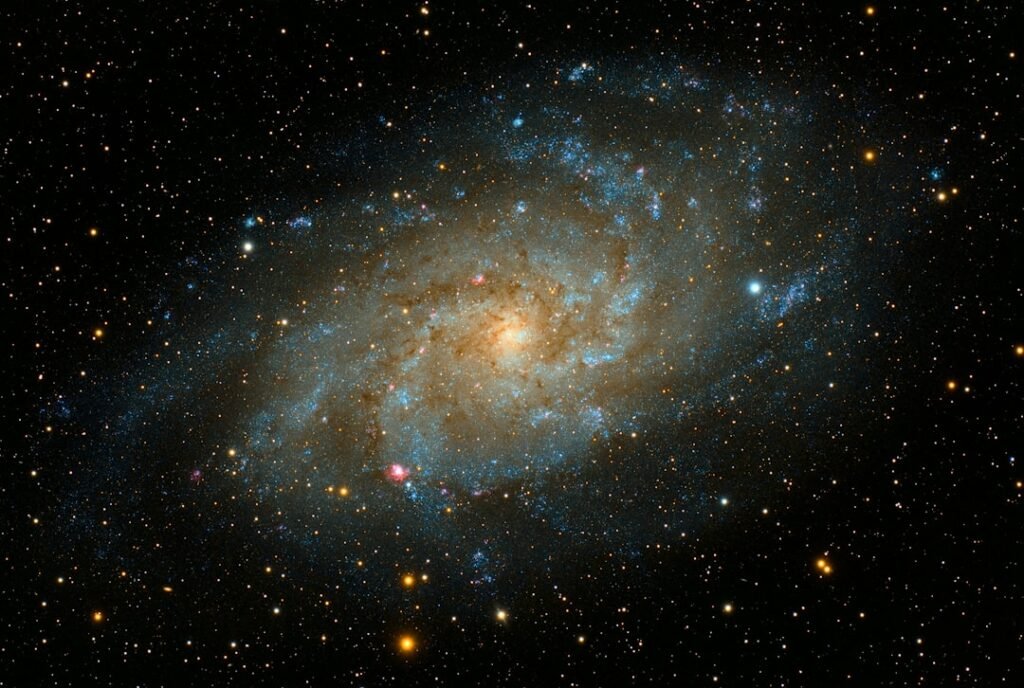

Shifting Views on the Universe’s Fate (Image Credits: Unsplash)
Recent observations from leading dark energy projects have cast doubt on the idea of eternal cosmic expansion, pointing instead to a future reversal that culminates in total collapse.
Shifting Views on the Universe’s Fate
For two decades, cosmologists largely accepted that a positive cosmological constant would drive unending expansion.[1][2] That consensus began to crack with fresh data released in 2025 from major surveys. These findings suggest dark energy, which constitutes about 68 percent of the universe’s mass and energy, behaves in ways that reveal an underlying negative cosmological constant.
Henry Tye, Horace White Professor of Physics Emeritus at Cornell University, integrated this data into an established model originally tied to Albert Einstein’s cosmological constant concept. His analysis, detailed in the paper “The Lifespan of our Universe” published in the Journal of Cosmology and Astroparticle Physics, predicts a finite end to cosmic growth.[2]
The Model Explaining the Turnaround
Tye’s framework incorporates a hypothetical low-mass particle that mimicked a positive cosmological constant in the universe’s early stages but evolved over time. This adjustment aligns with observations while shifting the effective constant to negative territory.[1] “People have said before that if the cosmological constant is negative, then the universe will collapse eventually,” Tye noted. “However, here the model tells you when the universe collapses and how it collapses.”[2]
The result challenges standard cosmology’s two main scenarios: perpetual expansion or eventual contraction. Tye’s work supports the latter, likening the process to a rubber band snapping back after stretching to its limit.
Mapping the Path to Collapse
At 13.8 billion years old, the universe stands near the midpoint of its projected 33-billion-year lifespan.[1] Expansion will persist for another 11 billion years until the cosmos reaches maximum size. Contraction would then accelerate, leading to a “big crunch” roughly 20 billion years from now.
This timeline emerges directly from the updated model:
- Current age: 13.8 billion years.
- Peak expansion: ~11 billion years ahead.
- Total lifespan: 33 billion years.
- Big crunch: ~20 billion years from present.
“This big crunch defines the end of the universe,” Tye wrote.[2]
Insights from DES and DESI Surveys
The pivotal evidence came from the Dark Energy Survey (DES) in Chile and the Dark Energy Spectroscopic Instrument (DESI) in Arizona. These projects, spanning both hemispheres, mapped millions of galaxies to probe dark energy’s nature. Their spring 2025 reports showed consistency: dark energy deviates from a pure cosmological constant, hinting at dynamic behavior.[3]
Co-authors Hoang Nhan Luu and Yu-Cheng Qiu, former doctoral students under Tye at Hong Kong University of Science and Technology, contributed to validating the model against this data.
Pending Confirmations from Global Efforts
Scientists anticipate refined measurements to test these predictions. DESI continues operations through at least another year, while other initiatives ramp up.
| Project | Location | Focus |
|---|---|---|
| Zwicky Transient Facility | San Diego | Galaxy mapping |
| Euclid Space Telescope | Europe | Dark energy surveys |
| SPHEREx | NASA | Infrared galaxy observations |
| Vera C. Rubin Observatory | Chile | Wide-field imaging |
Hundreds of researchers analyze galaxy distances to sharpen dark energy estimates.[1]
Key Takeaways
- New dark energy data indicates a negative cosmological constant, reviving Big Crunch theory.
- Universe reaches peak size in 11 billion years before contracting.
- Expected end: 20 billion years from now, after 33 billion total years.
This projection, if upheld, frames the universe with clear bookends – a Big Bang origin and Big Crunch finale – much like a life’s arc. “It’s good to know that, if the data holds up, the universe will have an end,” Tye observed.[2] What implications does a finite cosmos hold for our understanding of existence? Share your thoughts in the comments.